

Most federal job applicants in Nigeria are disqualified not because they're unqualified but because of avoidable documentation errors, wrong portals, mismatched credentials, and rushed applications. This post breaks down the real mistakes that sink applications, with honest advice most people won't tell you.
Source: EduJobs Africa
In 2021, I once helped a young man named Chukwuemeka from Enugu prepare his application for a Federal Civil Service Commission recruitment. He had a second-class upper degree, relevant work experience, and had passed his NYSC. By every standard metric, he was a strong candidate. He didn’t get shortlisted.
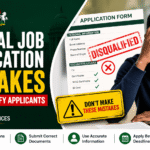
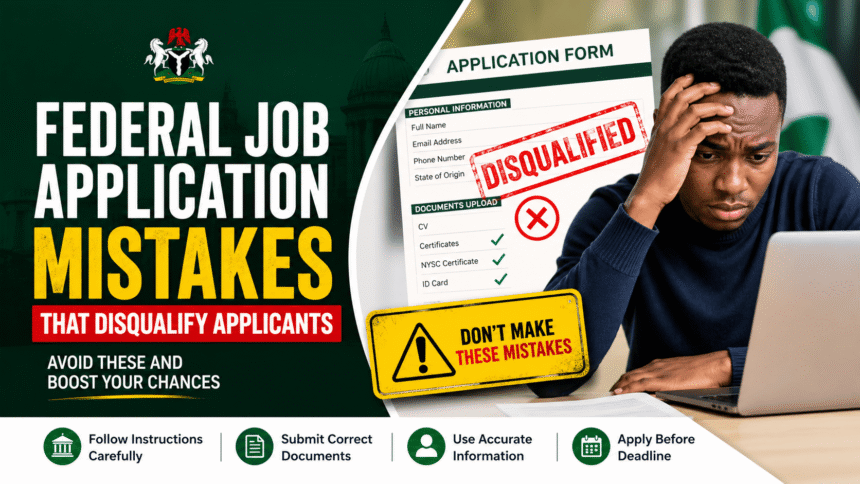
When I asked him to walk me through exactly what he submitted, I found it within two minutes. He had used the wrong date format on his credential details DD/MM/YYYY instead of what the portal required and his NYSC discharge certificate scan was uploaded as a file over the 200KB size limit. Two small things. Both quietly threw his application in the digital bin before any human even read his name.
That’s the brutal truth about federal job applications in Nigeria. You can be qualified and still lose not to a better candidate, but to a dropdown menu you didn’t read carefully enough.
Why Federal Job Portals Are Less Forgiving Than You Think
People treat government job portals like they treat WhatsApp type something in, press send, and assume it went through. But these portals, particularly the Federal Civil Service Commission (FCSC) portal and agency-specific recruitment platforms, are built with hard validation rules. A field that expects a specific format will not accept anything else, and it often won’t explain why your submission failed.
Part of the problem is that Nigerians are used to processes that have “sorting” built in someone at the back end who corrects obvious errors or calls you if something is missing. Federal recruitment, especially when thousands of applications come in, does not work that way. Automated shortlisting means your file is either correct or it isn’t. There is no middle ground, and nobody is calling you.
Mistake #1 — Applying to Positions You Are Not Grade-Eligible For
This one catches so many people off guard. Federal ministries and agencies advertise vacancies by grade level GL-06, GL-08, GL-09, and so on. Your qualification has to match the required entry grade level, and the matching is not intuitive to most applicants.
For example, an OND holder typically qualifies for GL-06. An HND or Bachelor’s degree holder enters at GL-08. A Master’s degree may qualify someone for GL-09 or GL-10 depending on the ministry. If you apply for a GL-08 position with an HND and the posting specifically states “Bachelor’s degree only,” your application is invalid even if HND and B.Sc. seem equivalent in your mind. The NUC and the ministry’s HR system do not agree with that equivalence in all contexts. Always read the requirements line by line.
Mistake #2 — Certificate Details That Don’t Match Your O’Level Records
I have seen this destroy otherwise strong applications more times than I can count. When you apply, you enter your WAEC or NECO results manually. If the name, examination number, or year you enter does not exactly match what WAEC’s result checker returns, your credentials will fail verification and your application will be flagged or discarded.
This matters especially for people who sat for exams in multiple sittings or who made corrections to their certificates after the fact. If your name appears as “Fatima Abubakar Musa” on your WAEC certificate and you enter “Fatima A. Musa” in the portal that is a mismatch. Use the name exactly as it appears on the physical certificate, character for character. The federal system checks these things, particularly when shortlisting gets to the verification stage.
Mistake #3 — Uploading Documents That Fail Silent Checks
Most federal recruitment portals specify document size limits (usually 50KB to 200KB for individual files), accepted file formats (PDF or JPEG only, in most cases), and sometimes even minimum or maximum pixel dimensions for passport photographs. The majority of applicants ignore these details completely, upload whatever they have, and assume the portal accepted it because the page moved forward.
What actually happens is that some portals accept the file upload but fail silently during backend processing. You think you submitted a complete application. The system has an incomplete record for you. When shortlisting runs, your file fails document verification. You never find out why.
Before you upload anything, compress your PDFs, resize your photos, and confirm the format. Tools like iLovePDF and Smallpdf are free and work on your phone. Spending five minutes on this can mean the difference between getting shortlisted and wondering why you never heard back.
Related Reading
How People Actually Get Government Jobs in Nigeria — Beyond the Official Process
Before you apply, understand the full landscape. This post breaks down what the recruitment brochures won’t say out loud.
Mistake #4 — Not Having a Valid Means of Identification at the Time of Application
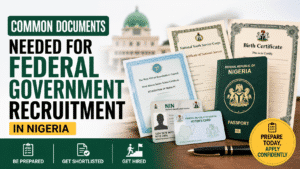
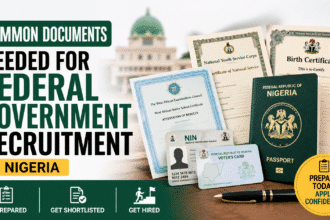
This sounds obvious until you realise how many applicants start an application, reach the section requesting a valid government-issued ID, and discover their National ID card is expired, their voter’s card belongs to an old polling unit, or their driver’s licence has a different address than what they’re submitting. Federal recruitment portals increasingly cross-reference ID details, and inconsistencies even minor ones create problems during verification.
If you are planning to apply for any federal role in the coming months, go and check your ID documents today. Not tomorrow. NIMC has made NIN slip and National e-ID updates faster than they used to be. Sorting this out before applications open is a hundred times easier than trying to fix it while a deadline is counting down.
What Nobody Tells You: Being Qualified Is the Starting Point, Not the Finish Line
Most career blogs talk about federal jobs as if getting the job is simply about sending in your documents and waiting. That is only half the story and honestly, it’s the easier half.
The uncomfortable reality is that many qualified applicants are disqualified for administrative reasons, not merit. And many who make it through the shortlisting stage face a different kind of challenge a physical verification and screening process that can be chaotic, underfunded, and conducted in conditions that test your patience more than your qualifications. State of origin documentation errors, result verification backlogs, and scheduling issues have all caused legitimate candidates to miss out at the final stages.
None of this means you shouldn’t apply. It means you should apply with both eyes open. Prepare your documents twice as carefully as you think necessary. Follow up through the official channels. And understand that persistence not just paperwork is part of the process.
Practical Steps: How to Apply Without Getting Quietly Disqualified
- 1Print out the full job advertisement and read every single requirement before opening the portal. Note the grade level, required qualification, accepted file types, and document size limits. Do this on paper so you can tick them off.
- 2Gather every document mentioned before you begin filling the form. Do not start the application and then go looking for your NYSC certificate. Many portals time out or lose your progress if you leave for too long.
- 3Check that every name, date, and examination number you plan to enter matches your physical certificates exactly character by character. This includes your O’Level results, degree certificate, and birth certificate.
- 4Compress and format all documents before uploading. Aim for PDFs under 150KB. Passport photos should be JPEG, white-background, and within the specified dimensions (usually 150×150 to 300×300 pixels).
- 5After submission, take a screenshot of your confirmation page or application number. Save it somewhere you can find it easily. This is your only proof of submission if any dispute arises later.
- 6Bookmark the official portal not a third-party site that mirrors it. Check your application status at least once a week. Updates often appear without any email notification being sent.
This is not the post to read once and forget.The next time a federal recruitment opens and it will, sooner than most people expect the candidates who get shortlisted will not necessarily be the most qualified. They’ll be the ones who read the instructions, prepared their documents properly, and submitted correctly. That person can be you. Save this post, share it with whoever you know is currently job hunting, and go check your documents today.