Author: Musa Mustapha

  • WAEC Past Questions and Answers 2015-2025: Best Sources, How to Use Them, and What Really Repeats

    WAEC Past Questions and Answers 2015-2025: Best Sources, How to Use Them, and What Really Repeats

    Last updated: August 7, 2026

    I sat in my uncle’s small shop in Minna, three weeks before my WAEC exam, with a booklet of past questions spread open on my lap. The booklet was from 2009. Half the pages were torn. The ink on some questions had smudged so badly you had to guess what the question was asking. But I treated that thing like gold because nobody had told me where else to look.

    I passed. Not brilliantly. But I passed.

    Years later, a girl named Hauwa from Gombe contacted me on this blog. She had failed WAEC twice, Economics and English. She was 19, her parents were talking about pulling her out of school entirely, and she was spending money she didn’t have on “expo” groups on Telegram that were obviously scams. We talked for about an hour. The first thing I asked her was: “Have you ever sat down with actual past questions from the last five years?” She said she had seen them but never really used them properly.

    She sat for WAEC the third time. She got C5 in Economics and B3 in English. She still sends me messages during festive periods.

    This article is for everyone who is in the position Hauwa was in. Not just the struggling ones but also the ones who are studying hard and still not sure they’re studying the right things.

    Why Past Questions Are Not Just “Practice”

    A lot of students treat past questions as a warm-up exercise. They flip through them the night before the exam, tick options at random, and call it studying. That is not how this works.

    WAEC, which is managed by the West African Examinations Council, follows something called a syllabus and a scheme of work that stays largely consistent from year to year. The council has examiners who set questions based on that same approved syllabus. Because the syllabus doesn’t change drastically, certain topics come back. Not the exact same question word for word, but the same concept, tested in a slightly different way.

    When you study past questions properly, you are not memorising answers. You are learning how WAEC thinks. You are training yourself to recognise the pattern of what they test, how they phrase trap options, and which topics they genuinely care about versus which ones are mentioned in the textbook but never show up in an exam hall.

    That is a very different thing from just reading your textbook cover to cover and hoping for the best.

    Where to Actually Get WAEC Past Questions (2015-2025)

    This is where most students waste money and time. Let me save you both.

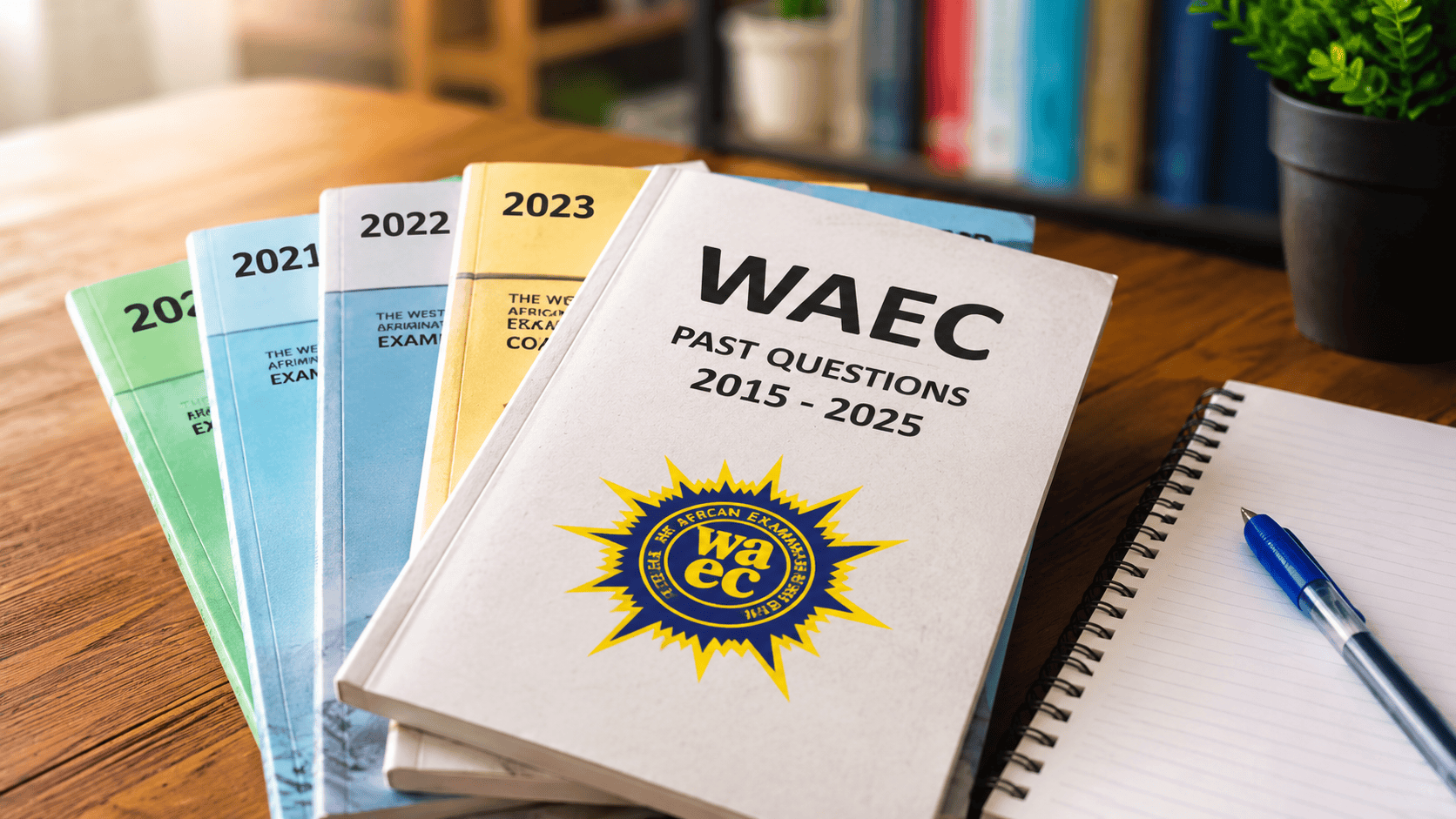
    The most legitimate and complete source is the WAEC past question booklets sold by the official WAEC office. You can find them at WAEC state offices across Nigeria, and some certified bookshops near federal and state secondary schools stock them. They are the real thing. No missing questions, no altered options. If you can get the physical booklet, get it. As of my last check, they go for between N500 and N1,500 per subject depending on the number of years covered.

    Digitally, there are a few platforms that are worth your time. Myschool.ng has a sizeable library of past questions across different WAEC years and subjects. The interface is straightforward, and most of it is free to access. Examguru.ng is another one that has organised past questions in a way that is easy to practice from. There is also the official WAEC e-learning portal at waeconline.org.ng, though I’ll be honest, navigating it can test your patience.

    What I tell students to avoid are the random PDF files circulating on WhatsApp groups and Telegram channels. Some of those files are genuine. Many are not. I have seen “WAEC past questions 2024” files that had questions from 2011 relabelled, or files where the answers were simply wrong. One student I spoke to last year had memorised incorrect answers from one of those files and walked into the exam confused.

    If you are going to use digital sources, stick to the platforms I named or ask your school’s subject teacher to help you verify the source.

    How to Use WAEC Past Questions the Right Way

    Getting the materials is the easy part. Using them correctly is where most students fall short.

    The approach I always recommend is this: pick one subject, go back ten years, and read through the questions without looking at the answers first. Try to answer from what you know. Then mark yourself. But do not just mark yourself and move on. For every question you got wrong, go back to your textbook and read the concept behind it. Understand why the correct answer is correct. Understand why the option you picked is wrong.

    This process is slow. It is supposed to be slow. Hauwa told me she spent three days on five years of Economics past questions alone. That is not excessive. That is how learning actually happens.

    After you have gone through that exercise, you will start to notice things. In English Language, the comprehension passages almost always test the same set of comprehension skills: identifying the writer’s tone, inferring meaning from context, and recognising cause-and-effect relationships. In Mathematics, quadratic equations, indices, and probability show up with a consistency that is almost reassuring. In Biology, ecology, genetics, and cell structure are perennial favourites.

    If you are also preparing for JAMB alongside WAEC, the same discipline of past-question study applies there. I wrote about the best apps for JAMB CBT practice, and that guide covers tools that are also useful for general exam preparation across both exams. You can read it here.

    What Actually Repeats Across 2015 to 2025

    I have spent time going through WAEC papers across different subjects, and I want to give you something specific rather than vague reassurances.

    In Chemistry, questions on mole concept, electrolysis, and organic chemistry reactions (particularly hydrocarbon series and functional groups) have appeared in every single year I checked from 2015 to 2024. Not the same question. The same concepts. A student who cannot balance a redox equation or explain what happens at the cathode during electrolysis is leaving marks on the table every year.

    In Economics, supply and demand analysis, national income concepts, and theories of production recur with high frequency. The data response section almost always tests a student’s ability to calculate or interpret something from a table, not just define terms.

    In English Language, the summary section is consistently the one that separates the B grades from the C grades. Students who learn how to identify the main point of a paragraph and write it in their own words, without copying from the passage, tend to score well. Those who lift sentences from the passage rarely do.

    In Mathematics, topics like logarithms, mensuration (area and volume calculations), and coordinate geometry have been present in almost every year across the decade I reviewed. Students who skip these topics because they seem “hard” often find themselves staring at familiar concepts in the exam hall with nothing to say.

    The Honest Truth About WAEC Expo Culture

    I have to say this even though it is uncomfortable.

    Every year, thousands of Nigerian students pay money to people who claim they will send WAEC answers the night before or morning of the exam. I know students who have done this. I know families who have pooled money together for it. Some of these schemes are outright fraud. Others involve breached security from individuals inside the exam chain, which is a criminal offence with consequences that extend beyond the student to their parents and their entire school.

    Even when it “works,” the student who enters the exam hall dependent on expo enters with anxiety, not knowledge. They cannot attempt the theory questions with confidence. They cannot adapt if the answers they received do not match what is on the actual paper, which happens more often than people admit. And if WAEC cancels their results (which they do, regularly), those students lose an entire year.

    The honest calculation is this: six months of consistent study using real past questions gives you a better chance of excellent results than any expo scheme. It also gives you knowledge you actually carry into university or into your career. The expo gives you nothing except stress and, if you’re unlucky, a criminal record.

    Practical Steps to Build Your WAEC Study Plan Around Past Questions

    Start by getting at least five years of past questions for each subject you are sitting. That is your baseline. Ten years is better.

    Work through one year’s worth of questions per subject each week. Do not rush this. Rushing defeats the purpose.

    Keep a notebook (physical or digital) where you write down every topic you got wrong. After you finish all the years, that notebook becomes your personal list of weak areas. Focus your remaining study time there.

    Simulate exam conditions at least twice before your exam date. Set a timer, put your phone away, and work through a full past paper from start to finish without stopping. The first time you do this, it will be uncomfortable. That discomfort is useful information.

    If you have access to a reading group or a good teacher, review the papers together after you have done them individually. You will be surprised how many things you misunderstood that a short conversation can fix.

    Finally, verify that you are using current past questions for your year. WAEC occasionally updates its syllabus. As of my last check, the 2023 WAEC Chief Examiner’s Report (available on the WAEC website) contains notes on which topics candidates struggled with most and what the examiners expected. That document is underused and is one of the most valuable free resources available.

    The Work Is Yours to Do

    Nobody passes WAEC on someone else’s effort. Not permanently. The students I have watched build genuine, lasting success in their education and careers are the ones who did the unglamorous work: sitting with past questions, getting things wrong, going back to the textbook, trying again.

    If Hauwa had not been willing to do that, my advice would have been worthless. The information is available. The past questions exist. The patterns are there for anyone who looks carefully enough.

    You already know what you need to do. The only question left is whether you will actually do it.

    Start today. Not after the next holiday. Not when you “feel ready.” Today.

  • WAEC 2026 New Subject Combination Rules: What Changed and How It Affects You

    WAEC 2026 New Subject Combination Rules: What Changed and How It Affects You

    Last updated: August 7, 2026

    Sometime in 2013 I was just sitting in a cybercafe in Birnin Kebbi, sweating through a shirt that had seen better days, trying to figure out why my O’Level combination wasn’t acceptable for the course I wanted to study. The man beside me was printing something. I had nothing to print. I had just wasted a whole registration cycle because nobody told me the rules had quietly changed and the school I wanted to attend had updated its requirements months earlier.

    Nobody wrote about it. Nobody explained it properly. I had to find out the hard way.

    I’m writing this so you don’t repeat that.

    What WAEC Actually Changed for 2026

    WAEC released updated guidelines affecting subject combinations ahead of the 2026 examination cycle. These changes touch on which subjects can be combined, which are now compulsory depending on your intended field of study, and how certain vocational and technical subjects are now being classified.

    The biggest shift that has caught students off guard is the reclassification of some subjects that were previously treated as standalone options. Subjects like Data Processing, which many students in the South-West especially have been picking as a soft credit, now carry stricter pairing requirements. If you’re going into any science or technology-related programme, WAEC now expects you to pair it with a core science subject rather than treat it as a filler.

    For Arts and Social Science candidates, the compulsory English Language and Mathematics rule hasn’t changed, but WAEC has tightened what qualifies as an acceptable third and fourth subject for specific faculties. Literature in English, for instance, can no longer substitute for a social science core in certain combinations that some universities were previously accepting from their end.

    As of my last check on the official WAEC portal (waec.wal-org), these updates are reflected in the 2026 syllabus document. Please verify directly there because things can shift between when I write this and when you’re reading it.

    Why This Matters More Than You Think

    Here’s what most blogs won’t tell you: WAEC doesn’t operate in isolation. What WAEC accepts as a valid combination and what JAMB requires, and what your target university’s Faculty of Medicine or Law or Engineering accepts, are three different conversations. They don’t always agree.

    I’ve seen students who had five credits including the right subjects, but their combination didn’t satisfy the Direct Entry requirements of their school. The university’s departmental requirement had a clause the student never read.

    If you are also currently preparing your JAMB registration, I wrote a detailed breakdown of how JAMB requirements interact with your O’Level combination over here: JAMB Registration 2026/2027 Complete Guide. Read it alongside this post because they connect directly.

    The Science Students Who Are Most Affected

    If you’re sitting for WAEC 2026 and you intend to study Medicine, Pharmacy, Nursing, or any allied health programme, you need to listen carefully.

    WAEC’s updated guidance now places extra scrutiny on combinations that include Biology, Chemistry, and Physics without a practical science component being properly accounted for in school-based assessments. Some schools have been registering students with incomplete practical schedules and WAEC has flagged this as a compliance issue going into 2026. Your result could be withheld if your school’s practical records don’t match the examination body’s expectations.

    This is not something your teacher might warn you about. It’s administrative and quiet. Ask your school’s WAEC coordinator specifically about the practical submission schedule before your exams begin.

    What Nobody Tells You

    The honest truth that this space almost never talks about is this: the students who suffer the most from combination errors are not the ones who were careless. They’re the ones who trusted secondhand information.

    I’ve mentored students who got their subject combination advice from a senior in school who sat WAEC two years earlier. The rules had changed. The senior didn’t know. The student lost a year.

    WAEC reviews its regulations periodically. Some changes are announced loudly. Others slip into the updated syllabus with no press release. The only way to stay safe is to read the primary source yourself or work with someone who has.

    Also, not all WAEC subject changes translate to automatic JAMB or university acceptance. I’ve watched students celebrate five credits only to find out their particular combination doesn’t meet a specific university’s post-UTME screening requirement. The combination game is layered. You have to play all the layers simultaneously, not one at a time.

    Your Practical Action Plan

    First, go to the WAEC official website and download the current 2026 syllabus. Not a summarized version from another blog. The actual document. Look at the subject combination appendix.

    Second, write down the exact course and university you want. Then go to that university’s JAMB brochure entry and look at the O’Level requirements section, not just the subjects but the specific grades and combinations they’ve listed.

    Third, cross-reference what your school has registered you to sit. If there’s a mismatch anywhere, speak to your WAEC registration officer now, not in March when the timetable has dropped.

    Fourth, if you’re combining WAEC with a GCE sitting to strengthen your combination, understand that WAEC now applies the same combination rules to private candidates. Running a second sitting to get a different subject combination that WAEC flags as inconsistent across both results will cause you problems.

    Fifth, screenshot or download everything. Portals change. Pages go offline. You want a local copy of whatever combination rules you relied on at the time you registered.

    You Have Less Room to Guess Than You Think

    The WAEC 2026 changes are not catastrophic if you catch them now. They become catastrophic in August when results are out and you’re sitting with a combination that no university will touch.

    I’ve been in that chair. It is not a nice place to sit. The silence after you realize something went wrong is one of the loneliest feelings a young Nigerian can have.

    You have time right now. Use it. Read the primary documents. Ask the right questions. Don’t let a policy update you never saw take a year from your life.

    If you found this useful, share it with someone sitting WAEC 2026. You might be doing them the biggest favor of their academic life.

  • WAEC Grading System Explained: How to Calculate Your Points for University Admission

    WAEC Grading System Explained: How to Calculate Your Points for University Admission

    Last updated: August 7, 2026

    Yes guys! I can still recall the afternoon my result came out on the WAEC portal. I was in a cybercafe in Minna, sweating through my shirt, refreshing the page like my life depended on it, because honestly, it did. When I finally saw my results, I had no idea what half of those letters meant. B3 in Chemistry. C5 in Physics. D7 in Further Mathematics. I just stared at the screen and asked the guy beside me, “Abeg, is this one pass or fail?”

    Nobody had explained the WAEC grading system to me properly. My school printed results and distributed them without a single session on what the grades actually meant for my university future. If you are in that same position right now, this post is for you.

    What the WAEC Grading System Actually Looks Like

    WAEC grades are not like your secondary school report card where you got 70% and your teacher wrote “Good.” WAEC uses a number-and-letter system that combines your raw percentage score with a grade that indicates your performance level.

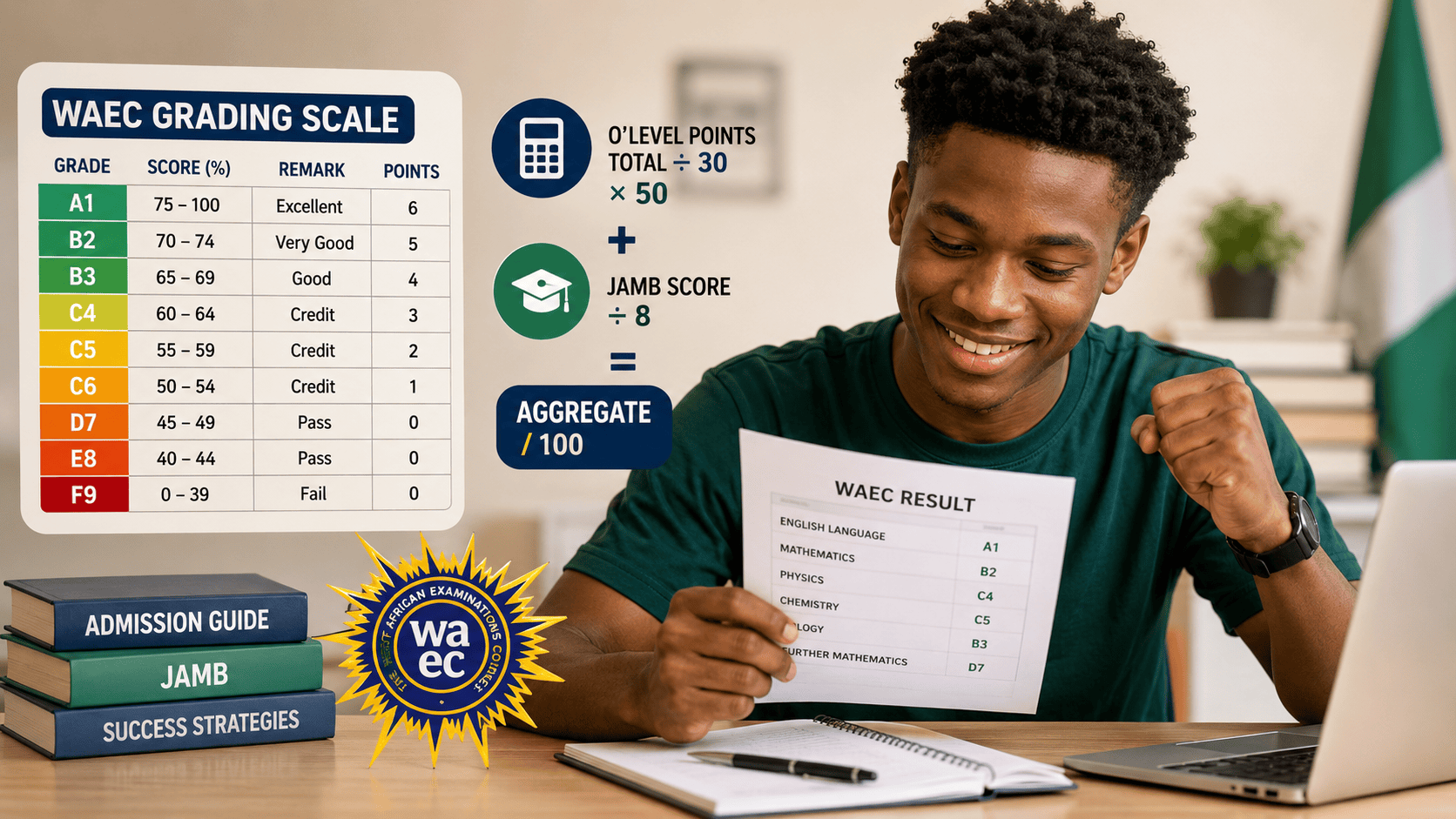
    Here is how it breaks down. A score between 75 and 100 percent gives you an A1, which is Excellent. From 70 to 74 percent, you get a B2, rated Very Good. B3, which is Good, covers 65 to 69 percent. Then come the Credit grades: C4 for 60 to 64, C5 for 55 to 59, and C6 for 50 to 54. Below that, D7 covers 45 to 49 and is a Pass, while E8 covers 40 to 44 and is also a Pass. Anything below 40 is F9, which is a Fail.

    The most important thing to understand is that only grades A1 through C6 are considered Credits. And for university admission in Nigeria, JAMB and WAEC-accepting institutions require a minimum of five Credit passes, which must include English Language and Mathematics for most courses.

    Why Credits Matter More Than Raw Scores

    A lot of students obsess over their percentage score when what universities actually look at is whether you have a Credit or not. The difference between a C6 and a D7 is not just one grade on a paper. That gap could be the reason JAMB rejects your admission during the o’level verification stage.

    I mentored a student from Kogi State, Blessing, who scored 289 on JAMB and was shocked when she did not get admitted to study Nursing. She had D7 in Biology. That was it. One subject, one grade below credit, and her entire admission fell apart. Universities running programs like Medicine, Law, Pharmacy, and Nursing are extremely strict about this.

    How WAEC Grades Translate Into Points for Aggregate Scores

    This is where most students get confused, and honestly, most blogs skip this part entirely. When universities calculate your aggregate admission score, they do not just look at whether you have Credits. They assign numerical points to each of your grades and use those points in a formula alongside your JAMB score and sometimes a Post-UTME score.

    The generally accepted point scale works like this. A1 carries 6 points. B2 carries 5 points. B3 carries 4 points. C4 carries 3 points. C5 carries 2 points. C6 carries 1 point. D7, E8, and F9 carry zero points each.

    Universities typically take your best five O’Level subjects and add up the points. The maximum you can score from your five best subjects is 30 points (5 subjects multiplied by 6 points each). That total is then converted to a score out of 50 using a simple formula: divide your total O’Level points by 30, then multiply by 50.

    Let me give you a real example. Suppose your five best subjects give you these grades: A1 in English (6 points), B2 in Mathematics (5 points), C4 in Physics (3 points), C5 in Chemistry (2 points), and B3 in Biology (4 points). Your total is 20 points. Divide 20 by 30, then multiply by 50. Your O’Level score in the aggregate formula becomes 33.3 out of 50.

    How the Full Aggregate Is Calculated

    Universities combine your O’Level score with your JAMB score (and Post-UTME score where applicable) to get your final aggregate. JAMB scores are usually converted to a score out of 50 by dividing your JAMB score by 8. So a JAMB score of 280 becomes 35 out of 50.

    Your full aggregate is then: O’Level score (out of 50) plus JAMB score (out of 50), giving a total out of 100. Using the example above, 33.3 plus 35 gives an aggregate of 68.3 out of 100.

    Some universities, especially older federal institutions, also factor in a Post-UTME score. In those cases, they may split the 100 marks three ways. Always check the specific formula for your target school on their official admissions portal before making assumptions.

    What Nobody Tells You About Your WAEC Grades and Admission

    Here is the truth that will save you from making a very painful mistake. Not all combinations of five Credit passes are treated equally. If you have A1 in five subjects but none of them are English Language and Mathematics, universities running science or social science courses will still reject your application at the screening stage.

    Also, some JAMB-accepting institutions verify your WAEC result directly through the WAEC Result Checker portal during admission screening. If there is any discrepancy between what you submitted and what the WAEC portal shows, your admission can be revoked, even after you have paid acceptance fees. This has happened to real students. Always cross-check your submitted grades against what the official WAEC portal displays.

    Your Practical Steps From Here

    First, check your result on the official WAEC portal at waecdirect.org and write down each subject grade alongside its numerical point value using the scale explained above.

    Second, identify your five strongest subject grades, making sure English Language and Mathematics are among them if your intended course requires both.

    Third, calculate your O’Level points total, divide by 30, and multiply by 50 to get your O’Level aggregate component.

    Fourth, take your JAMB score and divide by 8. Add that figure to your O’Level component. The result is your base aggregate. Compare this against the cut-off mark for your course and institution.

    Fifth, if your O’Level points are low, know that a higher JAMB score can partially compensate. Retaking JAMB to boost your score is sometimes a smarter move than repeating WAEC if your grades are already at Credit level.

    Sixth, verify everything on official portals. WAEC results go on waecdirect.org. JAMB admission status is checked on efacility.jamb.gov.ng. Never rely solely on your school printout.

    You Are Not Behind, You Just Need the Right Information

    The WAEC grading system is not complicated once someone explains it clearly. The frustrating part is that most students never get that explanation before they are already in a crisis. You have it now.

    Whether you are planning to sit WAEC for the first time, just received your results, or are in the middle of an admission cycle trying to figure out why your aggregate is not adding up, use what you have learned here to take one step forward today. Calculate your O’Level points. Know your number. Own your application.

    And if your grades did not go the way you hoped this time, that is not the end of your story. It was not the end of mine either.

  • WAEC Result Upgrade Scams Students Must Avoid in Nigeria (Read Before You Pay Anyone)

    WAEC Result Upgrade Scams Students Must Avoid in Nigeria (Read Before You Pay Anyone)

    Last updated: August 7, 2026

    Every admission season, the pressure returns. JAMB score is out, schools are releasing cut-off marks, parents are asking questions, and WhatsApp groups are full of “helper” contacts. That is when many students fall for WAEC Result Upgrade scams.

    Someone promises to change D7 to B3 in two days. Another claims they “work inside WAEC office.” They ask for ₦20,000, ₦50,000, or more. After payment, they disappear—or send a fake result screenshot.

    I have seen students lose money, miss admission deadlines, and suffer emotional stress because of this trap. If you are considering any WAEC Result Upgrade offer, please read this first.

    What Is WAEC Result Upgrade?

    This phrase is commonly used by fraudsters who claim they can alter or improve your WAEC grades after results have been released.

    Let’s be direct: WAEC does not officially authorize random agents to edit your grades for money.

    If there is any genuine correction process, it is usually for errors like name spelling, date of birth issues, or result checking concerns through official channels—not magically changing F9 to A1.

    How These Scams Usually Work

    1. They Use Urgency

    They say:

    • “Admission closes tomorrow.”
    • “Last batch tonight.”
    • “Do it now before portal shuts.”

    Pressure makes people think less carefully.

    2. They Borrow Trust

    Some use profile photos with suits, NYSC uniforms, or office logos. Others claim to know someone in WAEC.

    A display picture is not proof.

    3. They Request Part Payment First

    They ask for a “commitment fee” or “processing fee.” Once sent, more charges follow.

    4. They Send Edited Screenshots

    Many students do not know this: a screenshot is not an official result slip.

    3 Insights Most Blogs Don’t Mention

    1. Fake Upgrades Can Create Bigger Problems Later

    Even if someone gives you a manipulated printout, universities often verify results directly. Your admission can be delayed or cancelled.

    2. Scammers Target Parents Too

    Some fraudsters know parents are desperate to help their children. They emotionally pressure families into paying quickly.

    3. Cyber Cafés Can Mislead Students

    Not every café owner is dishonest, but some repeat rumors like “I know someone that upgrades results.” Always verify independently.

    Common Mistakes Students Make

    Believing WhatsApp Broadcast Messages

    If it starts with “100% legit,” be careful.

    Paying Without Verification

    Never send money because a friend said it worked for someone else.

    Waiting Too Long Before Planning Alternatives

    Many students waste months chasing fake upgrades instead of registering for the next exam.

    What To Do Instead (Safe Options)

    Rewrite Through Legit Exams

    Consider:

    • WAEC GCE
    • NECO
    • NABTEB (where relevant)

    Improve Other Admission Factors

    A stronger JAMB score or change of institution may help.

    Use Time Wisely

    While waiting, learn digital skills, volunteer, or prepare documents. One exam setback should not pause your whole life.

    Expert Tips From Musa Mustapha

    • If anyone guarantees grade changes, walk away.
    • Always verify updates from official WAEC sources. Policies and procedures can change.
    • Save your money for exam registration, textbooks, transport, or data.
    • Tell younger siblings and friends—many scams survive through silence.

    FAQ

    Is WAEC Result Upgrade real?

    Most offers online are scams. Be extremely cautious.

    Can WAEC correct mistakes?

    Yes, certain genuine data issues may have official procedures. Verify through WAEC directly.

    Can universities detect fake upgraded results?

    Often yes. Many schools verify results with official databases.

    What is the best alternative to poor WAEC grades?

    Rewrite through WAEC GCE, NECO, or other accepted exams.

    I already paid a scammer. What should I do?

    Stop further payments, gather evidence, report to your bank, and report relevant authorities.

    Honest Conclusion

    I understand the pressure. In Nigeria, one result can feel like it controls your future. Family expectations are real. Admission deadlines are stressful. But paying for a fake WAEC Result Upgrade usually adds pain, not progress.

    A delayed success built honestly is better than a rushed shortcut that damages your future. Protect your money, your name, and your peace of mind.

  • I Failed WAEC Twice – Here’s Exactly What I Changed to Score 7 A’s

    I Failed WAEC Twice – Here’s Exactly What I Changed to Score 7 A’s

    Last updated: August 7, 2026

    The second time I saw my WAEC result, I didn’t even open it immediately. I already knew what was inside.

    That kind of silence your chest carries… I had it.

    The first time I failed, people said, “It happens.” The second time, nobody said anything. That silence is worse than insults.

    I’m Musa Mustapha, and I’m not telling you a motivational story. I’m telling you exactly what I did differently the third time that gave me 7 A’s — after two painful failures.

    If you’re preparing for WAEC right now, or you’ve already failed once, read this slowly. This might save you a whole year of your life.

    The Reality I Had to Accept (After Failing Twice)

    After my second failure, I stopped blaming WAEC.

    Not the questions. Not the system. Not even my school.

    I sat down one evening in 2016 at home in Kaduna, and I asked myself one uncomfortable question:

    “If WAEC is truly unfair, why are thousands of students still getting A’s?”

    That question changed everything.

    Because the truth is, I wasn’t failing because WAEC is hard. I was failing because my approach was weak.

    And that’s the part most students don’t want to hear.

    Mistake #1: I Was Reading Hard — But Not Reading Right

    I used to “read” for hours.

    I would open my notebook, underline things, even feel proud of myself.

    But when I tried past questions, I couldn’t answer simple things.

    That’s when I realized something painful:

    Reading is not the same as understanding.

    The WAEC exam is not designed to reward who reads the most. It rewards who understands patterns.

    So I changed my method completely.

    Instead of just reading notes, I started studying with WAEC past questions as my main guide.

    Every topic I read, I immediately asked:

    • How has WAEC asked this before?
    • What pattern do they follow?
    • What kind of trick do they like using?

    Within weeks, things started making sense.

    WAEC is not unpredictable. It repeats styles — just in different forms.

    Mistake #2: I Ignored My Weak Subjects

    Let me be honest — I was avoiding Mathematics like it was a curse.

    English too? I just assumed I was “average” and left it like that.

    But WAEC doesn’t reward comfort.

    It exposes weakness.

    The subjects I feared the most were the exact ones dragging my result down.

    So I did something I had never done before:

    I faced them head-on.

    I started solving Maths every single day — even when I got everything wrong.

    I rewrote English essays and forced someone better than me to mark them.

    It was frustrating. It was slow. But it worked.

    Because consistency beats talent in WAEC.

    Mistake #3: I Studied Alone (Biggest Error)

    This one nearly ruined me.

    I thought studying alone meant I was serious.

    But in reality, I was stuck in my own understanding.

    When I finally joined a small group — just 3 of us — everything changed.

    We argued answers.
    We explained topics to each other.
    We corrected each other’s nonsense.

    And something powerful happened:

    If you can teach a topic, you understand it.

    That’s when I knew I was improving.

    What Nobody Tells You About WAEC

    Let me say something most blogs will never tell you:

    WAEC is not just about intelligence — it’s about exam strategy.

    I’ve seen brilliant students fail.

    I’ve also seen average students score A’s.

    Why?

    Because WAEC rewards:

    • Speed
    • Accuracy
    • Familiarity with question patterns

    Not who is “naturally smart.”

    Another truth?

    Some schools don’t prepare students properly. They rush the syllabus. They don’t focus on past questions.

    So if you’re depending only on your school, you might be in trouble.

    You have to take control of your own preparation.

    Nobody is coming to rescue your result.

    The Exact System I Used to Score 7 A’s

    When I decided I was done failing, I created a system. Not motivation — a system.

    Here’s exactly what I did:

    1. I Studied Past Questions Like a Textbook

    I got at least 10 years of WAEC past questions for each subject.

    Not to “practice” — but to study patterns.

    I noticed:

    • Certain topics come out every year
    • Some questions are just reworded versions of old ones

    That alone increased my confidence massively.

    2. I Created a Daily Timetable I Actually Followed

    Not those unrealistic timetables students draw and abandon after 2 days.

    Mine was simple:

    • 3 subjects per day
    • 2–3 hours total

    Consistency was more important than intensity.

    3. I Focused More on Understanding Than Memorizing

    Before, I used to cram.

    Now, I asked:

    • Why is this the answer?
    • How can WAEC twist this question?

    That mindset changed everything.

    4. I Practiced Under Exam Conditions

    This was a game changer.

    I started timing myself while solving questions.

    No phone. No distraction.

    Because knowing the answer is one thing — finishing on time is another.

    5. I Fixed My English and Maths Aggressively

    I gave them extra time daily.

    Because no matter your course, failing English or Maths can destroy your entire result.

    The Turning Point

    About one month before the exam, something strange happened.

    Past questions started feeling… familiar.

    Not because I had memorized them.

    But because I understood how WAEC thinks.

    That’s when my confidence became real.

    Practical Steps You Can Start Today

    If you’re serious about not failing WAEC, do this:

    1. Get at least 10 years of WAEC past questions for all your subjects
    2. Study topics alongside past questions — not separately
    3. Identify your weakest 2 subjects and double your effort there
    4. Form a small, serious study group (not more than 4 people)
    5. Practice answering questions under time pressure every week
    6. Stop “reading for long hours” — start reading with purpose
    7. Ask for help when you don’t understand something — immediately

    Do this consistently for 2–3 months, and your confidence will change.

    The Day I Saw My Result

    The third time, I opened my WAEC result with fear.

    But this time, it was different.

    A1. A1. B2. A1…

    I checked it again.

    Seven A’s.

    I didn’t shout. I didn’t run.

    I just sat down quietly… and smiled.

    Because I knew something most people don’t:

    It wasn’t luck. It was a system.

    Final Words — Read This Carefully

    If you’ve failed WAEC before, you’re not finished.

    But if you keep using the same method that made you fail…

    You’re repeating the same mistake.

    Change your strategy, not your dream.

    Because the difference between failure and 7 A’s is not talent.

    It’s how you prepare.

  • How to Receive Remote Job Payments as a Nigerian: Grey, Wise, Payoneer, and Dollar Accounts Explained

    How to Receive Remote Job Payments as a Nigerian: Grey, Wise, Payoneer, and Dollar Accounts Explained

    Last updated: August 6, 2026

    The first time a client sent me $150 for a writing job article, I almost lost it all.

    Not to scammers. Not to a bad client. To my own ignorance.

    The payment sat in a PayPal account for three weeks because I had no clue PayPal had stopped supporting Nigerian withdrawals. I tried everything. I contacted their support three separate times. In the end, I tracked down someone in another country to receive it on my behalf and send me naira through a third party. By the time the whole thing was sorted, I had lost nearly 18% of that money to fees and a terrible exchange rate.

    That was 2019. Since then I have helped dozens of Nigerian freelancers, remote workers, and students receiving scholarship stipends figure out the cleanest, cheapest way to get their foreign income into their hands. This post is everything I wish someone had handed me back then.

    Why This Is Even a Problem in the First Place

    Most blogs jump straight to “here are your options” without explaining why receiving foreign payments is complicated here. The reason is not simple. It is a combination of CBN policy constraints, Nigeria’s exclusion from certain global payment infrastructure, and the historical instability of the naira. Companies like PayPal have limited their Nigerian features not because Nigerians are untrustworthy, but because the regulatory and banking environment made it economically risky for them to operate fully here.

    This matters because it tells you there is no single perfect solution. Different platforms work better for different situations. Choosing the wrong one can cost you money every single month, quietly, in ways you might not even notice until you sit down and calculate it.

    Grey: The One Dominating the Conversation Right Now

    If you have spent any time in Nigerian freelancer groups on WhatsApp or X in the last two years, you have heard about Grey. And genuinely, the attention is deserved.

    Grey gives you a real US dollar account with actual routing numbers and account numbers, a UK account with sort code details, and a EUR account as well. Not a virtual card. Not a workaround. An actual account that foreign employers and clients treat like any other American or British bank account.

    Here is how it plays out in practice. Say you are working for a company in Canada that pays via direct bank transfer. You give them your Grey USD account details. They transfer the money the same way they would to any US bank. It lands in your Grey account within one to two business days. You then convert to naira at a rate close to the parallel market rate and withdraw to your Nigerian bank account.

    That last part, the parallel market rate, is the real story. The gap between the official bank rate and the real market rate has been enormous at various points in recent Nigerian history. Getting something close to the actual market rate means you keep significantly more of what you earned.

    Grey charges a fee on conversion and withdrawal. As of my last check, this sits around 1% for conversion plus a small withdrawal fee. Verify the current structure directly on the Grey app before you build a budget around it, because fintech fees do change.

    The app is clean, works well on both Android and iOS, and verification requires a BVN and a government ID. Most Nigerians get approved within 24 to 48 hours.

    One thing to know going in: Grey is built primarily for receiving payments and converting them. It is not a full-service bank. You cannot use it to pay international subscriptions or services the way you would a Visa card, though their feature set has expanded and continues to grow.

    Wise: The Stronger Pick When Your Client is in Europe or the UK

    Wise has a strong global reputation, and for Nigerians doing remote work with European clients specifically, it is one of the most fee-transparent options available.

    You can open a Wise account with a Nigerian passport and receive account details in multiple currencies including GBP, EUR, and USD. Clients in the UK or Europe pay you as though they are paying a local account. The money arrives quickly, the fees are shown upfront before you confirm anything, and the exchange rate is the mid-market rate with a clear percentage on top. No surprises buried in the small print.

    A Nigerian UX designer I mentored was contracted by a German SaaS company that preferred SEPA bank transfers. She used her Wise EUR account details. Every month the payment arrived within a day, she converted to naira, and withdrew to her GTBank account. The fees were lower than anything she had tried before, and she could see exactly what she would receive before she confirmed the conversion. No drama.

    The honest limitation with Wise is that the transfer experience to Nigerian bank accounts has not always been perfectly smooth for every user. It works, but the consistency has varied. Always test with a small amount before you rely on it for your full salary.

    Wise is also stricter on compliance than some alternatives. Large sudden deposits without a transaction history behind them can trigger a documentation request. This is not targeted at Nigerian users specifically, but it is worth being prepared for if you are just starting out and receiving your first few payments.

    Payoneer: Still Relevant, Especially for Platform Workers

    Payoneer has been in this space longer than most, and it stays particularly useful if you work on platforms like Upwork, Fiverr, Toptal, or Amazon Mechanical Turk. Many of these platforms have Payoneer as a native withdrawal option, which means money moves from your platform earnings directly to your Payoneer balance with very little friction.

    From Payoneer you can withdraw to a Nigerian bank account in naira. The exchange rate is not always the most competitive, and fees can stack if you are withdrawing frequently in small amounts. There is typically a fee to withdraw to a local bank, and the conversion rate often has a built-in spread that is less favorable than what you would get on Grey or Wise.

    The strength of Payoneer is its ecosystem. If your client is a company that already uses Payoneer’s business payment service, receiving from them into your Payoneer account is often free on your end. On Upwork specifically, the platform-to-Payoneer withdrawal above a certain threshold carries no fee. So Payoneer is the right tool for specific situations, not a blanket recommendation.

    A friend who does data annotation work on platforms like Scale AI and Appen uses Payoneer exclusively because those platforms pay directly into it. He does not think about it. The money arrives, he withdraws once a month, and he moves on. For that use case, it is genuinely the best option.

    Domiciliary Accounts in Nigerian Banks (The One Everyone Overlooks)

    This option gets left out of most remote work payment discussions and it should not.

    Nigerian commercial banks, including Access, GTBank, Zenith, and First Bank, offer what are called domiciliary accounts. These are accounts held in foreign currency, usually USD, GBP, or EUR, fully recognized by the CBN. When your foreign employer sends an international wire transfer (SWIFT) to that account, the dollars arrive and sit there in dollars. You decide when to convert and at what rate. You can also leave the money in dollars if you want to protect its value against naira depreciation over time.

    The challenge with this route is the SWIFT transfer fee. Most international wires attract a sending fee from your client’s bank, typically $15 to $50, and sometimes a receiving fee from your Nigerian bank on top. This makes domiciliary accounts impractical for small or frequent payments. For a developer earning $3,000 a month from a US company paying via wire, the domiciliary account can be the cleanest option. For a freelancer receiving $200 for a one-off project, the same fees eat too much.

    You can open a domiciliary account at any of these banks with a valid ID, BVN, and utility bill. The process takes a few days. When you get to the branch, specifically ask to speak with someone in the international banking or corporate banking unit. Regular tellers sometimes have outdated information about current CBN policies on foreign-funded domiciliary accounts, and you do not want to make decisions based on stale answers.

    The Honest Truth About All of These Platforms

    None of them are permanent fixtures.

    Grey is still a startup. Wise has pulled back features in certain African markets before without much warning. Payoneer has changed its fee structure multiple times over the years. The CBN has issued circulars that disrupted how these services interact with Nigerian bank accounts, sometimes overnight. This is just the reality of operating in this environment.

    The freelancers who handle this best are the ones who never rely on a single channel. They might receive via Grey, keep a Payoneer account as a backup, and have a domiciliary account available for larger payments. That is not paranoia. It is basic financial self-defense.

    The other thing nobody says clearly enough: timing your conversion matters. If you earn $500 and the naira rate swings from N1,500 to N1,700 per dollar between when you receive the payment and when you convert it, that is either an extra N100,000 in your pocket or out of it depending on the direction. Checking the rate before you convert takes 30 seconds. Do it every time.

    And while you are getting your payment systems right, make sure your work schedule is just as dialed in. If you are managing clients across different time zones, this guide on time zone tips for Nigerian remote workers is worth reading next. Getting paid well and showing up on time are two things that together determine how long your remote career actually lasts.

    What to Actually Do (Step by Step)

    1. Ask your client directly how they prefer to pay. Do not assume. The answer shapes everything else. Options usually include wire transfer, Wise, Payoneer, or a platform-native payment system.
    2. Match your tool to their payment method. If they do direct bank transfers, open a Grey account for USD or EUR. If they pay via a freelance platform, get Payoneer set up. If they send wire transfers and your income is large and monthly, open a domiciliary account at a commercial bank.
    3. Test the full route before you depend on it. Ask your client to send a small test payment first. Trace it all the way from their end to your Nigerian bank account before you ask them to send your first full salary. You want to confirm the route works end to end with no surprises.
    4. Track your conversion rates in writing. Keep a simple note or spreadsheet. Write down the rate you got each time you converted. After three months you will start to see patterns that help you make smarter decisions about when to convert and when to wait.
    5. Keep your verification documents current. Every platform requires ID verification. An expired NIN slip or outdated passport details on file can lock your account at the worst possible time. Update your information proactively, not reactively.
    6. Keep at least two receiving options active. Never let your entire income flow through a single platform. Things break. Policies change. An app can go down. Be ready before it happens, not after.

    Your Skill Earned That Money. Protect How You Collect It.

    Getting your first remote payment as a Nigerian is one of the best feelings you will experience as a young professional. I still remember the moment the first one landed in my account without drama. It felt like confirmation that the work was real and that the grind had a point.

    But I have also watched people lose real percentages of their income to fees they did not understand, exchange rates they never tracked, and platforms they trusted without testing. That is money that should be going into their savings, their families, their futures.

    You spent time and energy building the skill that someone across the world is paying for. Put that same energy into protecting how you receive it.

    Start with one platform. Test it. Understand its fees. Then build your backup. You will thank yourself later.

  • How to Build a Freelance Portfolio From Scratch as a Nigerian With No Client Experience

    How to Build a Freelance Portfolio From Scratch as a Nigerian With No Client Experience

    Last updated: August 6, 2026

    The year was 2024. I had just finished my NYSC in Kwara State, my savings were depleting, and I had applied for numerous graduate jobs. Nothing. Just silence.

    One evening, I stumbled into a Facebook group for remote workers and saw a guy from Enugu who said he made 150,000 naira in a single month writing copy for a UK brand. No office. No tie. No signing-in register. I laughed first. Then I sat with it. Then I got hungry.

    The problem was obvious. I had no portfolio. No clients. No testimonials. No proof of anything. And every freelance platform I visited had a wall of experienced people competing for the same projects. I didn’t know yet that the “no experience” problem is completely solvable. It just takes a specific kind of strategy, not luck.

    If you’re reading this from Abuja, Lagos, Kano, Port Harcourt or somewhere in between, and you keep asking yourself how you’re supposed to get clients when no one has hired you yet, this post is exactly what I wish existed when I was in that spot.

    The Real Reason Most Nigerians Never Start

    The biggest lie in the freelance world is that you need a client to build a portfolio. You don’t. What you need is work. Those are two different things.

    A client gives you a project and pays you. Work is any output that demonstrates your skill. You can produce work today, right now, without anyone hiring you. The problem is that most people are waiting for permission that is never coming.

    I see this pattern constantly. A developer who can build a functional app but has a GitHub profile with zero repositories. A writer who has been reading and forming opinions for six years but has not published a single article. A graphic designer who creates stunning things for fun but has never packaged those pieces into a presentable format.

    The portfolio problem is 80% a confidence problem dressed up as an experience problem.

    Start With Spec Work (Not Fake Clients)

    Here’s what I tell every young person I mentor: pick two or three real Nigerian brands you admire and create unsolicited work for them as if they hired you.

    If you’re a social media manager, redesign their Instagram content calendar for one week. If you’re a copywriter, rewrite their homepage like it’s your real brief. If you’re a web developer, rebuild their mobile experience in a cleaner, faster way and document your process.

    This is called spec work, and it is legitimate. It is not lying. Your portfolio will show this as “conceptual project” or “personal project” and any serious client who reviews it will care far more about what the work looks like than whether someone paid for it. The quality is the credential.

    When I built my first content portfolio, three of my six pieces were spec articles I wrote for brands that never asked me to. One was for a fintech startup in Lagos. Another was a long-form career guide I wrote as if I was commissioned by a federal university. Nobody paid me. But those pieces won me actual paying work before the end of that quarter.

    The One Platform Most Nigerian Freelancers Ignore

    Everyone hears about Upwork and Fiverr, and yes, they matter. But the most underused portfolio tool for Nigerian freelancers is their own published content online.

    A Medium article. A LinkedIn post that went slightly viral. A Notion portfolio page with case studies. A GitHub repository that shows consistent commits over six months. These things tell a client your story before you even send a proposal.

    The mental shift I want you to make is this: your digital footprint is your CV now. A recruiter or client in London or Toronto is not going to ask for your O’Level result. They will Google you. They will check what you’ve published, what problems you’ve solved in public, and whether your thinking looks sharp.

    Start there. Write about your niche. Document what you’re learning. Share your process. Build in public, even when nobody is watching yet.

    What Nobody Tells You About Nigerian Freelancers and Payments

    There’s something uncomfortable that most freelance blogs skip entirely, probably because they’re written from London or San Francisco.

    Getting paid as a Nigerian freelancer is genuinely complicated. PayPal barely works. Dollar transactions attract conversion issues. And if you try to receive payments carelessly, you can lose a significant percentage in fees or trigger compliance flags with your bank.

    This is not a small detail. I’ve watched talented Nigerians lose clients because they couldn’t provide a clean payment method at the point of contract. One of the first practical things you must sort out before you start pitching is your payment infrastructure.

    Grey and Wise are the most reliable options I’ve seen for receiving freelance payments cleanly from abroad. Payoneer is another solid choice, especially if you’re on a platform like Upwork. I wrote a full breakdown on how to receive remote job payments in Nigeria using Grey, Wise, and Payoneer if you want to get that sorted properly.

    Don’t build the portfolio and then realize you can’t collect your money. Set up the account now.

    Platforms That Actually Pay Nigerian Developers Well

    If you’re a developer specifically, your portfolio path is slightly different because the top-tier platforms require a technical vetting process. Andela, Toptal, and Turing all run structured assessments to place developers with international companies, and once you pass, the pay is legitimately transformative by Nigerian standards.

    The catch is that the bar is real. You will need demonstrable projects and strong problem-solving ability. But the good news is that everything we’ve talked about so far, the spec work, the GitHub commits, the documented projects, is exactly what those platforms want to see.

    I covered how each of those platforms works, what their vetting looks like, and which fits what skill level in this post on Andela, Toptal, and Turing for Nigerian developers. If you’re a developer who is serious about earning in dollars, that’s worth reading after this.

    A Practical Starting Plan (Six Weeks)

    Week one: identify your niche clearly. Not “I can do anything.” Choose one: writing, design, development, video editing, social media, data entry, virtual assistance. One.

    Week two: produce three spec projects in that niche. Real brands, realistic briefs, actual finished output.

    Week three: build your portfolio home. A free Notion page, a Behance profile, a personal website on Carrd, or a polished LinkedIn with a featured section. Whatever fits your niche, but it must exist somewhere searchable.

    Week four: set up your payment account. Grey, Wise, or Payoneer. Get verified before you need it.

    Week five: write or publish one piece of content related to your niche. A LinkedIn article, a case study, a tutorial. Something that shows your thinking, not just your execution.

    Week six: send five targeted cold pitches to real businesses. Not mass applications. Five real ones with specific observations about their business and how you can help.

    That is six weeks. Most people reading this will not do it. The ones who do will have something real by month two.

    The Honest Truth About the First Ninety Days

    Your first few clients will probably pay less than you deserve. That is a fact, not a failure. The early work is not about money. It is about converting your spec portfolio into a client testimonial portfolio. Once you have two or three people who can speak to what it is like working with you, everything changes.

    Do not let the first difficult months convince you there is no path forward. There absolutely is. But the path requires you to start before you feel ready, which is the only time anyone ever actually starts anything worth doing.

    Nigeria has produced globally competitive talent in tech, design, writing, and dozens of other freelance fields. The infrastructure is harder here, the internet is not always reliable, and the imposter syndrome hits differently when you’re working across currency and cultural gaps. None of that means you cannot do this.

    It means you have to be more deliberate. Which, if you’ve read this far, you already are.

    Start the portfolio this week. Not next Monday. This week.

  • Entry-Level Jobs in Nigeria for Fresh Graduates in 2026 That Don’t Require Experience

    Entry-Level Jobs in Nigeria for Fresh Graduates in 2026 That Don’t Require Experience

    Last updated: August 6, 2026

    About three months after NYSC, one day in my room i was staring at job listings on my phone and feeling like I was invisible. Every role wanted “minimum 2 years experience.” For what? I had just spent a year serving this country, and somehow that did not count. I applied to 40-something jobs before anyone called me back. That was years ago, but every week, students message me through edujobsafrica.com saying the exact same thing.

    So I want to write this post for the version of me that was sitting in that room, confused and slowly losing confidence. Because the truth is, there are real jobs in Nigeria right now that genuinely do not require work experience. You just have to know where to look and what those jobs actually value in place of experience.

    Why “No Experience Required” Is Real, Not a Trick

    A lot of fresh graduates read “entry-level” and assume it still means they need something. Sometimes that assumption is correct. Some companies write “entry-level” and then ask for two years experience in the same breath, which should be illegal honestly.

    But there is a category of jobs where that is not the case. These roles are built around your degree, your aptitude, your trainability, and sometimes your energy alone. Organizations that run graduate trainee schemes, federal agencies with mass recruitment exercises, and tech-adjacent startups that need young talent they can shape from scratch, these are the places that genuinely do not care that you have never held a full-time role before.

    What they want instead is a clean CV, evidence that you can think, and proof that you will show up and grow. Which means your first job is to present yourself properly. If you have not done that yet, read my guide on how to write a professional CV in Nigeria in 2026 before you apply to anything on this list.

    10+ Entry-Level Jobs in Nigeria for Fresh Graduates in 2026

    1. Federal Civil Service Graduate Trainee Roles

    The Federal Civil Service Commission runs recruitment exercises for fresh graduates across multiple ministries and agencies. These roles, sometimes called GL 08 or GL 07 positions, are designed specifically for people who just finished NYSC. You need your degree, your NYSC certificate, and a WAEC result. Nothing more. The pay is not glamorous but the job security and pension structure are real, and a lot of people I know have built serious careers from these entry points. Watch the Federal Civil Service Commission portal at fedcisc.gov.ng for announcements.

    2. Bank Graduate Trainee Programs

    Access Bank, GTBank, Zenith, UBA, First Bank, and most of the major commercial banks run annual graduate trainee programs. They hire in batches, train you for months, and place you in roles across operations, customer service, digital banking, and sometimes even credit analysis. Some of these programs pay above 200,000 naira monthly as a trainee, which is decent for someone with zero experience. The tests are competitive, especially the aptitude and psychometric assessments, so prepare seriously. Don’t walk in expecting them to just select you because you have a degree.

    3. NYSC Skill Acquisition and Entrepreneurship Jobs

    This one most people sleep on. After NYSC, the skills you picked up during skill acquisition programs can qualify you for jobs with NGOs, social enterprises, and development organizations that specifically recruit from the NYSC pool. I have seen corps members transition directly into paid roles at organizations they partnered with during service year. If you networked well during NYSC, those contacts are still valid.

    4. Tech Sales and Business Development Roles

    If you have a phone, decent English, and you are not afraid to talk to people, you can get into tech sales in Nigeria right now without any prior experience. Companies like PalmPay, Moniepoint, OPay, and dozens of fintech startups hire field sales agents and business development executives almost continuously. The base salary is often modest but commissions can make it very worthwhile. Most of these companies will train you from scratch.

    5. Customer Service Representative

    Almost every company with a contact center in Nigeria hires fresh graduates for customer service. Telecoms like MTN and Airtel, banks, e-commerce platforms like Jumia and Jiji, health insurance companies, they all need people who can communicate clearly and handle client issues. If you have good spoken English and patience, you can get this job. Some roles are fully remote too, which matters when transport costs are what they are in Lagos and Abuja.

    6. Content Writing and Social Media Management

    Nigerian digital agencies and media companies hire fresh graduates to write content and manage social media accounts. If you can write clearly, understand basic online tone, and know your way around Instagram or X (formerly Twitter), you are already ahead. Companies like Stears, Zikoko, YNaija, and various marketing agencies post these roles frequently on LinkedIn and Jobberman. Build a small portfolio of sample content and attach it to your application.

    7. Graduate Trainee Programs at Oil and Gas Companies

    NNPC, Schlumberger (now SLB), Halliburton, and Total Energies run graduate trainee schemes that are open to engineering, sciences, and sometimes business graduates. These are competitive and the selection process is long, but they do not require experience. They require technical aptitude and the willingness to go through a rigorous hiring process. The salaries for these roles are among the highest for fresh graduates in Nigeria. Set Google alerts for these companies so you do not miss when applications open.

    8. Teaching and Education Roles

    Private schools, tutoring centers, and EdTech platforms like PrepClass and Tuteria hire graduates to teach or tutor students. You do not need a teaching certificate for most private school roles, especially at the secondary level. If you have strong subject knowledge, particularly in mathematics, sciences, or English, you can start teaching almost immediately after NYSC. Some states also run direct recruitment exercises for public school teachers.

    9. Government Agency Schemes (NASIMS, GEEP, YouWin)

    The federal government and some state governments run youth employment and empowerment programs that are not traditional jobs but function like one. N-Power, coordinated through NASIMS, places young graduates in schools, health centers, and communities and pays a monthly stipend. As of my last check, the program has had multiple batches and the application portal is nasims.gov.ng. These roles come with hands-on experience that can launch a real career if you treat it seriously.

    10. Administrative and Office Assistant Roles

    Small and medium-sized companies across Nigeria hire fresh graduates as admin assistants, executive assistants, front desk officers, and office managers. These jobs rarely require experience. They require reliability, basic computer skills (Word, Excel, Google Docs), and professionalism. They are not glamorous but they get you inside an organization where you can move up fast if you perform.

    11. Logistics and Dispatch Coordination

    With the growth of e-commerce in Nigeria, companies like GIG Logistics, Sendbox, and Kwik now hire fresh graduates for coordination, dispatch planning, and client liaison roles. These are not driving jobs. These are administrative and operational roles that manage the movement of goods. Fresh degree, clean record, and good communication skills are usually all you need.

    12. Research and Data Entry Roles

    Survey companies, market research firms, and data companies hire entry-level researchers and data entry operators constantly. IPSOS, Kantar, and local firms like Infosight hire fresh graduates for fieldwork, data collection, and basic analysis. If you studied any social science, business, or even education, this is a natural fit.

    What Nobody Tells You

    The jobs exist. The real problem is how most fresh graduates apply for them.

    A lot of people send the same generic CV to 80 companies and wonder why nobody calls. What actually works is targeted, specific applications where your CV is adjusted for each role, where your cover letter shows that you read the job description, and where you follow up after applying.

    I have also noticed something uncomfortable that I want to say clearly. Some fresh graduates in Nigeria are holding out for “big” jobs when they should be building experience. A job that pays 80,000 naira a month in a real company is not beneath you. It is a starting point. The people I know who moved fastest in their careers were not the ones who waited longest for the perfect offer.

    How to Actually Get These Jobs: A Practical Step Plan

    First, fix your CV before you do anything else. One page, clean formatting, relevant achievements from your degree and NYSC. The guide I linked earlier will walk you through this properly.

    Second, create a LinkedIn profile and complete it fully. Set your location to Nigeria, add your education, and under your headline write something specific like “Fresh Graduate | Business Administration | Open to Entry-Level Opportunities.” Recruiters from banks, NGOs, and tech companies search LinkedIn in Nigeria more than most people realize.

    Third, register on Jobberman, MyJobMag, and NGCareers today. These three platforms have the highest volume of legitimate Nigerian job listings. Set up email alerts for “graduate trainee,” “entry level,” and “fresh graduate.”

    Fourth, apply to federal and state government recruitment portals directly. Many government jobs are never advertised publicly. They are posted only on official portals. Bookmark the Federal Civil Service Commission portal, your state civil service portal, and the portals for agencies in your field.

    Fifth, tell people you are looking. This sounds uncomfortable but it works. A lot of the first jobs Nigerians land come through someone who knew someone. Your church, your mosque, your former lecturers, your NYSC platoon mates. Let people know you are available and what you are looking for.

    You Are Not Behind

    If you are reading this and it has been six months or even a year since NYSC and you still do not have a job, I need you to hear this. You are not a failure. The Nigerian job market is genuinely hard and the economy has not made it easier. But the path forward is not waiting. It is applying strategically, building any experience you can find, and staying visible.

    One of the students I mentored last year sent me a message in January saying she had given up on getting a “real job” and was thinking of going back to school. I told her to apply to one more round of graduate trainee programs and fix her CV first. She got a call from a fintech company in February and started March 1st.

    It can happen fast. But only if you keep moving.

  • Top 20 Companies Currently Hiring in Nigeria in 2026 With Application Links

    Top 20 Companies Currently Hiring in Nigeria in 2026 With Application Links

    Last updated: August 6, 2026

    It was a Tuesday morning in 2023, I had just finished my NYSC and I was sitting in my mother’s parlour in Kaduna with my laptop, 32 open browser tabs, and zero job offers. Every page I landed on either had expired listings or vague “submit your CV at our office” instructions with no address.

    Seven years later, nothing frustrates me more than watching Nigerian graduates go through the same thing. Outdated job lists. Ghost portals. Articles written by people who clearly never applied to a single Nigerian company.

    This post is different. I spent time pulling together companies that are actively hiring in Nigeria right now, in 2026, not last year’s recycled content. Some of these I know personally through people I’ve mentored. Others I’ve verified through official channels. Where I’m not 100% certain, I’ll tell you to double-check.

    Because that’s the thing nobody says out loud: job hunting in Nigeria is a full-time job in itself.

    Why Most “Hiring in Nigeria” Lists Are Useless

    Before we get into the list, let me say something uncomfortable. Most blog posts in this niche are copy-pasted from each other. You see the same 10 companies, same descriptions, same “click here to apply” links that go nowhere. Some of those articles were written in 2021 and are still ranking on Google in 2026. The companies on the list might not even be recruiting.

    I’m not here to waste your data.

    Every company below either has an active 2026 recruitment cycle running, recently announced openings, or has a continuous application portal that is live. I will tell you what roles they typically hire for, how to apply, and what your actual chances look like.

    The List: 20 Companies Hiring in Nigeria in 2026

    1. MTN Nigeria

    MTN is one of the most consistent hirers in Nigeria’s private sector. They recruit for technical roles (network engineers, IT specialists), commercial roles (sales, marketing), and graduate trainee programmes. In 2025, their graduate trainee intake received over 80,000 applications for under 200 slots, which tells you both how competitive it is and how real the opportunity is.

    Apply via: careers.mtnonline.com

    2. Dangote Group

    With operations across cement, refining, fertiliser, and food processing, Dangote regularly posts vacancies across multiple business units. Their refinery alone created thousands of direct and indirect jobs. They tend to advertise roles in procurement, engineering, finance, and logistics.

    Apply via: dangote.com/careers

    3. Access Bank

    Access Bank runs one of Nigeria’s most structured graduate recruitment programmes. Their Entry Level Programme is competitive but very real. I personally know a young man from Kano who got in with a 2.2 from a state university because his aptitude test score was exceptional. The lesson: don’t rule yourself out.

    Apply via: accessbankplc.com/careers

    4. Zenith Bank

    Similar to Access, Zenith recruits heavily at the graduate level. Their HR process involves an aptitude test (usually administered through Workforce Group), panel interviews, and medical screening. The key thing to know is they strongly favour candidates from accredited universities with a minimum of second class lower.

    Apply via: zenithbank.com/careers

    5. First Bank of Nigeria

    One of Africa’s oldest banks. First Bank runs ongoing recruitment and is known for absorbing a large number of fresh graduates annually, especially into their retail banking segment. They also post specialized roles in digital banking, risk management, and compliance.

    Apply via: firstbanknigeria.com/careers

    6. TotalEnergies Nigeria

    TotalEnergies consistently recruits engineers (petroleum, mechanical, electrical), HSE officers, and finance professionals. They also run a Young Graduate Programme that gives recent graduates a structured entry into the oil and gas sector.

    Apply via: careers.totalenergies.ng

    7. Shell Nigeria (SPDC and SNEPCo)

    Shell’s recruitment in Nigeria is often tied to project phases. When they’re actively drilling or expanding, they hire aggressively. As of early 2026, Shell has been advertising roles in geosciences, operations, and project management. Their applications go through a global portal.

    Apply via: shell.com/careers (search “Nigeria”)

    8. Nigerian Breweries (Heineken Group)

    Nigerian Breweries runs one of the most respected graduate management trainee programmes in the country. It’s tough. The selection process typically spans four to six months and includes a business case presentation. But graduates who make it often describe it as the best decision of their career.

    Apply via: nigerianbreweries.com/careers

    9. Unilever Nigeria

    Unilever Nigeria typically recruits for supply chain, marketing, finance, and R&D roles. They’re known for their UFLP (Unilever Future Leaders Programme), which is open to recent graduates. Placement is competitive but the training is genuinely world-class by Nigerian industry standards.

    Apply via: unilever.com/careers (filter by Nigeria)

    10. Nestlé Nigeria

    Nestlé runs structured recruitment for their technical (engineering and production) and commercial divisions. They also partner with universities for internship pipelines, and several of those interns eventually convert to full employees. If you’re in food science, nutrition, or chemical engineering, this one is worth pursuing seriously.

    Apply via: nestle-esar.com/careers

    11. Flour Mills of Nigeria (FMN)

    FMN is one of Nigeria’s largest food manufacturing companies with businesses spanning flour, sugar, pasta, feeds, and agro-allied operations. They hire aggressively in engineering, operations, and sales. Their Management Trainee Programme is open yearly.

    Apply via: fmnplc.com/careers

    12. Lafarge Africa (Holcim Group)

    Lafarge recruits for roles in mining, cement production, logistics, and corporate functions. They’re particularly active in recruiting chemical engineers, mechanical engineers, and finance professionals. Their parent company Holcim has pushed a global sustainability agenda that has opened new roles in ESG and environmental compliance in Nigeria.

    Apply via: lafarge-holcim.com/careers (filter Nigeria)

    13. Procter and Gamble (P&G) Nigeria

    P&G runs a strong campus recruitment programme in Nigeria, targeting students and recent graduates across engineering, IT, and business. Their local office recruits into global roles sometimes, which means a P&G job in Lagos can be a launchpad for a global career.

    Apply via: pg.com/careers

    14. PZ Cussons Nigeria

    PZ Cussons Nigeria (makers of Robb, Morning Fresh, Nunu milk) hires across commercial, supply chain, finance, and HR functions. They run a Graduate Trainee intake that typically opens between Q1 and Q3 each year.

    Apply via: pzcussons.com/careers

    15. Stanbic IBTC Bank

    Stanbic IBTC is part of Standard Bank Group, one of Africa’s biggest banking groups. They consistently hire into banking, insurance (they own Stanbic IBTC Insurance), asset management, and stockbroking. Their online application portal is clean and regularly updated.

    Apply via: stanbicibtc.com/careers

    16. KPMG Nigeria

    KPMG recruits graduates and experienced professionals into audit, tax, and advisory services. Their “Smart Movers” programme targets top graduates. If you have a strong academic record and you’re interested in professional services, KPMG’s process is structured and predictable.

    Apply via: kpmg.com/ng/careers

    17. Deloitte Nigeria

    Similar to KPMG, Deloitte Nigeria runs regular intake for audit, consulting, risk, and financial advisory. They also recruit heavily for technology consulting, which has grown significantly. A contact of mine who joined Deloitte’s Lagos office in 2024 said the process took three months from application to offer letter.

    Apply via: deloitte.com/ng/careers

    18. NNPC Limited (and NAPIMS/NUPRC)

    NNPC has been going through a transformation since the Petroleum Industry Act, and recruitment has reflected that. They hire engineers, geoscientists, lawyers, economists, and IT professionals. Roles with NNPC’s subsidiaries and joint venture monitoring arms also come up regularly. Watch the official portal closely.

    Apply via: nnpcgroup.com (check the careers section)

    19. Nigerian Communications Commission (NCC)

    For those interested in government and regulatory roles, the NCC regularly advertises positions for engineers, legal officers, economists, and administrative staff. Government jobs come with stability, pension, and official working hours that many private sector jobs don’t offer. Just be patient with the process.

    Apply via: ncc.gov.ng (check announcements)

    20. Federal Civil Service Commission (FCSC)

    Every year, the FCSC runs nationwide recruitment across federal ministries and agencies. In 2025, they advertised over 5,000 positions across multiple cadres. The 2026 cycle is expected. Monitor the portal actively.

    Apply via: fedcivilservice.gov.ng

    Expanding Beyond These 20: UN, World Bank, and NGO Jobs

    Here is something I wish someone had told me when I was job hunting: limiting yourself to private sector companies in Nigeria is leaving money and opportunity on the table.

    The United Nations, World Bank, and international NGOs actively hire Nigerians, both in Nigeria and internationally. The pay is significantly better than most local companies, the benefits are structured, and the experience looks exceptional on any CV. The challenge is that most graduates don’t know how to find and apply for these roles.

    I wrote a detailed guide on exactly how to find and apply for UN, World Bank, and NGO jobs in Nigeria. If this list has given you ideas about your career direction, that guide will show you how to reach the next level: read it here at edujobsafrica.com.

    The Honest Truth About Job Hunting in Nigeria

    Nobody wants to say this, so I will.

    Most people who apply to these companies never hear back. Not because they’re not qualified, but because they applied once, got discouraged, and stopped. Or they sent the same CV to every company without customising a single line. Or they applied through third-party job boards with outdated listings instead of going directly to the company’s official portal.

    I applied to 40 plus companies before I got my first offer. Not 5. Not 10. Forty. And I know people who applied to more. The Nigerian job market rewards persistence more than almost any other quality. That’s not motivational talk, it is the statistical reality of how many applicants compete for each role.

    Another truth: your degree class matters less than most people think, and your soft skills matter more. Every recruiter I’ve spoken to in Nigeria, from banking to FMCG, says they can train technical skills. What they can’t easily fix is someone who can’t communicate, can’t take feedback, or doesn’t show up reliably.

    How to Maximise Your Chances With These Companies

    First, go directly to official career portals, not third-party job boards. The listings are fresher, applications are processed directly, and you’re not competing with people who applied weeks before you through an aggregator.

    Second, create a tailored CV for each sector. Your CV for a bank should not look the same as your CV for an oil company. The keywords, the framing, the skills you emphasise, all of it should shift. I know this is extra work. That’s the point.

    Third, follow these companies on LinkedIn. Recruitment announcements often go out there 48 to 72 hours before the official portal goes live. Being early matters when thousands of people are applying.

    Fourth, apply even when you don’t meet every requirement. If you meet 70% of the criteria, submit your application. Recruiters write wish lists, not hard rules.

    Finally, prepare for aptitude tests. Companies like Zenith Bank, Access Bank, Nigerian Breweries, and Nestlé all use aptitude testing as a filter. Practise numerical reasoning, verbal reasoning, and abstract reasoning tests regularly. There are free resources online and it genuinely makes a difference.

    One More Thing Before You Go

    I want you to save this page. Not just read it, save it. Bookmark it, screenshot it, send it to someone in your circle who is looking for work right now.

    Job hunting in Nigeria is hard. The economy is unpredictable, competition is fierce, and the process is sometimes opaque. But companies are still hiring. People are still getting jobs. Someone will get the Access Bank graduate trainee offer this cycle. Someone will land the Nestlé internship. Someone will pass the MTN aptitude test.

    It could be you, but only if you’re actually in the game.

    Start today. Pick three companies from this list. Go to their official portals right now. Check the current openings. If there’s nothing live, set a reminder to check again in two weeks.

    The job you’re looking for is not waiting for you. You have to go find it.

  • Pros and Cons of Working for the Nigerian Government in 2026: Is It Still Worth It?

    Pros and Cons of Working for the Nigerian Government in 2026: Is It Still Worth It?

    Last updated: August 6, 2026

    The exact day my uncle called me into his sitting room in Kaduna, sat me down on that old leather chair, and told me with full seriousness: “Musa, just find government work. Once you enter, you are settled.”

    That was 2014. He had spent 27 years at the Ministry of Works. Pension coming every month. Low stress. Long holidays. He believed in it the way some people believe in prayer.

    But that was 2014. This is 2026. And the question I get in my inbox almost every week from fresh graduates across Nigeria, Ghana, Cameroon, and even Kenya, is whether government work is still the dream their parents sold them. My honest answer is: it depends on what you actually want from your career.

    I am not going to give you a motivational speech. I am going to give you the real picture.

    Why People Still Chase Government Jobs in Nigeria

    The number one reason young Nigerians still apply to federal civil service jobs, even with all the frustration, is job security. Private companies can fold. Startups can crash. Multinationals can downsize. But the Nigerian government, for all its dysfunction, rarely sacks career civil servants en masse.

    That stability is real, and I will not dismiss it. A friend of mine named Hauwa got posted to the Federal Inland Revenue Service after NYSC in 2021. She has since gotten two salary increments through the Consolidated Public Service Salary Structure, she gets her health insurance through the National Health Insurance Authority, and she has not missed a single paycheck. She is not rich. But she is stable in a way that many of her mates in private sector are not.

    Beyond job security, the pension scheme under the Contributory Pension Scheme, managed by the Pension Commission (PenCom), means that if you stay long enough and your employer contributes correctly, retirement is not a death sentence. That matters a lot in a country where most informal workers have nothing waiting for them at 60.

    Government jobs also come with certain allowances. Housing allowances, transport allowances, hazard pay for some roles, medical cover. These do not always work perfectly in practice, but they exist on paper and sometimes in reality too.

    If you are the kind of person who values predictability, wants to eventually start a small business on the side without worrying about being fired, and does not need your career to be exciting, government work can give you that foundation.

    The Real Drawbacks Nobody Talks About Honestly

    Here is where I need to be straight with you.

    The average federal civil servant salary in Nigeria is still painfully low relative to cost of living. Grade Level 8 officers, which is where most fresh graduates with a degree start, earn a basic salary that often cannot cover rent in Lagos or Abuja without supplementing with something else. The Consolidated Public Service Salary Structure has not kept pace with inflation, and the naira has lost significant value since 2023. What looked like a reasonable salary two years ago now buys considerably less.

    Promotion is another issue. In many ministries and agencies, promotion is still largely tied to years of service rather than performance. I have spoken with people who are brilliant, hardworking, and completely stuck at GL 10 because someone above them will not retire. The system rewards patience more than merit, and for ambitious young people, that is genuinely suffocating.

    Then there is the culture. This is the part I almost did not write, but you need to hear it. In many government offices, innovation is not encouraged. The instinct is to do things the way they have always been done. I know someone who joined a federal agency excited to digitise some of their processes. Within a year, he had quietly given up. Not because the ideas were bad, but because the resistance from older colleagues and the absence of any structure to reward new ideas made it pointless.

    Bureaucracy in government does not just slow things down. It can drain your energy over time. And for a generation that grew up seeing what ambition and hustle can produce, that drain is a real cost.

    The Agencies Where Government Work Actually Pays Well

    Not all government jobs are equal. This is something people outside the system often do not know.

    The Central Bank of Nigeria (CBN) pays its staff significantly above average civil service rates. NNPCL (the successor to NNPC) has always been one of the best-paying government-affiliated organisations in the country. The Economic and Financial Crimes Commission (EFCC), the Nigeria Customs Service, and the Nigerian Ports Authority all have salary structures that are notably higher than what the standard federal civil service structure offers.

    Regulatory agencies like the Nigerian Communications Commission (NCC) and the Securities and Exchange Commission (SEC) are also known to offer competitive pay and a relatively more professional working environment.

    If you are going to pursue government work, targeting these specific agencies can make a real difference in both your earnings and your day-to-day work experience. The Federal Civil Service Commission portal at fedcivilservice.gov.ng is where many of these openings are listed when they arise.

    What Nobody Tells You About Government Employment in 2026

    Here is the uncomfortable truth: the people who are thriving inside government jobs right now are mostly those who combined them with something else.

    I am not saying they are doing anything wrong. I mean that the best-positioned government workers I know have used the stability of the job as a launchpad. They consult on the side. They run small businesses. They invest. They freelance. The government job provides the floor, not the ceiling.

    The civil service was never really designed to make you wealthy. It was designed to provide steady, modest income in exchange for serving the public. The problem is that a generation of Nigerians was told it was the whole package. It is not. It is one piece.

    If you go in expecting the job to provide everything, you will be disappointed. If you go in treating it as a stable base while you build other income streams, it can actually work very well for you.

    This is something the career advice most Nigerian blogs give you will never say, because it sounds like you are undermining public service. But it is just reality.

    How This Compares to Private Sector in 2026

    Private sector jobs, especially in tech, finance, and FMCG, often pay better starting salaries. A junior software developer in a mid-size Lagos tech company can earn more in their first year than many GL 8 civil servants. If your skills are in demand, the private sector will price them closer to their market value than the government will.

    But the volatility is also real. Layoffs happen. Startups close. Foreign-owned companies restructure. I have seen friends who were earning well in private companies lose their jobs with two weeks notice and spend months searching.

    If you are weighing both options right now, I would encourage you to also explore the salary data and career paths laid out in this guide on high-paying career paths for Nigerian graduates in 2026 before making a final decision. Understanding what the market pays across sectors will help you negotiate better and choose smarter.

    Steps to Take If You Decide Government Work Is Right for You

    The first thing you need to do is get clear on which specific agency or ministry you are targeting. Applying to “government” in general is not a strategy. Research the mandate of the agency, what roles they hire for, and what the working conditions are actually like. Speak to people who work there if you can.

    Second, get your documents in order before any recruitment window opens. Your certificate, NYSC discharge certificate, WAEC and JAMB results, and birth certificate all need to be accessible and authenticated. Government recruitment processes often have document requirements that catch people off guard.

    Third, take the job test preparation seriously. The Federal Civil Service Commission and most agencies run written aptitude tests, and they are not trivial. Past questions are available online and worth going through. Agencies like EFCC and Customs have historically had competitive entry exams.

    Fourth, once you get in, start building skills that make you transferable both inside government and outside it. Do not let the comfort of the job make you stop learning. Data analysis, project management, procurement and public financial management skills are all valued inside government and translate well outside it too.

    Is It Still Worth It?

    For someone who values security, wants to raise a family without unpredictable income, and is self-disciplined enough to build other income alongside the job, yes, government work in Nigeria still has real value in 2026.

    For someone who is highly ambitious, needs performance-based growth, or would suffocate in a bureaucratic environment, the frustration will likely outweigh the benefits.

    The worst thing you can do is take a government job for the wrong reasons and spend ten years resenting it. The second worst thing is dismiss it entirely without understanding what it can actually offer.

    My uncle is retired now. He is fine. Not wealthy, but fine. He has no regrets about his 27 years. But he also started a small provision store in his third year in service, which he quietly built for decades. He never told me that part when he was giving me advice. He assumed I would figure it out.

    I am telling you now so you do not have to.