Category: Postgraduate Scholarships

Discover masters and PhD scholarships for African graduates seeking international study opportunities.

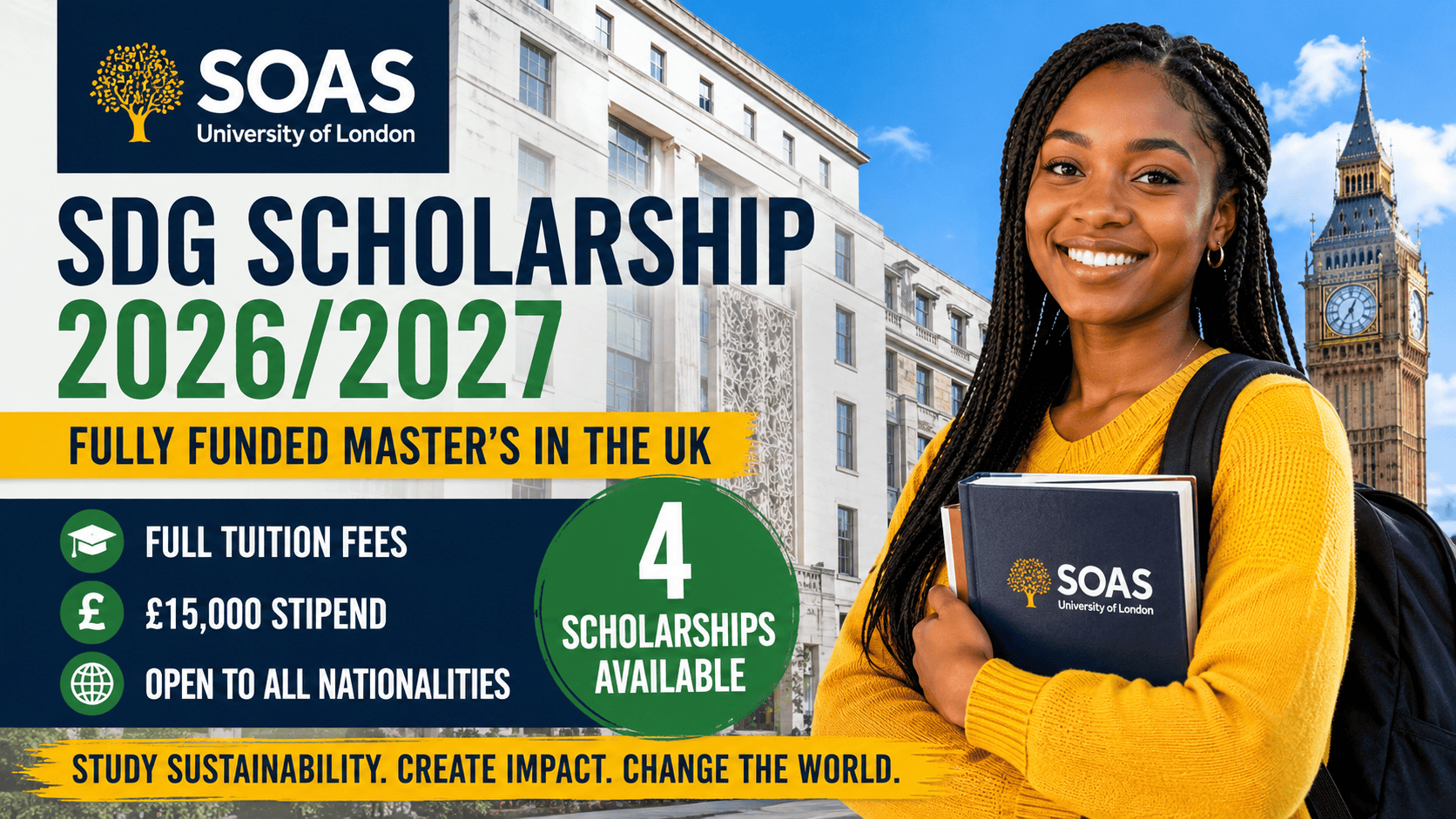
  • SOAS SDG Scholarship 2026/2027: Full Tuition + £15,000 Funding for Master’s Students Who Want to Make Real Change

    SOAS SDG Scholarship 2026/2027: Full Tuition + £15,000 Funding for Master’s Students Who Want to Make Real Change

    Last updated: August 3, 2026

    A few years ago, Aisha from Kano emailed me after midnight.

    She had found a scholarship in the UK and almost skipped it because she assumed it was “for people with connections.”

    That line stayed with me.

    Because I hear it all the time.

    Not qualified enough.

    Not rich enough.

    Not connected enough.

    Meanwhile, somebody else with the same CGPA, same dream, and same fear applies anyway and gets in.

    That’s why I always say this: don’t reject yourself before the school does.

    The SOAS University of London Sustainable Development Goal Scholarship is one of those opportunities worth paying attention to, especially if your work or academic interests sit around climate, development, education, policy, inequality, or social impact.

    And yes, it is fully funded.

    Full tuition.

    Plus at least £15,000 for living costs.

    For many students, that can be the difference between “I wish I could” and “I’m going.”

    Why this scholarship stands out

    There are many master’s scholarships in the UK.

    Some cover only part of tuition.

    Some cover tuition but leave you struggling with rent in London.

    This one does more.

    For the 2026/2027 academic year, SOAS is offering four scholarships tied to the United Nations Sustainable Development Goals.

    That means they’re looking for students whose studies connect to real-world challenges.

    Things like:

    • climate action
    • quality education
    • public health
    • human rights
    • gender equality
    • development studies
    • clean energy
    • inequality
    • governance
    • sustainable cities

    If your long-term goal is to solve a real problem in your community or beyond, this scholarship is built around that.

    And SOAS already has a strong reputation for global development, Africa-focused research, politics, and international studies, so the fit makes sense.

    What the scholarship covers

    If selected, you’ll receive:

    • Full tuition fee coverage
    • Minimum maintenance stipend of £15,000
    • Opportunity to study in London for your master’s degree
    • Access to SOAS academic and professional networks
    • Exposure to students and researchers from across the world

    One thing to note:

    Pre-sessional courses are not included.

    So if your admission requires extra English or pre-master’s preparation before the main programme begins, verify directly with SOAS whether you’ll need separate funding for that.

    Who can apply

    This is where many people overcomplicate things.

    Here’s the practical version.

    You can apply if you:

    • are applying as a new student for 2026/27 entry
    • have applied for an eligible full-time one-year taught master’s programme at SOAS
    • hold, or expect to graduate with, a strong academic record
    • can show genuine interest in sustainability or global development
    • can demonstrate leadership or evidence of impact

    SOAS notes preference for applicants with first-class honours or equivalent.

    If you have a 2:1 equivalent, it may still be worth applying.

    I would not rule yourself out too quickly.

    If your academic record is solid and your work tells a convincing story, submit it.

    Let them decide.

    The part most students miss

    The scholarship application is not the first step.

    Your course application comes first.

    That matters.

    You must first apply for an eligible master’s programme at SOAS.

    Only after that can you access the scholarship application through the admissions portal.

    That means waiting until the deadline week to begin is risky.

    Admissions review takes time.

    And once deadlines close, that’s usually it.

    What they are likely looking for beyond grades

    This is where many applications rise or fall.

    Good grades matter.

    But grades alone rarely carry a scholarship like this.

    The people reading your application want to see whether your work connects to the bigger mission.

    Ask yourself:

    What problem do I care about deeply?

    Why does it matter to me personally?

    What have I already done about it?

    What will this degree help me solve after graduation?

    If your answer is “I just want to study abroad,” that won’t be enough.

    If your answer is:

    “I grew up in a flood-prone community in Bayelsa and want to work on climate adaptation policy in West Africa.”

    That’s stronger.

    If it’s:

    “I volunteered teaching girls in rural schools and want to improve access to education policy.”

    Also strong.

    Specific wins.

    Always.

    What Nobody Tells You

    Here’s the uncomfortable truth.

    A lot of students write scholarship personal statements like job applications.

    Too formal.

    Too stiff.

    Too generic.

    Too many lines like:

    “I am passionate about sustainable development and wish to contribute positively to society.”

    That sentence says almost nothing.

    Anyone can write it.

    Instead:

    Tell the real story.

    Tell them what happened.

    Tell them what you saw.

    Tell them what frustrated you.

    Tell them what pushed you toward this work.

    The panel already knows what sustainable development is.

    They want to know why you care.

    That difference matters.

    Another thing nobody says loudly enough:

    Don’t copy motivation letters from the internet.

    I’ve reviewed too many where the first paragraph sounds like it came from the same PDF.

    It’s easy to spot.

    And scholarship panels read hundreds.

    Your real voice is safer than borrowed perfection.

    Important dates for SOAS SDG Scholarship 2026/2027

    Here are the dates that matter most:

    Scholarship portal opens: 14 May 2026

    Deadline: 12 June 2026 at 12 noon (UK time)

    Expected notification period:

    From July 2026 onward

    If shortlisted, successful candidates are expected to hear first.

    Still, timelines can shift.

    Always verify updates on the official portal before proceeding.

    What to do now

    If this scholarship fits your goals, here’s exactly what I’d do next.

    1. Check your programme eligibility

    Visit the SOAS scholarship page and confirm your intended master’s programme aligns with sustainable development goals.

    Don’t assume.

    Check.

    2. Submit your course application immediately

    Do not wait for the scholarship deadline to do this.

    Course admission comes first.

    Without it, you may not access the scholarship application.

    3. Gather your documents early

    Start preparing:

    • degree certificate or transcript
    • academic references
    • CV if requested
    • personal statement
    • passport details
    • proof of expected graduation if still in school

    4. Write your statement like a human being

    Avoid templates.

    Avoid buzzwords.

    Be specific.

    Use examples.

    Connect your past work to your future plans.

    5. Keep checking your email

    Admissions updates often come by email.

    Check spam too.

    I’ve seen students miss deadlines because a university email landed in Promotions.

    Final thoughts

    If you’ve been looking for a fully funded master’s scholarship in the UK and your work connects to sustainability, policy, education, climate, development, or justice, this is worth serious attention.

    Only four awards are available.

    That makes it competitive.

    But competitive does not mean impossible.

    Somebody gets selected.

    Every year.

    No one starts as “the perfect candidate.”

    They just apply with a strong case.

    And sometimes that’s enough.

    If this sounds like your path, don’t spend two weeks overthinking it.

    Start the application.

    Then improve it as you go.

    That’s usually better than waiting for perfect.

  • NNPC-SNEPCo Postgraduate Scholarship 2026: A Real Opportunity for Nigerian Graduates Who Want a UK Master’s Without Paying the Bill

    NNPC-SNEPCo Postgraduate Scholarship 2026: A Real Opportunity for Nigerian Graduates Who Want a UK Master’s Without Paying the Bill

    Last updated: July 23, 2026

    A few years ago, a friend in Zaria Abdullahi Ahmad sold his laptop to pay an application fee for a UK master’s.

    He already had the admission.

    What he didn’t have was tuition.

    That part was over ₦20 million once everything was added. Fees, visa, accommodation, flight, feeding.

    He deferred the admission.

    Then deferred it again.

    Eventually he gave up.

    That story is common in Nigeria.

    Getting admission abroad is hard. Paying for it is harder.

    Which is why the NNPC-SNEPCo Postgraduate Scholarship 2026 deserves attention right now.

    Not because it promises miracles.

    Because it removes the biggest barrier for many qualified Nigerians: money.

    And if you’re planning a master’s in the UK, especially in energy, engineering, AI, geoscience or related fields, this is one of the strongest funding options currently open.

    Why this scholarship matters more than people think

    Most scholarship posts online stop at “apply here.”

    That doesn’t help much.

    What matters is whether this one is realistic for you.

    And whether you should start now or ignore it.

    The NNPC-SNEPCo postgraduate scholarship is funded by Shell Nigeria Exploration and Production Company Limited under its partnership with the Nigerian National Petroleum Company Limited.

    For the 2026 cycle, selected Nigerians will study in the UK for a one-year MSc.

    Not partially funded.

    Fully funded.

    That includes:

    • full tuition fees
    • one economy return flight from Nigeria to the UK
    • contribution toward living expenses
    • medical insurance aligned with UK student visa requirements

    For anyone who has checked UK postgraduate costs recently, you already know what that means.

    This can easily save you tens of millions of naira.

    The courses are not random, and that matters

    One thing I like about this scholarship is that the eligible courses are clear.

    They’re tied to real sectors.

    Shell isn’t funding random programmes. They’re targeting areas connected to oil and gas, engineering, technology, and future energy systems.

    The scholarship is linked to two UK universities:

    University of Aberdeen

    Eligible courses include:

    • MSc Geophysics
    • MSc Safety & Reliability Engineering for Oil & Gas
    • MSc Advanced Chemical Engineering
    • MSc Integrated Petroleum Geoscience

    Newcastle University

    Eligible courses include:

    • MSc Data Science and AI
    • MSc Data Science
    • MSc Engineering Management
    • MSc Sustainable Chemical Engineering
    • MSc Artificial Intelligence
    • MSc Robotics and AI
    • MSc Marine and Ocean Engineering

    That course list tells you a lot.

    This isn’t just for petroleum engineering graduates.

    Computer science graduates can fit.

    Engineering graduates can fit.

    Chemical engineering graduates can fit.

    Geoscience graduates can fit.

    Even AI and robotics applicants can fit.

    The part many applicants get wrong before they even begin

    Here’s the catch.

    You do not start with the scholarship form.

    You start with university admission.

    That trips up many people every year.

    You first apply directly to either:

    • University of Aberdeen
    • Newcastle University

    For one of the approved courses.

    Then wait for a formal offer.

    Only after that does the scholarship application become available through the university.

    No admission offer, no scholarship application.

    Simple.

    But many people wait until scholarship deadline season before checking.

    By then it’s already late.

    Who can actually apply?

    Here’s the practical version.

    You’re likely eligible if:

    • you’re Nigerian
    • you currently live in Nigeria
    • you’ll be between ages 21 and 28 by 30 September 2026
    • you’ve completed NYSC by September 2026
    • you have a strong academic background, roughly equivalent to UK upper second class
    • you can meet English language requirements
    • you haven’t previously studied in the UK or another developed country
    • your international passport remains valid through at least December 2026

    The English requirement listed publicly includes at least IELTS 6.5, though always confirm directly with the university before booking any exam.

    And yes, verify everything on the official portal before proceeding. Universities update requirements quietly sometimes.

    What Nobody Tells You

    Let me say the uncomfortable part.

    This scholarship is competitive.

    Very competitive.

    Thousands will hear “fully funded UK scholarship” and rush in.

    Many will not get past admission.

    Some will get admission but miss scholarship deadlines.

    Some will qualify academically but write weak personal statements.

    Some will ignore details like passport validity.

    Some will leave IELTS too late.

    And some will submit everything correctly and still not get selected.

    That’s the reality.

    So if you’re applying, don’t treat it like a lottery ticket.

    Treat it like a serious project.

    Start early.

    Give it attention.

    Because scholarships like this are often won months before people think they begin.

    Also, another thing many people misunderstand:

    This scholarship does not guarantee a job with Shell after graduation.

    Shell says this clearly.

    There’s no employment bond.

    No automatic recruitment.

    No promise of placement.

    That shouldn’t discourage you.

    It just means apply for the degree, not for imagined employment.

    If I were applying for this myself, here’s exactly what I’d do

    If I were a fresh applicant today, this is the route I’d follow.

    1. Pick your course immediately

    Don’t start with “I’ll see later.”

    Choose one course.

    Read every admission page.

    Check:

    • entry requirements
    • transcript requirements
    • references
    • IELTS score
    • deadlines

    2. Prepare your admission documents

    Usually that means:

    • degree certificate or statement of result
    • academic transcript
    • CV
    • statement of purpose
    • reference letters
    • international passport
    • English language proof

    Get these ready early.

    Transcript delays alone can destroy timelines.

    I’ve seen it happen too many times.

    3. Submit your university application first

    This is the key move.

    Without the offer letter, you’re stuck.

    Prioritise admission.

    4. Watch your email closely

    Scholarship instructions typically follow through the university once admission is offered.

    Check spam folder too.

    Many people miss important messages there.

    5. Prepare for possible interview

    Shortlisted applicants may be interviewed before final selection.

    If that happens, be ready to answer:

    • why this course
    • why this university
    • how it connects to Nigeria
    • your career goals
    • how you’ll use the degree after graduation

    Keep answers practical.

    No motivational speech.

    No “I want to change the world.”

    Be specific.

    Small mistakes that can quietly ruin your chances

    These ones hurt because they’re avoidable.

    I’d watch out for:

    • expired passport
    • weak statement of purpose
    • waiting too long for IELTS
    • applying to the wrong course
    • missing university deadlines
    • incomplete transcripts
    • using generic scholarship essays copied online
    • not reading email updates after applying

    The strongest applicants usually aren’t lucky.

    They’re prepared.

    What to do now

    If the NNPC-SNEPCo postgraduate scholarship is on your radar, here’s your move.

    1. Visit the official scholarship page

    Read the requirements yourself.

    Don’t rely on blogs alone. Including mine.

    Always cross-check.

    2. Pick between Aberdeen and Newcastle

    Look at modules.

    Not just school rankings.

    Choose based on where your background fits.

    3. Start your university application this week

    Not next month.

    This week.

    4. Sort out your passport and transcript

    These two create unnecessary panic later.

    5. Prepare for IELTS if required

    Check whether your programme allows waiver or requires test evidence.

    Verify directly with the university.

    6. Track the deadline carefully

    For this cycle, completed scholarship applications are expected to reach participating universities by 8 June 2026.

    Again, confirm directly on the official portal in case anything changes.

    One last thing

    I know how easy it is to talk yourself out of scholarships.

    Maybe your CGPA isn’t “perfect.”

    Maybe you think students from Lagos have better chances.

    Maybe you’re from Kano, Minna, Uyo, Bauchi, Gombe, Kaduna, Ibadan, Makurdi, and wondering whether people like you actually get picked.

    They do.

    But only if they apply.

    Not everybody gets funded.

    That part is true.

    But nobody gets funded by watching deadline countdown posts on X.

    If this fits your profile, give it a proper shot.

    Then let the selection panel decide.

    That’s better than wondering about it next year.

  • UCL Is Offering a £20,500 Scholarship in 2026 — But Most Applicants Will Misunderstand What They Really Want

    UCL Is Offering a £20,500 Scholarship in 2026 — But Most Applicants Will Misunderstand What They Really Want

    Last updated: July 23, 2026

    In 2021, a student from Kano messaged me after losing two scholarship opportunities. Her grades were strong, her CV was neat, and her references were solid. But she kept failing one invisible test: telling her story in a way selectors could trust.

    That is exactly why many people will miss this UCL scholarship.

    They will focus on GPA, certificates, and grammar. But this scholarship is asking a deeper question: Has your life experience given you a reason to improve public health?

    Why This Scholarship Feels Different

    Many scholarships reward academic excellence alone. This one is tied to purpose.

    University College London’s IMPACT Scholarship supports applicants applying for the online Master of Public Health (MPH) who have experienced inequality and want to use that experience to create better health outcomes.

    That means your background matters here — not as pity, but as perspective.

    If you grew up in a community with poor healthcare access, watched relatives struggle with maternal care, dealt with disability barriers, poverty, exclusion, or caregiving pressure, that lived reality can become part of your strength.

    What UCL Is Actually Looking For

    Let me be blunt: they are not asking for a sad story.

    They want evidence that your experience shaped your thinking and direction.

    You need to explain three things clearly:

    First, how inequality affected your life or worldview.

    Second, why studying public health now makes sense for your journey.

    Third, how you will use the degree to improve communities, systems, or policy later.

    That last part is where many applicants fail. They talk only about escaping hardship, not solving problems.

    Who Can Apply in 2026

    To be considered, you need to meet admission requirements for the UCL online MPH and submit an application for the 2026/27 intake.

    The scholarship is connected to that programme. No MPH application, no scholarship consideration.

    It is open internationally, so Nigerian, Ghanaian, Kenyan, South African and other African applicants can apply if eligible.

    Always verify programme entry requirements directly on the official UCL portal before submitting.

    What the Official Website Will Never Tell You

    Two scholarships.

    That means competition will be serious.

    So please don’t apply casually with generic essays copied from the internet. This is where honesty beats polish.

    A simple, truthful story told with clarity often outperforms a fake “perfect” essay.

    If English is not your strongest area, that is okay. Clear thinking matters more than decorative grammar.

    What To Do Now (Smart Application Plan)

    1. Check the UCL MPH page and confirm you meet admission requirements.
    2. Apply for the MPH programme first for the 2026/27 session.
    3. Write your personal story carefully — focus on lived experience, growth, and purpose.
    4. Show future impact by naming the health issue you want to tackle.
    5. Edit everything twice for clarity and honesty.
    6. Submit before 30 June 2026, 11:59pm BST. Do not wait for final day.

    My Honest Advice to African Applicants

    Too many students think elite UK schools only choose polished, privileged candidates.

    Not always.

    Sometimes they are searching for people who understand real problems because they lived them.

    That can be you.

    Your struggle is not automatically a scholarship ticket. But if it built insight, discipline, and mission, it can become part of a powerful application.

    Apply seriously. Apply early. Apply with truth.

    And if fear is stopping you, remember this: many opportunities are lost before rejection ever happens.

  • University of Melbourne Human Rights Scholarship 2026: The Funding Is Huge, but Your Research Proposal Matters More

    University of Melbourne Human Rights Scholarship 2026: The Funding Is Huge, but Your Research Proposal Matters More

    Last updated: July 23, 2026

    A few years ago, I spoke with a Nigerian student Amina, who had the grades, the passion, and even a supervisor willing to support her application.

    She still got rejected.

    Not because she wasn’t smart.

    Not because she lacked experience.

    Her proposal simply didn’t answer one brutal question clearly enough:

    “Why does this research need to happen?”

    That part gets people.

    And if you’re looking at the University of Melbourne Human Rights Scholarship for 2026, that question will probably decide whether your application moves forward or quietly disappears in the pile.

    This scholarship is generous. Very generous.

    But money is not really what they’re looking for.

    They’re looking for someone whose research can add something meaningful to the human rights conversation.

    That changes how you apply.

    This scholarship is bigger than tuition funding

    A lot of scholarships cover fees.

    Some cover fees and maybe a stipend.

    This one goes much further.

    The University of Melbourne Human Rights Scholarship supports graduate research students whose work focuses directly on human rights.

    For selected students, support can include:

    • Annual living allowance: AUD $44,500 per year (2026 rate)
    • Full tuition fee support
    • Relocation support
    • Overseas Student Health Cover (for eligible international students)

    Depending on your degree and how long your programme runs, the total package can reach well over AUD $100,000.

    For many students coming from Nigeria, Ghana, Kenya, South Africa, or elsewhere across Africa, that’s the difference between “I wish I could do this” and actually boarding the flight.

    Who this scholarship is really built for

    This is not a general postgraduate scholarship.

    That part matters.

    It’s specifically for students beginning a graduate research degree whose work connects directly to human rights.

    That usually means:

    • Master by Research
    • PhD or doctoral research

    And your research must clearly fit within human rights.

    Broadly, that could include work around:

    • refugee rights
    • migration
    • gender equality
    • children’s rights
    • social justice
    • disability rights
    • environmental justice
    • legal reform
    • policy development
    • indigenous rights
    • inclusion and equity

    But simply mentioning one of those topics is not enough.

    The university will want to see that human rights is the core of your research, not just something attached to the side of it.

    That distinction matters more than many people realise.

    The part many applicants underestimate

    Most students spend too much time worrying about grades.

    Yes, academic merit matters.

    But your proposal can carry more weight than your CGPA if the research is sharp, focused, and useful.

    I’ve seen students with strong academics submit vague proposals like:

    “I want to research women’s rights in Africa.”

    Too broad.

    Too soft.

    Too difficult to assess.

    A stronger version looks more like:

    “Examining barriers to legal protection for internally displaced women in North-East Nigeria and how existing policy frameworks can be improved.”

    That gives reviewers something concrete.

    They can immediately understand:

    • what the research is
    • where it focuses
    • why it matters
    • what contribution it might make

    That clarity gives you an edge.

    You’ll need more than academic interest

    This is where many applicants miss it.

    The scholarship doesn’t only look at your research idea.

    They also want evidence that your commitment to human rights exists outside the classroom.

    That can come from many places.

    Maybe:

    • volunteering with an NGO
    • legal aid work
    • youth advocacy
    • refugee support work
    • policy internships
    • community organising
    • gender-based violence awareness campaigns
    • disability inclusion work
    • public interest journalism

    Even small involvement counts if it’s real.

    You do not need to have founded an international organisation.

    You do not need a TED Talk.

    You just need proof that this work matters to you beyond university admission.

    For example:

    Did you volunteer with an IDP education programme in Borno?

    Did you write consistently about girls’ education access?

    Did you support legal awareness in your community?

    Did you work on child protection through an NGO?

    That matters.

    Include it.

    What nobody tells you

    Your research proposal is doing two jobs at once

    This part catches people off guard.

    Your proposal isn’t just academic.

    It’s also persuasive.

    It must prove:

    • you can do research
    • your topic matters now
    • your work can contribute something useful to human rights knowledge

    That means your proposal should not read like a class assignment.

    It should read like work that deserves funding.

    That difference is subtle.

    But reviewers feel it immediately.

    Also, many students think passion can replace precision.

    It cannot.

    You can care deeply about human rights and still submit a weak application if your proposal is unclear.

    And the opposite is also true.

    A focused, practical proposal with a clear methodology often performs better than emotional writing without structure.

    Before you apply, check these eligibility details carefully

    Before putting weeks into your application, confirm the basics.

    Generally, applicants must:

    • receive or be working toward an offer for an eligible graduate research degree at the University of Melbourne
    • be starting in the scholarship award year
    • conduct research in a human rights-related field
    • meet programme admission requirements

    There’s another important detail many people miss.

    Applicants typically should not already hold a research qualification at the same or higher level than the one they’re applying for.

    Always verify this directly on the official University of Melbourne scholarship page before proceeding, because policies can change.

    What to prepare early

    If you wait until the portal deadline week, it becomes stressful fast.

    Start gathering these now:

    • academic transcripts
    • degree certificates
    • CV
    • research proposal
    • statement of purpose
    • evidence of volunteer or human rights-related work
    • references or recommendation letters
    • proof of admission or offer status

    The hardest part is usually not documents.

    It’s writing.

    Especially the proposal.

    Give yourself time for drafts.

    Then step away from it.

    Then return and cut what feels vague.

    What to do now

    If this scholarship is on your list, here’s how I’d approach it.

    1. Confirm your research idea fits human rights clearly

    Be brutally honest.

    Can someone read your title and instantly connect it to human rights?

    If not, refine it.

    2. Check the University of Melbourne graduate research admission page

    Confirm your degree pathway first.

    No point preparing scholarship documents before knowing your admission route.

    3. Build a strong proposal before touching the scholarship application

    Do not rush this part.

    Your proposal is your application’s backbone.

    4. Gather proof of your work outside school

    Certificates help.

    Letters help.

    Volunteer records help.

    Even links to published work can help.

    5. Verify deadlines directly on the official portal

    Scholarship dates can move.

    Always double-check on the university website before submitting anything.

    Final thoughts

    I like this scholarship because it rewards more than grades.

    It rewards substance.

    It rewards people trying to do work that actually improves lives.

    And for African students especially, there’s room here if your research is thoughtful and your application is prepared properly.

    Don’t try to impress reviewers with complicated language.

    That usually backfires.

    Say what your research is.

    Say why it matters.

    Show that you’ve already cared about this work before the scholarship existed.

    That combination is powerful.

    And sometimes, that’s enough to get funded.