Category: Government Jobs

Explore federal and state government job recruitment opportunities and application guides.

  • State Government Jobs in Nigeria 2026: Where to Find Them and How to Apply

    State Government Jobs in Nigeria 2026: Where to Find Them and How to Apply

    Last updated: August 6, 2026

    I was sitting in a cybercafe in Kaduna in 2018, refreshing the Jobberman page every twenty minutes like that was going to change anything. I had applied to twelve federal government positions that year. Nothing. Not even a shortlisting email. My NYSC certificate was fresh. My CV was three pages long and completely useless. A friend of mine, Abdullahi, had gone a different route. He applied to the Kaduna State Civil Service Commission, got called for a screening three months later, and by the time I was still refreshing Jobberman, he was already earning a monthly salary and planning his wedding.

    I never forgot that.

    Most Nigerian graduates spend their entire job search chasing federal government positions while completely ignoring state government jobs that are often easier to access, faster to process, and sometimes better-paying when you factor in cost of living. This post is for the person who is ready to stop making that mistake.

    Why State Government Jobs Deserve More of Your Attention

    The Nigerian federal government employs a lot of people, yes. But there are 36 states plus the FCT, and every single one of them runs a civil service with dozens of ministries, agencies, and parastatals. That is 36 separate employment ecosystems most graduates never properly tap into.

    State governments hire across education, health, agriculture, finance, local government administration, information technology, rural development, and more. Some states like Lagos, Rivers, and Kano run civil services that rival federal agencies in size and salary. Lagos State, for example, operates one of the most organized state civil services in the country, with a dedicated recruitment portal and transparent examination processes through the Lagos State Civil Service Commission.

    Beyond the mainstream ministries, states also employ through their own teaching hospitals, state universities, polytechnics, colleges of education, and state-owned corporations. The Oyo State Government, for instance, regularly advertises through the Oyo State Teaching Service Commission (TESCOM) for teachers across secondary schools. Anambra, Enugu, and Imo states have done the same in recent years. These are jobs that genuinely need people.

    The Real Portals to Bookmark Right Now

    This is where most blog posts fail you. They say “visit the official portal” and leave you to figure out what that means. I’ll be specific.

    For Lagos State, the Civil Service Commission publishes vacancies at lagosstate.gov.ng and sometimes through lssc.gov.ng. For Rivers State, check the Rivers State Government official website and their Civil Service Commission. Kano State vacancies are typically published via kanostate.gov.ng. Kaduna State has been fairly active in recent years with postings on kadstate.gov.ng.

    For FCT-related state-level jobs, check careers.fct.gov.ng. Ogun State uses ogunstate.gov.ng. Cross River State, which has a reputation for paying salaries consistently, posts openings via crossriverstate.gov.ng.

    The honest truth is that not every state has a reliable digital recruitment system. Some states still advertise primarily through newspapers, radio, and official government gazettes. If you are targeting a state like Zamfara, Yobe, or Borno, you may need to physically visit the State Civil Service Commission or check their State Gazette, which is a government publication most people do not know about. Your state’s Ministry of Establishments and Training is also a key place to visit or monitor, because they usually manage the bulk of civil service recruitment at the state level.

    You should also watch the Federal Civil Service Commission website closely, because while it deals with federal jobs, it often lists positions that are jointly administered with state structures. Speaking of federal salary structures, if you want to understand how government pay is organized across both levels, I wrote a detailed breakdown of the CONPASS and CONTISS salary structures that will help you know what you are getting into before you even apply. State governments often adapt these same scales, so knowing the structure gives you real negotiating awareness.

    What the Actual Application Process Looks Like

    This varies by state, but there is a general pattern you can prepare for.

    Most state civil service recruitments start with a public advertisement, either online, in newspapers like Vanguard, Punch, or Thisday, or through official radio. Once an advert goes live, there is usually a window of two to six weeks for applications. You fill out an online form or a downloadable PDF form (some states are still using PDFs in 2026, which tells you everything), attach your credentials, and submit.

    After submission, shortlisted candidates are called for a screening exercise. This typically involves document verification, sometimes a written aptitude test, and occasionally an oral interview. States like Lagos run structured computer-based tests through their commission before the interview stage. Others are far less formal.

    One thing I have seen catch people off guard: many states require that you are an indigene or resident of that state to apply. This is not always enforced, but it is written into the requirements. If you are from Plateau State but living in Abuja, check whether the state you are applying to requires proof of state of origin. Some ask for a letter of indigeneship from your local government chairman. Get that document before you need it, because processing it takes time you might not have.

    What Nobody Tells You About State Government Jobs

    Here it is. The thing most blogs skip.

    State government jobs are not equally stable across the board. Before you commit to any application, spend thirty minutes researching that state’s salary payment record. Some states owe workers months of back salaries. As of recent reports, states like Ondo, Ekiti, and several others have had periods of salary arrears that lasted for months. I am not saying avoid those states permanently, but you should know what you are walking into. Talk to people who already work in that civil service. Check news archives. A quick Google search of “[State name] civil service salary arrears 2024 2025” will tell you a lot.

    The second thing nobody says openly is that connection still plays a role in state civil service recruitment more than it does at the federal level. Federal recruitment, especially through the Federal Civil Service Commission, has become more standardized with computer-based tests and centralized processes. State recruitment can be more… personal. This does not mean you should not apply. It means you should apply properly, have all your documents correct, perform well on any test, and also be ready to follow up through official channels. The candidate who shows up to the screening confused and unprepared loses, even if they had the right contacts.

    A Step-by-Step Plan to Apply for State Government Jobs in 2026

    First, decide which two or three states you want to target. Prioritize your home state, a neighboring state, and one major economic state like Lagos, Rivers, or Abuja FCT if you are mobile.

    Second, bookmark the official websites of those states’ civil service commissions and check them at least twice a week. Set a Google Alert for terms like “Kano State Government recruitment 2026” or “Lagos Civil Service Commission vacancy.”

    Third, prepare a state-specific application folder. This means having your O’Level results, NYSC discharge certificate, degree certificate, birth certificate, letter of indigeneship, and recent passport photographs all scanned and ready in both JPEG and PDF formats at under 200KB each. Many portals have file size limits that will reject your application silently.

    Fourth, follow reputable job aggregator sites like MyJobMag, NGCareers, and Jobberman, but also follow Nigeria-specific government job accounts on X (formerly Twitter) and Facebook groups dedicated to government recruitment. These communities often share vacancy announcements within hours of publication.

    Fifth, when you find a vacancy, read the requirements completely before filling the form. Do not waste your time applying for a role that requires five years of post-NYSC experience when you are a fresh graduate. Many people apply out of desperation and then wonder why they never hear back.

    Finally, after submission, keep your phone active and check your email including your spam folder. State government shortlisting notifications often end up in spam because they come from unfamiliar government email addresses.

    You Are Closer Than You Think

    I know how frustrating this search feels. I know what it is like to send applications into what feels like a black hole. But state government jobs in Nigeria are real, they are available in 2026, and they are going to thousands of people who simply stayed consistent and knew where to look.

    The person reading this post right now is already ahead, because most people are still chasing only federal jobs while ignoring 36 other doors. Pick your states, bookmark those portals, get your documents ready, and apply before the deadline closes. That is the whole strategy. It is not complicated. It just requires you to start.

    If you found this useful, share it with someone who is currently in their job search. And if you have a question about a specific state’s process, drop it in the comments. I read every single one.


  • Civil Service Exam in Nigeria: How to Prepare and Pass the Federal Civil Service Aptitude Test

    Civil Service Exam in Nigeria: How to Prepare and Pass the Federal Civil Service Aptitude Test

    Last updated: August 6, 2026

    My neighbour’s son, Bashir, graduated with a Second Class Upper from University of Abuja in 2021. Economics. CGPA of 4.1. The kind of result that makes parents brag at Friday prayers.

    He applied to the Federal Civil Service Commission that same year. Got shortlisted. Sat the aptitude test. Failed.

    Not because he was not smart. He was very smart. He failed because he walked into that exam hall thinking it would be like his university exams. He thought reading his course materials would be enough. It was not.

    He came to me months later, frustrated and embarrassed, asking what he did wrong. When I looked at the topics he had prepared, I understood immediately. He had prepared for the wrong thing entirely.

    That experience is why I am writing this post today.

    What the Federal Civil Service Aptitude Test Actually Is

    A lot of people hear “civil service exam” and assume it is just a formality, or that connection (what we call “man-know-man”) is the only thing that matters. That belief has destroyed more opportunities than I can count.

    The Federal Civil Service Commission (FCSC) conducts a Computer-Based Test (CBT) as part of its recruitment process. This is the gateway. Before they look at your certificate, before any interview, you must pass this test. And unlike JAMB, where you can retake the following year with minor adjustments to your strategy, a failed civil service aptitude test can set you back by years depending on when the next recruitment window opens.

    The test is not subject-specific. It does not ask you what you studied in school. Whether you read Law, Nursing, or Agricultural Science, you will be tested on the same general competency areas. That is the part Bashir did not know.

    The Core Areas the Test Covers

    Based on what past candidates have reported and what the FCSC has historically examined, the test typically covers five broad areas.

    The first is Verbal Reasoning. This goes beyond just knowing English grammar. It tests your ability to read a passage and draw accurate conclusions from it, identify logical relationships between words, and understand the meaning of words in context. Many candidates who speak excellent English still fail this section because it requires a specific type of analytical reading they are not used to.

    The second is Quantitative Reasoning. Do not confuse this with university-level mathematics. The questions are closer to secondary school Mathematics, but the real trap is speed. You are expected to solve problems quickly and accurately under time pressure. Basic arithmetic, fractions, percentages, ratios, simple algebra and data interpretation from charts and tables are the common formats.

    The third is General Knowledge and Current Affairs. This is where your awareness of Nigeria and the world around you either saves you or kills you. Questions here range from Nigerian history (names of past heads of state, dates of major events, constitutional milestones) to how government institutions work, geography, and what has been happening in the news in recent months.

    The fourth area is Abstract Reasoning or Logical Thinking. This involves identifying patterns in sequences of shapes or numbers, and figuring out the rule that connects them. It looks strange if you have never practiced it, but once you understand the logic behind it, it becomes one of the most predictable sections.

    The fifth is sometimes Civil Service Rules and Basic Public Administration Knowledge. Not every recruitment includes this, but when it does, questions come from the Public Service Rules and areas like the structure of the three tiers of government.

    How to Actually Prepare (Not the Generic Advice You Have Heard Before)

    I have helped over a dozen people prepare for various Nigerian government aptitude tests, and the biggest mistake I see is people buying one textbook and reading through it like a novel.

    That does not work here.

    Start with a proper diagnostic. Sit down and attempt 40 questions across all five areas without any preparation. Not to pass, but to know where your weak points are. If you scored 3 out of 10 in Abstract Reasoning, that is where you need the most time, not in an area where you are already comfortable.

    After your diagnosis, get a dedicated aptitude test workbook. Books like Quantitative and Verbal Aptitude by JAMB Study guides publishers, or specifically compiled Civil Service past question booklets, are sold at bookstores like Quintessence in Lagos or major shops in Abuja around Area 10. Some reliable vendors also sell them as PDFs. The key is to get materials that contain ACTUAL past questions, not invented ones.

    For current affairs, follow credible Nigerian news sources consistently in the weeks before your test. Channels Television, TheCable, and Punch are reliable. Make a habit of noting names, figures, dates, and decisions from government news because examiners favor information that is verifiable and policy-related.

    For verbal reasoning, practice reading comprehension daily. Read a short newspaper editorial, then ask yourself: what is the main point? What does the author imply but not state directly? What conclusion can you draw? This trains the kind of critical reading the test demands.

    For quantitative reasoning, do not just solve questions. Time yourself. The real skill being tested is accuracy under pressure. Set a timer for 20 minutes and solve 15 questions. Review what you got wrong and understand WHY, not just what the correct answer was.

    Also practice on free CBT platforms online. Myschool.ng and Prepclass.com.ng have free practice questions across categories, and they simulate the computer-based interface, which matters more than people think. Some candidates have lost precious time on exam day because they were not comfortable with the CBT navigation interface.

    The Honest Truth: What Nobody Tells You About This Test

    The civil service aptitude test is not the hardest exam you will ever write. But it is the most misunderstood.

    The exam is designed to be completed within a specific time window, typically 60 to 90 minutes for 80 to 100 questions. That means you have less than one minute per question on average. People who walk in unprepared for the time pressure end up spending four minutes on one quantitative question and then rushing through the last 30 questions in blind panic.

    Here is something else most blogs will not tell you: your score matters even after you pass the cutoff. The FCSC is not just looking for people who pass. They are ranking candidates. If you score 60 and the cutoff is 50, you are in competition with everyone who scored between 60 and 100. The higher your score, the better your chance of being called for the next stage, especially when slots for a particular department fill up. Treat this like a competition, not a pass/fail checkbox.

    Another uncomfortable truth: the recruitment portal sometimes lists job openings and closes them within days. Checking the FCSC portal (jobs.fedcivilservice.gov.ng) once a week is not enough. You need to be watching it or following verified social media handles that announce new openings immediately. Many candidates have missed application windows because they saw the vacancy announcement on a blog three weeks after the portal closed.

    The Specific Steps to Prepare in 4 to 6 Weeks

    If you have about a month to prepare before a scheduled test, here is how I would structure it.

    Week one is for diagnosis and material gathering. Take a full mock test, identify your three weakest areas, and get your study materials in order. Do not start studying randomly.

    Week two focuses on your weakest two areas. Spend 45 minutes daily on each one. Use practice questions, not just theory reading. After every practice session, review every single wrong answer.

    Week three shifts toward current affairs and general knowledge. Spend 30 minutes each day reading and summarizing major news. Look up basic Nigerian constitutional history, the structure of federal ministries, names of current ministers and key government officials (verify this on official government websites since these change), and geography.

    Week four is for timed full mock tests. Take at least one complete 80-question timed test every two days. Score yourself. Review. Identify where you are still losing time.

    If you have a fifth and sixth week, use them for consolidation. Revisit the questions you got wrong in your mock tests. Focus on patterns, not just answers.

    One more thing, prepare for the CBT format. Do not assume that because you know the answers you will perform well. Navigating questions on a screen, flagging questions to return to, and submitting before time runs out are skills by themselves. Practice them.

    And on your way to building your full career in public service or anywhere else, do not ignore the skills of selling yourself in the interview stage. I wrote a detailed guide on how to handle that part here: how to answer common job interview questions in Nigeria. Many candidates pass the aptitude test and then crash at the interview because they did not prepare for it. Both stages deserve equal attention.

    The Bigger Picture

    Bashir retook the exam the following cycle. He came to me this time before, not after. We worked through two weeks of structured practice together. He passed.

    He is now a Grade Level 08 officer at one of the federal ministries. He told me the aptitude test questions in his second attempt were not drastically different from what we had practiced. The difference was that he knew what to expect, and he had done the work.

    That is all this comes down to. Not luck. Not connection. Not your CGPA. The aptitude test is a fair gate, and preparation is the key.

    If you are reading this before your exam date, you still have time. Start with the diagnosis. Get the right materials. Practice under time pressure. And take the current affairs seriously because that section is where the gap between candidates who prepared and those who guessed becomes very visible.

    You did not come this far to fail a test that is genuinely passable with the right approach. Go prepare. Properly this time.

  • Federal Government Promotions and Salary Structure in Nigeria: What CONPASS and CONTISS Mean for Your Career

    Federal Government Promotions and Salary Structure in Nigeria: What CONPASS and CONTISS Mean for Your Career

    Last updated: August 6, 2026

    My cousin bro Aminu called me from Abuja, three months after he started work at the Federal Ministry of Agriculture. He was excited, but also confused. His offer letter said “CONPASS 07, Step 1” and he had no idea what that meant for his take-home, his future, or whether he had somehow been shortchanged. He asked me to explain it.

    I could not explain it properly at the time. And that embarrassed me, because I had been writing about government jobs for years.

    That phone call sent me on a deep dive into how the Nigerian federal civil service actually pays its workers. What I found is that most people, including serving civil servants, do not fully understand the system they are working inside. They collect salaries every month without knowing what determines that figure, when it increases, or how to move up faster.

    This post is my attempt to fix that. If you are applying for a federal government job, already working in one, or helping someone navigate an offer letter, read this carefully.

    Why the Salary Structure Matters More Than the Job Title

    The title on your ID card might say “Administrative Officer” or “Education Officer” but what actually determines your pay in the Nigerian federal civil service is something different entirely: your salary scale and grade level.

    The federal government uses what is called a Consolidated Salary Structure. Essentially, it is a framework that groups all federal workers into categories based on their qualifications and roles, and assigns each category a pay scale with steps that increase over time. The two you will encounter most often are CONPASS and CONTISS.

    CONPASS stands for Consolidated Public Service Salary Structure. It covers workers in most mainstream federal ministries and departments. CONTISS, on the other hand, stands for Consolidated Tertiary Institutions Salary Structure, and it applies specifically to staff in federal universities, polytechnics, and colleges of education.

    So if you are employed by the Federal Ministry of Finance, you are likely on CONPASS. If you are employed as a non-teaching staff at the University of Ibadan or Bayero University Kano, you are on CONTISS. The structures are different, but the logic behind them is the same.

    Breaking Down CONPASS: Grades, Steps, and What They Actually Pay

    CONPASS runs from Grade Level 01 at the bottom to Grade Level 17 at the top. Here is how the entry points typically work based on qualification:

    If you enter with the West African Senior School Certificate (WAEC/NECO) and nothing else, you come in around GL 03 or GL 04. If you hold an Ordinary National Diploma (OND), you typically enter at GL 06. A Higher National Diploma (HND) or a Bachelor’s degree brings you in at GL 08 or GL 09. And if you have a postgraduate degree, specifically a Master’s, you may enter at GL 10 or above depending on the role and the ministry.

    Each grade level also has steps, usually Step 1 through Step 15. You start at Step 1 and move up one step every year if your performance appraisal is satisfactory. The increase from one step to the next is small but consistent. Moving from one grade level to the next, which is the bigger jump in pay, requires promotion, which I will explain shortly.

    As of the most recent reviewed figures from the Office of the Head of the Civil Service of the Federation (OHCSF), a GL 08 officer at Step 1 earns a basic salary somewhere around N70,000 to N80,000 per month, though actual take-home is higher when you factor in allowances. A GL 12 officer earns significantly more. These figures change when the government reviews the structure, so always verify current rates on the OHCSF website or through your ministry’s human resources office.

    What CONTISS Looks Like for University Staff

    If you are working or hoping to work in a federal tertiary institution as administrative, library, technical, or academic support staff, CONTISS is your framework. It runs from CONTISS 03 at the bottom to CONTISS 15 at the top.

    The entry points mirror CONPASS in logic: your qualification at entry determines your starting level. An OND holder comes in around CONTISS 06. An HND or B.Sc. holder usually enters at CONTISS 08. A Master’s degree may qualify you for CONTISS 09 or CONTISS 10 depending on the role.

    One thing that catches a lot of university employees off guard is the difference between CONTISS and CONUASS. CONUASS is the Consolidated University Academic Salary Structure, and it applies to lecturers and professors. If you are hired as an Assistant Lecturer at a federal university, you are on CONUASS, not CONTISS. These are different scales entirely. I have seen people mix them up on job applications, and it creates unnecessary confusion during documentation.

    How Promotions Actually Work in the Federal Civil Service

    This is the part that most blogs skip entirely, and it is where people lose years of income without knowing it.

    In the federal civil service, promotion is not automatic just because you have served for a certain number of years. It is based on a combination of things: your annual performance appraisal score (marked by your supervisor), the availability of vacancies in the next grade level, a written promotion examination, and in some ministries, an oral interview.

    The Annual Performance Evaluation Report (APER) is the form your supervising officer fills out every year. If you consistently score “outstanding” or “commendable,” your name goes forward for promotion consideration. If you score below a threshold, you do not move.

    The promotion exam is something many young civil servants do not take seriously. I have heard stories of people who were due for promotion at GL 10 to GL 12 but failed the written exam twice because they did not prepare. Meanwhile, colleagues who sat the exam seriously moved ahead. The exam is set by the Federal Civil Service Commission and covers your area of specialization, public service rules, and general knowledge of government operations.

    Promotion is confirmed by the Federal Civil Service Commission (FCSC), not your minister or director-general. This is important because it means your promotion cannot be arbitrarily blocked at the ministry level if you have met all requirements and passed the exam.

    The Honest Truth About Salary Structure in Nigerian Federal Service

    Most civil servants in Nigeria spend their entire careers on salaries that should be higher, not because the structure does not allow it, but because they do not know how to push the process.

    Here is what nobody tells you. The step increment is supposed to happen every year, but in many ministries it is not processed automatically. You have to follow up with your human resources department to ensure your step increment is reflected in the payroll. I have spoken to people who spent three years on Step 1 simply because they assumed the system would handle it. It did not. They had to go back and request a retrospective correction.

    Also, your entry point matters enormously over a 30-year career. Someone who enters at GL 08 and someone who enters at GL 06 for the same ministry, doing similar work, will retire at different levels if nothing changes. If you have the qualifications to justify a higher entry grade, do not accept a lower one just to get the job quickly. Negotiate your entry grade before signing.

    A Real Example: Tunde’s Career Over 10 Years

    Let me show you how this plays out in practice.

    Tunde graduated with a B.Sc. in Public Administration from Ahmadu Bello University in 2015 and joined the Federal Ministry of Interior in 2016 at GL 08, Step 1. Every year, with a satisfactory appraisal, he moved up one step. By 2019, he was at GL 08, Step 4. He sat the GL 08 to GL 09 promotion exam in 2020 and passed. He moved to GL 09, Step 1. By 2024, after another successful promotion exam, he was at GL 10.

    Each of those moves came with a salary jump, not just in basic pay but in the allowances attached to the grade. His housing allowance, transport allowance, and medical allowance all scaled with his grade level.

    Now compare that to someone who joined the same ministry in 2016 at GL 06 because they came in with an OND and did not bother upgrading their qualification. By 2024, they might be at GL 08 at best, earning roughly what Tunde earned when he first started.

    This is why I always tell young Nigerians: if you are going to work for the federal government, understand the structure before day one. And if you want to understand the kinds of opportunities available beyond the federal level, it helps to also look at state government jobs in Nigeria for 2026, because the salary structures at the state level are different and sometimes move faster for certain roles.

    The Step-by-Step Action Plan

    If you are an applicant or a serving officer trying to make this system work for you, here is what to actually do.

    First, before you accept any offer, confirm your entry grade level in writing. Do not accept verbal assurances. The offer letter must state the grade level and step clearly.

    Second, get a copy of the current CONPASS or CONTISS salary table from the OHCSF website (ohcsf.gov.ng) or request it directly from your ministry’s human resources department. Know what your grade level pays at each step so you can track whether your payslip is accurate.

    Third, take your APER seriously. Every year, before the review period closes, review your own performance, document your achievements, and have a direct conversation with your supervisor about your score. Passive employees get average scores. Intentional ones get better ones.

    Fourth, start preparing for your promotion exam at least six months before you become eligible. Ask senior colleagues who have sat the exam what areas it covers. The Federal Civil Service Commission has a syllabus, and some past questions circulate through ministries. Use them.

    Fifth, follow up on your step increment every January. Go to HR and confirm your step has been updated in the integrated payroll system (IPPIS). If it has not, raise it formally in writing, and keep a copy.

    This Is Your Career, Not a Lottery

    The Nigerian federal civil service gets a lot of criticism, some of it deserved. But the salary structure, when you understand it, is actually more predictable and transparent than most private sector arrangements. You can calculate almost exactly where you will be financially in five, ten, or twenty years if you know your grade level and work the system properly.

    The people who retire from the civil service frustrated are often the ones who never understood the rules. They spent decades assuming someone else was managing their career progression.

    Do not be that person. Learn the structure, track your own records, and treat every promotion cycle as something you prepare for, not something that just happens.

    If you have questions about your specific grade level, your ministry’s promotion timeline, or how to interpret your offer letter, drop them in the comments. I read every one.

  • Nigerian Army, Navy, and Air Force Recruitment 2026: Requirements, Screening Process, and How to Prepare

    Nigerian Army, Navy, and Air Force Recruitment 2026: Requirements, Screening Process, and How to Prepare

    Last updated: August 6, 2026

    I still remember one evening in Zaria back in 2018.

    A neighbour’s son had just returned from a Nigerian Army screening exercise. His white shirt was soaked through with sweat. His shoes were dusty. He looked exhausted.

    But he was smiling.

    Not because he had passed yet. The final list was not even out.

    He was smiling because he survived the process.

    That stuck with me.

    Military recruitment in Nigeria is one of those things people talk about casually until it’s their turn. Then reality lands hard.

    You suddenly realise it’s not just filling a form online.

    It is medical tests. Fitness drills. Document verification. Height checks. Long queues. Early mornings. Rumours everywhere.

    And if you’re not prepared, it can humble you fast.

    If you’re planning for Nigerian Army, Navy, or Air Force recruitment 2026, this guide will help you understand what to expect and how to prepare properly.

    What Nigerian Army, Navy, and Air Force Recruitment 2026 Usually Looks Like

    The Nigerian Army, Nigerian Navy, and Nigerian Air Force run separate recruitment exercises.

    Their portals, timelines, and requirements may differ slightly, but the process is usually similar.

    As of my last check, recruitment notices are normally announced through official channels:

    • Nigerian Army recruitment portal
    • Nigerian Navy recruitment portal
    • Nigerian Air Force recruitment portal

    Please verify dates directly from the official portal before applying. Timelines can shift.

    Most applicants apply for one of these:

    • Non-tradesmen/women
    • Tradesmen/women
    • Direct Short Service in some cases

    For many young Nigerians, especially fresh WAEC or ND holders, non-trades recruitment is usually the common route.

    Nigerian Army, Navy, and Air Force Recruitment 2026 Requirements

    This is where many people get screened out before physical screening even starts.

    The Nigerian Army, Navy, and Air Force recruitment 2026 requirements will likely include:

    1. Nigerian citizenship

    You must be Nigerian by birth.

    2. Valid identification

    Usually one or more of these:

    • National Identification Number (NIN)
    • BVN in some cases
    • State of origin certificate
    • Birth certificate

    3. Educational qualifications

    Usually:

    • WAEC
    • NECO
    • NABTEB

    Some positions may require:

    • ND
    • HND
    • BSc
    • trade certifications

    Credits in English and Mathematics are often important depending on the role.

    4. Age requirement

    This varies.

    Usually applicants fall within late teens to late twenties depending on entry type.

    Always check the official advert.

    5. Height requirement

    This catches people off guard.

    Minimum height often applies.

    Both men and women are measured physically at the screening centre.

    No amount of online argument changes the tape measure on screening day.

    6. Medical fitness

    You must be medically fit.

    Vision issues, certain health conditions, or physical limitations can affect eligibility depending on the role.

    Nigerian Army, Navy, and Air Force Recruitment 2026 Screening Process

    The Nigerian Army, Navy, and Air Force recruitment 2026 screening process usually moves in stages.

    Online application

    You complete the form online.

    Upload documents.

    Print acknowledgement slips.

    Keep copies.

    Keep backups.

    Then keep backups of the backups.

    Cybercafés lose files every day.

    Shortlisting

    If shortlisted, your name appears on the portal.

    Sometimes candidates also get email or SMS alerts, but do not rely only on that.

    Check manually.

    Physical screening

    This is where things become real.

    Usually involves:

    • credential verification
    • height measurement
    • medical checks
    • fitness assessment

    Expect queues.

    Expect delays.

    Carry water.

    Carry patience.

    Aptitude test

    Some recruitment categories include written exams or aptitude tests.

    Questions may cover:

    • English
    • current affairs
    • basic mathematics
    • Nigerian history
    • military knowledge

    This is why exam preparation matters.

    If you’re brushing up on aptitude tests, this guide on Nigeria civil service exam preparation guide can also help. A lot of the preparation overlaps.

    Final selection and training

    Successful candidates are invited for training.

    That is a different level entirely.

    What Nobody Tells You

    People talk about recruitment forms.

    Few talk about disappointment.

    You may prepare well and still not make the first shortlist.

    You may travel for screening and spend money on transport and accommodation.

    You may pass document verification and fail medicals.

    That happens.

    I’ve seen people break down after travelling across states for screening.

    I’ve also seen people apply three times before getting selected.

    The honest truth is this:

    Preparation improves your chances.

    It does not guarantee selection.

    Still, preparation matters because lack of preparation almost guarantees failure.

    How to Prepare for Nigerian Army, Navy, and Air Force Recruitment 2026

    If I were applying today, this is exactly what I would do.

    1. Gather your documents now

    Do not wait for the portal to open.

    Start with:

    • WAEC or NECO result
    • birth certificate
    • local government certificate
    • NIN slip
    • passport photos

    Keep both physical and scanned copies.

    2. Start basic fitness training

    Start small.

    Jogging.

    Push-ups.

    Sit-ups.

    Walking long distances.

    Nothing extreme.

    Just consistency.

    Your body will thank you later.

    3. Read current affairs weekly

    Follow:

    • defence news
    • Nigerian government announcements
    • major national events

    This helps with aptitude tests.

    4. Follow only official recruitment channels

    Ignore WhatsApp forwards demanding money.

    Military recruitment in Nigeria is regularly targeted by scammers.

    If anybody promises “slot” for payment, be careful.

    Very careful.

    5. Budget for the screening trip

    Transport.

    Feeding.

    Accommodation if needed.

    Photocopies.

    Unexpected expenses always show up.

    Plan ahead.

    Final Thoughts

    If Nigerian Army, Navy, or Air Force recruitment 2026 is on your mind, take it seriously now, not when the portal opens.

    That part is where many people lose time.

    Get your documents ready.

    Build your fitness.

    Prepare for screening.

    Prepare mentally too.

    And if this year doesn’t go your way, it doesn’t automatically mean you’re done.

    Sometimes it just means try again stronger.

    I know what it feels like to miss opportunities. I battled JAMB twice before finding my feet. I applied for more than 40 jobs before my first offer came through.

    Rejection hurts.

    But preparation keeps you in the game.

    If you’re preparing for Nigerian Army, Navy, or Air Force recruitment 2026, start now.

    Your future self will be glad you did.

  • The Truth About Federal Government Jobs in Nigeria Nobody Warns You About Before You Apply

    The Truth About Federal Government Jobs in Nigeria Nobody Warns You About Before You Apply

    Last updated: August 6, 2026

    The first federal job I ever applied for was in 2019, right after NYSC. I remember sitting in a crowded cyber café in Kano, refreshing the portal like my life depended on it. I thought once I submitted that application, my life was about to change.

    It didn’t.

    Months passed. No email. No SMS. Nothing. Just silence.

    If you’re chasing a federal government job right now, I understand you. I’ve been there. I’ve also guided people who eventually got in. But there are truths nobody tells you early enough — and that’s what I want to share with you.

    Why Federal Government Jobs Feel Like a “Golden Ticket”

    Let’s be honest — in Nigeria, federal government jobs are seen as stability.

    Salary comes in (most times), pensions are guaranteed, and your parents can finally say, “My child works with the government.” That alone carries weight in our society.

    But what many people don’t understand is that the process of getting that job is a different game entirely. It’s not just about qualification. It’s timing, information, and sometimes — connections.

    The Application Process Is Not Always Transparent

    When I first applied through the Federal Civil Service portal, I assumed it was straightforward: apply → get shortlisted → attend interview → get job.

    Reality is more complicated.

    Some recruitments are genuinely merit-based. Others? Not so much.

    There are cases where internal candidates, referrals, or people with influence already have an edge before the application even opens. That doesn’t mean you shouldn’t apply — it just means you shouldn’t rely on it as your only plan.

    Long Silence Doesn’t Mean Rejection

    One mistake I made was assuming silence meant I had failed.

    In Nigeria, federal recruitment can take months — sometimes over a year. Files move slowly. Approvals delay. Budgets stall.

    I’ve seen someone get a job offer nearly 10 months after applying.

    So if you’re waiting, don’t pause your life. Keep applying elsewhere. Build skills. Move forward.

    Your Course of Study Matters More Than You Think

    A student I mentored studied Microbiology but kept applying for administrative roles in government agencies.

    He kept getting ignored.

    Why?

    Because many federal roles are structured around specific cadres — engineering, health, education, finance. If your degree doesn’t align closely, your chances drop sharply.

    This is something most blogs won’t tell you clearly.

    The Honest Truth

    Let me say something uncomfortable.

    Some federal jobs are not won purely by merit.

    Connections, internal referrals, and political influence still play a role in certain recruitments. It’s not everywhere, but it exists.

    Now here’s the part people get wrong — they hear this and give up completely.

    Don’t.

    Because I’ve also seen people with zero connections get in. It’s harder, yes. But not impossible.

    Your job is to increase your chances, not sit back and complain about the system.

    What You Should Do Instead (Practical Steps)

    1. Apply only through verified portals
      Always confirm from official government websites before applying. Avoid WhatsApp links and random blogs.
    2. Tailor your application to the role
      Don’t use one CV for everything. Match your experience to the job description.
    3. Focus on relevant agencies
      If you studied engineering, target agencies that actually need engineers.
    4. Build experience while waiting
      Volunteer, intern, freelance — anything that adds value to your profile.
    5. Network quietly
      Talk to people already working in government agencies. Information is power in this system.

    Final Words: Don’t Put Your Life on Hold

    If I could go back to 2019, I would tell myself one thing:

    “Apply, but don’t wait.”

    Federal government jobs in Nigeria can change your life — but waiting endlessly for them can also waste your time.

    Keep moving. Keep building. Keep applying.

    And if that opportunity finally comes, you’ll be ready — not desperate.

    Written by Musa Mustapha — Education and career blogger at edujobsafrica.com. Musa has spent years helping African students navigate scholarships, exams, and job opportunities. Have a question or story to share? Reach him via the Contact page.

    Meta Description

    The real truth about federal government jobs in Nigeria — delays, hidden realities, and what you must do to increase your chances.

    Slug

    truth-about-federal-government-jobs-nigeria

    Summary

    This post exposes the hidden realities of federal government jobs in Nigeria, including delays, lack of transparency, and how to improve your chances of getting hired.

  • Federal Job Application Mistakes That Quietly Disqualify You Before You Even Know It

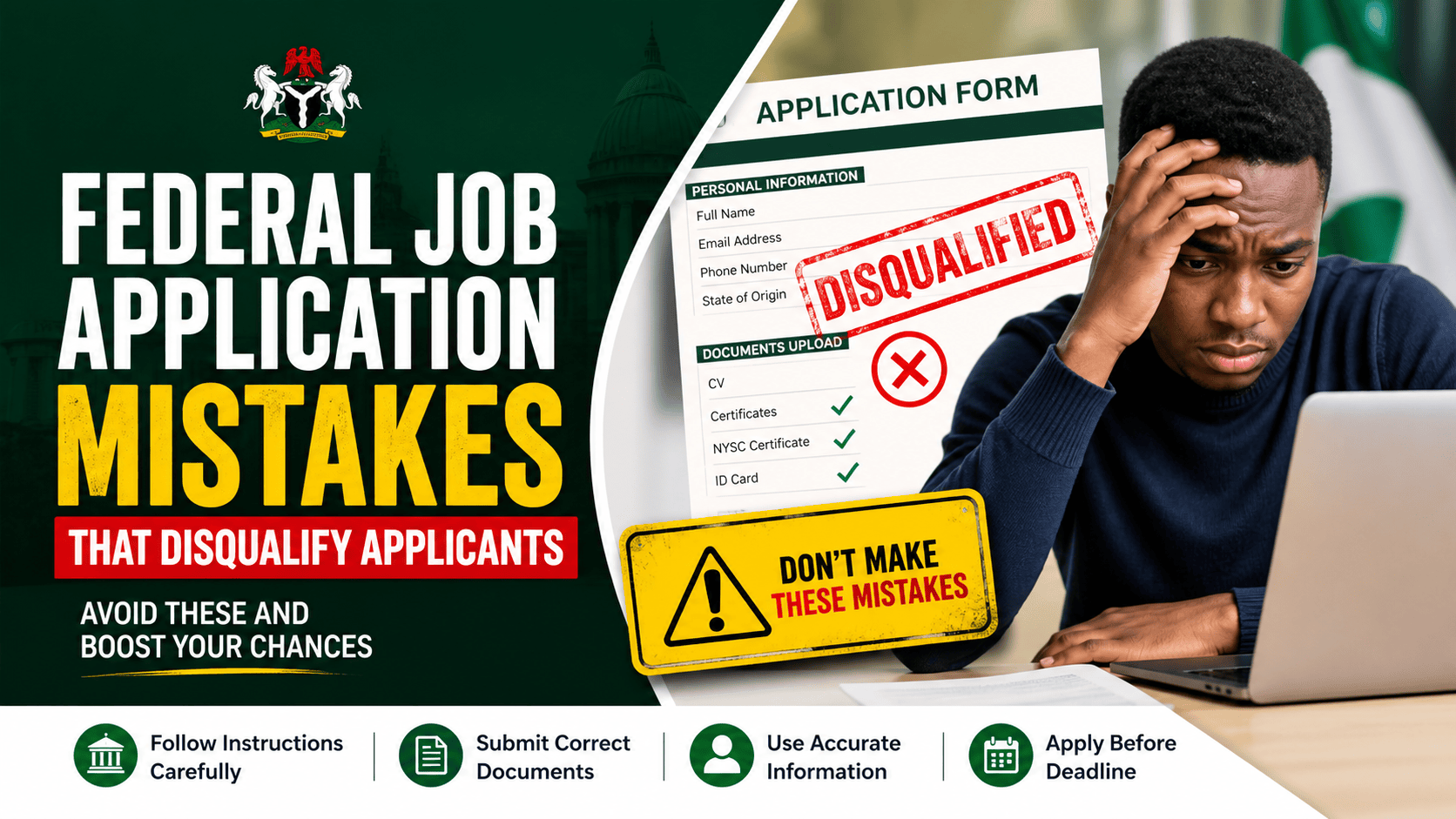
    Federal Job Application Mistakes That Quietly Disqualify You Before You Even Know It

    Last updated: August 6, 2026

    In 2021, I once helped a young man named Chukwuemeka from Enugu prepare his application for a Federal Civil Service Commission recruitment. He had a second-class upper degree, relevant work experience, and had passed his NYSC. By every standard metric, he was a strong candidate. He didn’t get shortlisted.

    When I asked him to walk me through exactly what he submitted, I found it within two minutes. He had used the wrong date format on his credential details DD/MM/YYYY instead of what the portal required and his NYSC discharge certificate scan was uploaded as a file over the 200KB size limit. Two small things. Both quietly threw his application in the digital bin before any human even read his name.

    That’s the brutal truth about federal job applications in Nigeria. You can be qualified and still lose not to a better candidate, but to a dropdown menu you didn’t read carefully enough.

    Why Federal Job Portals Are Less Forgiving Than You Think

    People treat government job portals like they treat WhatsApp type something in, press send, and assume it went through. But these portals, particularly the Federal Civil Service Commission (FCSC) portal and agency-specific recruitment platforms, are built with hard validation rules. A field that expects a specific format will not accept anything else, and it often won’t explain why your submission failed.

    Part of the problem is that Nigerians are used to processes that have “sorting” built in someone at the back end who corrects obvious errors or calls you if something is missing. Federal recruitment, especially when thousands of applications come in, does not work that way. Automated shortlisting means your file is either correct or it isn’t. There is no middle ground, and nobody is calling you.

    Mistake #1 — Applying to Positions You Are Not Grade-Eligible For

    This one catches so many people off guard. Federal ministries and agencies advertise vacancies by grade level GL-06, GL-08, GL-09, and so on. Your qualification has to match the required entry grade level, and the matching is not intuitive to most applicants.

    For example, an OND holder typically qualifies for GL-06. An HND or Bachelor’s degree holder enters at GL-08. A Master’s degree may qualify someone for GL-09 or GL-10 depending on the ministry. If you apply for a GL-08 position with an HND and the posting specifically states “Bachelor’s degree only,” your application is invalid even if HND and B.Sc. seem equivalent in your mind. The NUC and the ministry’s HR system do not agree with that equivalence in all contexts. Always read the requirements line by line.

    Mistake #2 — Certificate Details That Don’t Match Your O’Level Records

    I have seen this destroy otherwise strong applications more times than I can count. When you apply, you enter your WAEC or NECO results manually. If the name, examination number, or year you enter does not exactly match what WAEC’s result checker returns, your credentials will fail verification and your application will be flagged or discarded.

    This matters especially for people who sat for exams in multiple sittings or who made corrections to their certificates after the fact. If your name appears as “Fatima Abubakar Musa” on your WAEC certificate and you enter “Fatima A. Musa” in the portal that is a mismatch. Use the name exactly as it appears on the physical certificate, character for character. The federal system checks these things, particularly when shortlisting gets to the verification stage.

    Mistake #3 — Uploading Documents That Fail Silent Checks

    Most federal recruitment portals specify document size limits (usually 50KB to 200KB for individual files), accepted file formats (PDF or JPEG only, in most cases), and sometimes even minimum or maximum pixel dimensions for passport photographs. The majority of applicants ignore these details completely, upload whatever they have, and assume the portal accepted it because the page moved forward.

    What actually happens is that some portals accept the file upload but fail silently during backend processing. You think you submitted a complete application. The system has an incomplete record for you. When shortlisting runs, your file fails document verification. You never find out why.

    Before you upload anything, compress your PDFs, resize your photos, and confirm the format. Tools like iLovePDF and Smallpdf are free and work on your phone. Spending five minutes on this can mean the difference between getting shortlisted and wondering why you never heard back.

    Related Reading

    How People Actually Get Government Jobs in Nigeria — Beyond the Official Process

    Before you apply, understand the full landscape. This post breaks down what the recruitment brochures won’t say out loud.

    Mistake #4 — Not Having a Valid Means of Identification at the Time of Application

    This sounds obvious until you realise how many applicants start an application, reach the section requesting a valid government-issued ID, and discover their National ID card is expired, their voter’s card belongs to an old polling unit, or their driver’s licence has a different address than what they’re submitting. Federal recruitment portals increasingly cross-reference ID details, and inconsistencies even minor ones create problems during verification.

    If you are planning to apply for any federal role in the coming months, go and check your ID documents today. Not tomorrow. NIMC has made NIN slip and National e-ID updates faster than they used to be. Sorting this out before applications open is a hundred times easier than trying to fix it while a deadline is counting down.

    What Nobody Tells You: Being Qualified Is the Starting Point, Not the Finish Line

    Most career blogs talk about federal jobs as if getting the job is simply about sending in your documents and waiting. That is only half the story and honestly, it’s the easier half.

    The uncomfortable reality is that many qualified applicants are disqualified for administrative reasons, not merit. And many who make it through the shortlisting stage face a different kind of challenge a physical verification and screening process that can be chaotic, underfunded, and conducted in conditions that test your patience more than your qualifications. State of origin documentation errors, result verification backlogs, and scheduling issues have all caused legitimate candidates to miss out at the final stages.

    None of this means you shouldn’t apply. It means you should apply with both eyes open. Prepare your documents twice as carefully as you think necessary. Follow up through the official channels. And understand that persistence not just paperwork is part of the process.

    Practical Steps: How to Apply Without Getting Quietly Disqualified

    1. 1Print out the full job advertisement and read every single requirement before opening the portal. Note the grade level, required qualification, accepted file types, and document size limits. Do this on paper so you can tick them off.
    2. 2Gather every document mentioned before you begin filling the form. Do not start the application and then go looking for your NYSC certificate. Many portals time out or lose your progress if you leave for too long.
    3. 3Check that every name, date, and examination number you plan to enter matches your physical certificates exactly character by character. This includes your O’Level results, degree certificate, and birth certificate.
    4. 4Compress and format all documents before uploading. Aim for PDFs under 150KB. Passport photos should be JPEG, white-background, and within the specified dimensions (usually 150×150 to 300×300 pixels).
    5. 5After submission, take a screenshot of your confirmation page or application number. Save it somewhere you can find it easily. This is your only proof of submission if any dispute arises later.
    6. 6Bookmark the official portal not a third-party site that mirrors it. Check your application status at least once a week. Updates often appear without any email notification being sent.

    This is not the post to read once and forget.The next time a federal recruitment opens and it will, sooner than most people expect the candidates who get shortlisted will not necessarily be the most qualified. They’ll be the ones who read the instructions, prepared their documents properly, and submitted correctly. That person can be you. Save this post, share it with whoever you know is currently job hunting, and go check your documents today.

  • How to Navigate the FCSC Online Portal (And Actually Get Shortlisted)

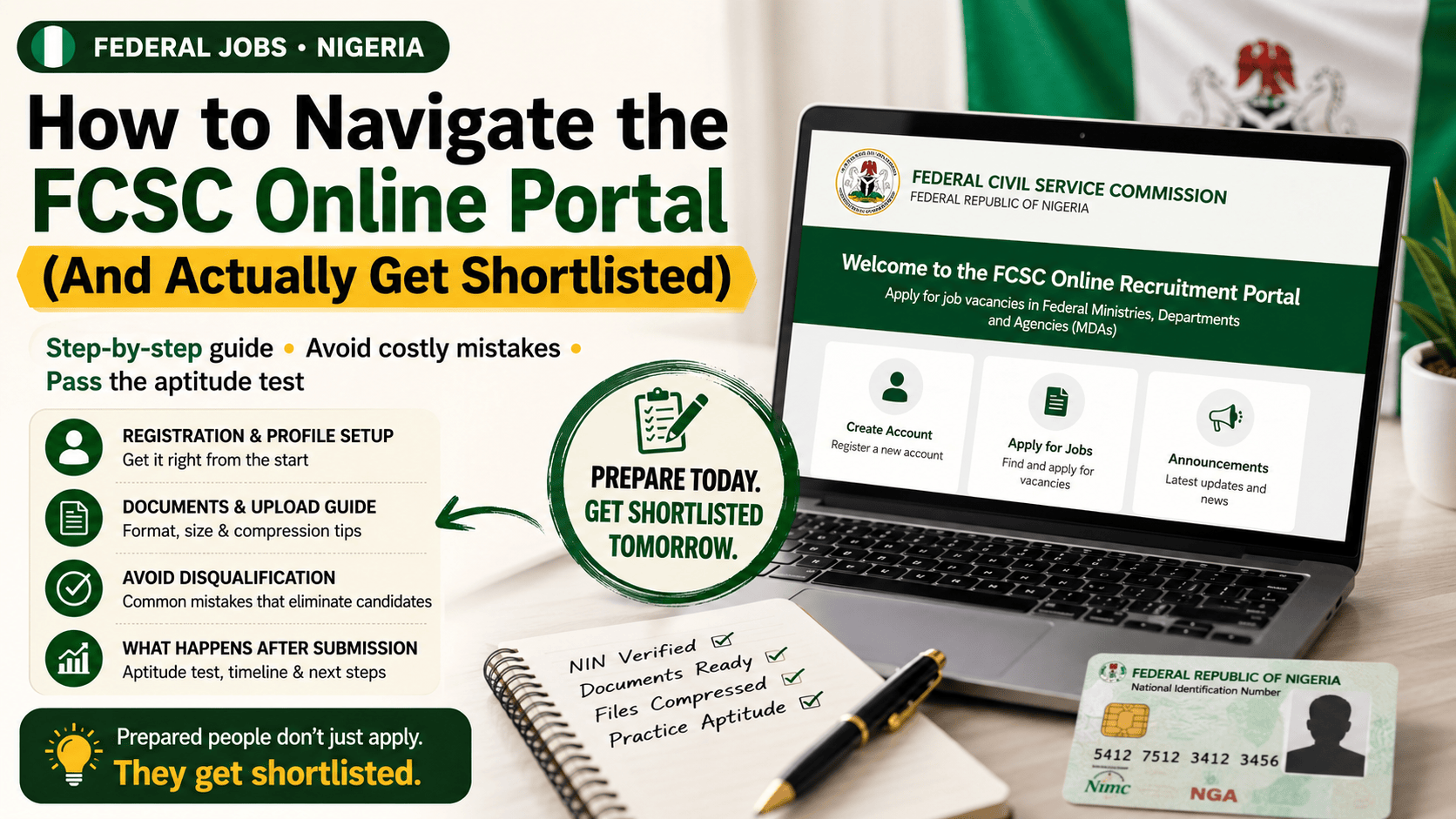
    How to Navigate the FCSC Online Portal (And Actually Get Shortlisted)

    Last updated: August 6, 2026

    The first time I helped my cousin Abdulrahman apply for a federal job in 202, we spent three full hours on the FCSC portal and accomplished absolutely nothing useful. Not because we weren’t smart we just had no guide. Every tab felt like a trap. Every error message felt personal. We eventually submitted something, but neither of us was confident about what we’d actually done.

    That experience is exactly why I’m writing this post. Because I’ve seen too many qualified Nigerians people with first-class degrees, strong CVs, and real ambition fail to get shortlisted not because they lacked merit, but because they couldn’t navigate a government portal. If that’s been you, let’s fix that today.

    What the FCSC Actually Does (And Why It Matters to You)

    The Federal Civil Service Commission is the body responsible for recruiting, promoting, and disciplining workers across Nigeria’s federal ministries, departments, and agencies the MDAs. If you want to work in a core federal ministry, not a parastatal, not a state agency, but a ministry under the federal government, then the FCSC is almost certainly the door you have to walk through.

    Their recruitment exercises don’t open every single year, but when they do, the positions are real. Salaries follow the Consolidated Public Service Salary Structure (CONPASS), and the benefits pension, health insurance, and the kind of job security that most private sector roles in Nigeria simply cannot offer are genuine. So yes, understanding their portal properly is worth your time.

    Finding the Correct Portal — This Step Can Save You from a Scam

    The official FCSC website is fedcivilservice.gov.ng. I say this clearly because there are fake, cloned sites that look nearly identical to the real thing and they exist purely to harvest your personal data or collect so-called “processing fees.” The real FCSC portal has never, to my knowledge, required applicants to pay anything during the application process.

    Important: When recruitment is active, the portal link is published directly on the official FCSC homepage. Bookmark that URL from the source. Do not follow recruitment links shared in random Facebook groups or WhatsApp forwards without first verifying them against the official site.

    Registration and Profile Setup — First Impressions Count Here Too

    Once you’re on the right portal, creating your account is your first real task. Use an email address you check regularly shortlist notifications and test invitations land there, and missing one because you used a dormant Yahoo account from secondary school is a mistake you don’t want to make.

    During registration, you’ll typically be asked for your National Identification Number (NIN), so have it ready before you start. Once your email is verified and you’re logged in, you’ll land on a dashboard where you fill in personal details, educational qualifications, and work experience. Take your time here. If the name on your portal profile doesn’t match your WAEC certificate or your degree exactly even a missing middle name that discrepancy can flag your application during document screening and knock you out before a human ever reads your CV.

    Uploading Documents Without Making Costly Errors

    The portal enforces strict file size and format requirements, usually PDFs or JPEGs under a specific size limit. Many people hit walls here because they’re trying to upload a 12MB scan of their university certificate. Use a free tool like Smallpdf or ILovePDF to compress your files before you even attempt to upload them.

    The documents typically required include your O’Level result, your degree certificate or statement of result if your certificate is still being processed, your NYSC discharge or exemption letter, a birth certificate or sworn declaration of age, and a passport photograph with a plain white background. For a full, detailed breakdown of everything you need to have ready, my earlier post on common documents needed for federal government recruitment in Nigeria covers it all in one place go read it before you come back here.

    What Nobody Tells You About FCSC Applications

    Here is the part most blogs skip entirely: submitting your application is just the beginning, not the finish line.

    After submission, shortlisted candidates are typically invited for a computer-based aptitude test. This test covers verbal reasoning, quantitative aptitude, and sometimes current affairs. Candidates who actually prepare for this not those who assume their degree is enough are the ones who make it through to the oral interview stage.

    Also be aware that FCSC recruitment cycles can stretch six to eighteen months from application to final posting. If you apply and hear nothing for three months, that doesn’t automatically mean rejection. Stay patient and stay off the anxiety forums.

    One more uncomfortable truth: many quiet disqualifications happen because of application errors, not qualification gaps. Mismatched names, wrong qualification codes, a transcript uploaded to the wrong field these seem like minor issues but they are elimination triggers. Before you hit submit, read my post on federal job application mistakes that disqualify applicants it could save your application.

    Your Action Plan Before the Next Recruitment Opens

    1. Visit fedcivilservice.gov.ng today and bookmark the official page not when recruitment opens, now.
    2. Confirm your NIN is active and tied to your correct date of birth via the NIMC portal or any NIMC office.
    3. Gather and scan all your academic credentials now, while there’s no deadline pressure crowding scanners and cybercafés.
    4. Compress every document to under 500KB using Smallpdf or a similar free tool. Test-upload one to make sure the format is accepted.
    5. Create your portal account with a reliable email address, and keep your login credentials somewhere you won’t lose them.
    6. Start practising verbal and quantitative reasoning consistently even in months when recruitment isn’t open. The test comes fast when it comes.

    Federal jobs in Nigeria are competitive, yes. But a significant number of people who don’t make it aren’t losing to more qualified candidates they’re losing to more prepared ones. Prepared people read the guidelines. They verify their portals. They compress their files. They show up to the aptitude test having actually practised. You’ve already started by reading this post. Now take the next step and share this with someone in your circle who has been asking about federal jobs and doesn’t know where to begin. That person needs this more than they know.

  • The Importance of National Identification Number (NIN) in Job Applications

    The Importance of National Identification Number (NIN) in Job Applications

    Last updated: August 6, 2026

    Tunde from Lagos sent me a voice note that was almost painful to listen to. He had applied for a federal government recruitment exercise, made it through the shortlisting stage, and then got disqualified at the verification step because of one thing: he had never completed his NIN registration. Everything he had worked for, the preparation, the form filling, the weeks of waiting, collapsed because of something he thought was “just a government card thing.”

    That was in 2022. Since then, I have heard almost the same story from at least thirty different people in my inbox. And every time, the frustration is the same: nobody told them this would matter so much.

    If you are chasing federal jobs, state government roles, or even some serious private sector positions in Nigeria today, understanding the role of your National Identification Number is not optional. It is survival. And in a job market this competitive, the small things, the micro-opportunities you ignore, are often the ones that cost you everything.

    What NIN Actually Is and Why Government Bodies Now Treat It Like Gospel

    The National Identification Number, issued by the National Identity Management Commission (NIMC), is an 11-digit number that is uniquely tied to your biometric data. It is not your voter’s card number. It is not your BVVN. It is a completely separate, biometrically anchored identifier that the federal government of Nigeria has decided is the foundation of citizen verification going forward.

    When you walk into a government office today, when you apply on a recruitment portal, or when your documents are being verified before an offer letter is printed, the first thing many screening teams do is run your NIN through the NIMC database. If what you put on your form does not match what is on the database, whether it is your date of birth, your name spelling, or your state of origin, you are flagged. Sometimes silently. You just never hear back.

    That is the part that terrifies me most. Most people are not told why they were disqualified. They just wait and wait until the silence becomes the answer.

    The Quiet Way NIN Affects Federal Recruitment in Nigeria

    The Federal Civil Service Commission, the IPPIS (Integrated Payroll and Personnel Information System), and most federal MDAs (Ministries, Departments and Agencies) now use NIN as a key verification tool. It is built into the architecture of how government tracks who is on its payroll and who is a legitimate applicant.

    When you are filling a federal recruitment form and you input your NIN, that number is essentially a window into your entire official identity. Your name as registered with NIMC will be cross-referenced with whatever name you used on your application. If your mother registered you as “Mohammed” but your NYSC certificate says “Muhammad” and your NIN says “Muhammed,” you have created three different identities in the system, and the system does not forgive that kind of confusion.

    I have written about similar issues in my post on common documents needed for federal government recruitment in Nigeria, and name inconsistency is always in the top three reasons people lose otherwise solid applications. NIN adds another layer because it is biometric. You cannot photoshop your fingerprint.

    NIN and Private Sector Jobs: The Shift That Is Already Happening

    People assume NIN is only a government thing. That is no longer true. Since the Central Bank of Nigeria mandated the linking of NIN to BVN for all bank accounts, and since telecom companies went through the mass SIM-NIN registration exercise in 2020 and 2021, NIN has quietly become a standard part of formal employment onboarding in the private sector too.

    Several financial institutions now request NIN as part of their Know Your Customer (KYC) process for new employees. Fintech companies, insurance firms, and even some large manufacturing companies collect it during HR onboarding. The HR teams are not doing this because they love paperwork. They are doing it because their compliance frameworks now require it.

    If you are applying for any role that involves handling customer data, financial transactions, or regulatory compliance, your employer will likely need your NIN before they can complete your pre-employment checks. The earlier you understand this, the better you position yourself.

    The Micro-Opportunities That NIN Unlocks Beyond the Obvious Jobs

    Here is something most career blogs will not tell you: your NIN is a gateway to micro-opportunities that are not always labelled as “jobs” but can be just as life-changing.

    The Nigerian Youth Investment Fund (NYIF), the Government Enterprise and Empowerment Programme (GEEP), federal scholarship schemes like the Bilateral Education Agreement (BEA) awards, and several state-level skill acquisition and grant programmes all require NIN verification before your application is processed or your funds are released. These are real, active opportunities that thousands of young Nigerians miss not because they are unqualified but because their NIN records are incomplete, incorrect, or simply not done.

    I personally helped a reader from Kano access a federal empowerment micro-grant in 2023. The application was simple. The only serious barrier was NIN. Once we sorted her registration, she went back, reapplied, and got the grant within two months. That money funded her tailoring business. The opportunity was always there. The missing piece was just that number.

    What Nobody Tells You About NIN and Name Inconsistencies

    This is the uncomfortable truth that I feel obligated to say clearly. A significant number of Nigerians have NIN records with errors, and most of them do not know it.

    When many of us did our initial NIN enrollment, the process was rushed. The centres were overcrowded, the data entry officers were overworked, and mistakes happened. Names were misspelled. Dates of birth were entered incorrectly. Local government areas were assigned wrongly. And then people left with their slips, assumed everything was fine, and went on with their lives.

    Years later, those errors show up at the worst possible moment: during a job verification exercise or when an offer letter is being processed. NIMC does have a correction process, but it is not instant. You typically need to visit a NIMC enrollment centre, present original documents, and wait for the correction to be processed on the backend. As of my last check, this can take anywhere from a few days to a few weeks depending on the centre and the nature of the error.

    Do not wait until you are in the middle of a job application to discover this. Check your NIN details now by dialling *346# on your registered phone line. Confirm your name, date of birth, and other details match what is on your certificates. If anything is wrong, start the correction process immediately.

    Also, be aware that some of the mistakes that disqualify candidates during federal job screening go beyond NIN alone. If you want to understand the full picture of what can go wrong during federal job applications, I have a detailed breakdown in my post on federal job application mistakes that disqualify applicants. Read it. Seriously.

    How to Get Your NIN Right Before Your Next Application

    Step one is to confirm you actually have a NIN. Dial *346# on an MTN, Airtel, Glo, or 9mobile line that was registered with your NIN. Your number should appear.

    Step two is to compare every detail that appears with what is on your birth certificate, WAEC certificate, and any other official document you plan to use for job applications. Write them side by side if you have to.

    Step three: if there are discrepancies, visit the nearest NIMC enrollment centre with your original documents and a passport photograph. Do not send someone else. The biometric component means your physical presence is required for corrections.

    Step four: after any correction, give it at least two weeks before applying for anything where NIN verification will be done. The backend system needs time to update, and if you apply while the correction is still pending, the old (wrong) data may be what gets pulled.

    Step five: before submitting any federal job application, go to the official NIMC self-service portal at nimc.gov.ng and check what your current records look like. This is the same database that recruiters access.

    Step six: make sure the exact name on your NIN matches the name on your NYSC certificate and your highest educational qualification. Those three documents are the trinity of Nigerian federal employment documentation. Any mismatch between them is a problem, but a mismatch involving your NIN is often harder to explain and harder to fix quickly.

    The Honest Truth About NIN Agents and Third-Party Help

    I will be direct with you. There are people charging between two thousand and ten thousand naira to “help” you get or correct your NIN. Some of them genuinely have connections to enrollment centres and can expedite things. Others will collect your money, take your documents, and leave you worse off than you started.

    NIN registration and basic corrections are free at official NIMC centers. If you are paying someone, make sure you are paying for their time and transportation assistance, not for something that should cost you nothing. The only fees that are officially sanctioned by NIMC are for certain upgrade or premium services, and even those are clearly stated on the official website.

    If you are outside Nigeria right now and need your NIN, Nigerian embassies and consulates in certain countries have been authorized to conduct NIN enrollment. Check the official NIMC website or contact your nearest embassy to confirm if this service is available where you are.

    The Bigger Picture: NIN Is Not Going Away

    The Nigerian government’s digital identity push is not slowing down. If anything, NIN requirements are expanding, not contracting. The plan, as stated by NIMC and backed by various government directives, is to eventually integrate NIN into virtually every formal transaction in Nigeria, from land registration to tax filing to school admissions.

    For job seekers specifically, this means one thing: the sooner you treat your NIN as seriously as you treat your certificate or your NYSC discharge letter, the better. It is no longer a peripheral document. It is becoming central infrastructure for your entire formal life in Nigeria.

    In a country where micro-opportunities in government schemes, grants, and job portals are increasingly tied to a single verified number, being unprepared is not something you can afford.

    Sort your NIN today. Verify your records. Fix what is broken. And then go after every opportunity with confidence, knowing that when the verification call comes, you will not be the person who loses a life-changing job over an 11-digit number.

  • Pros and Cons of Working for the Nigerian Government in 2026: Is It Still Worth It?

    Pros and Cons of Working for the Nigerian Government in 2026: Is It Still Worth It?

    Last updated: August 6, 2026

    The exact day my uncle called me into his sitting room in Kaduna, sat me down on that old leather chair, and told me with full seriousness: “Musa, just find government work. Once you enter, you are settled.”

    That was 2014. He had spent 27 years at the Ministry of Works. Pension coming every month. Low stress. Long holidays. He believed in it the way some people believe in prayer.

    But that was 2014. This is 2026. And the question I get in my inbox almost every week from fresh graduates across Nigeria, Ghana, Cameroon, and even Kenya, is whether government work is still the dream their parents sold them. My honest answer is: it depends on what you actually want from your career.

    I am not going to give you a motivational speech. I am going to give you the real picture.

    Why People Still Chase Government Jobs in Nigeria

    The number one reason young Nigerians still apply to federal civil service jobs, even with all the frustration, is job security. Private companies can fold. Startups can crash. Multinationals can downsize. But the Nigerian government, for all its dysfunction, rarely sacks career civil servants en masse.

    That stability is real, and I will not dismiss it. A friend of mine named Hauwa got posted to the Federal Inland Revenue Service after NYSC in 2021. She has since gotten two salary increments through the Consolidated Public Service Salary Structure, she gets her health insurance through the National Health Insurance Authority, and she has not missed a single paycheck. She is not rich. But she is stable in a way that many of her mates in private sector are not.

    Beyond job security, the pension scheme under the Contributory Pension Scheme, managed by the Pension Commission (PenCom), means that if you stay long enough and your employer contributes correctly, retirement is not a death sentence. That matters a lot in a country where most informal workers have nothing waiting for them at 60.

    Government jobs also come with certain allowances. Housing allowances, transport allowances, hazard pay for some roles, medical cover. These do not always work perfectly in practice, but they exist on paper and sometimes in reality too.

    If you are the kind of person who values predictability, wants to eventually start a small business on the side without worrying about being fired, and does not need your career to be exciting, government work can give you that foundation.

    The Real Drawbacks Nobody Talks About Honestly

    Here is where I need to be straight with you.

    The average federal civil servant salary in Nigeria is still painfully low relative to cost of living. Grade Level 8 officers, which is where most fresh graduates with a degree start, earn a basic salary that often cannot cover rent in Lagos or Abuja without supplementing with something else. The Consolidated Public Service Salary Structure has not kept pace with inflation, and the naira has lost significant value since 2023. What looked like a reasonable salary two years ago now buys considerably less.

    Promotion is another issue. In many ministries and agencies, promotion is still largely tied to years of service rather than performance. I have spoken with people who are brilliant, hardworking, and completely stuck at GL 10 because someone above them will not retire. The system rewards patience more than merit, and for ambitious young people, that is genuinely suffocating.

    Then there is the culture. This is the part I almost did not write, but you need to hear it. In many government offices, innovation is not encouraged. The instinct is to do things the way they have always been done. I know someone who joined a federal agency excited to digitise some of their processes. Within a year, he had quietly given up. Not because the ideas were bad, but because the resistance from older colleagues and the absence of any structure to reward new ideas made it pointless.

    Bureaucracy in government does not just slow things down. It can drain your energy over time. And for a generation that grew up seeing what ambition and hustle can produce, that drain is a real cost.

    The Agencies Where Government Work Actually Pays Well

    Not all government jobs are equal. This is something people outside the system often do not know.

    The Central Bank of Nigeria (CBN) pays its staff significantly above average civil service rates. NNPCL (the successor to NNPC) has always been one of the best-paying government-affiliated organisations in the country. The Economic and Financial Crimes Commission (EFCC), the Nigeria Customs Service, and the Nigerian Ports Authority all have salary structures that are notably higher than what the standard federal civil service structure offers.

    Regulatory agencies like the Nigerian Communications Commission (NCC) and the Securities and Exchange Commission (SEC) are also known to offer competitive pay and a relatively more professional working environment.

    If you are going to pursue government work, targeting these specific agencies can make a real difference in both your earnings and your day-to-day work experience. The Federal Civil Service Commission portal at fedcivilservice.gov.ng is where many of these openings are listed when they arise.

    What Nobody Tells You About Government Employment in 2026

    Here is the uncomfortable truth: the people who are thriving inside government jobs right now are mostly those who combined them with something else.

    I am not saying they are doing anything wrong. I mean that the best-positioned government workers I know have used the stability of the job as a launchpad. They consult on the side. They run small businesses. They invest. They freelance. The government job provides the floor, not the ceiling.

    The civil service was never really designed to make you wealthy. It was designed to provide steady, modest income in exchange for serving the public. The problem is that a generation of Nigerians was told it was the whole package. It is not. It is one piece.

    If you go in expecting the job to provide everything, you will be disappointed. If you go in treating it as a stable base while you build other income streams, it can actually work very well for you.

    This is something the career advice most Nigerian blogs give you will never say, because it sounds like you are undermining public service. But it is just reality.

    How This Compares to Private Sector in 2026

    Private sector jobs, especially in tech, finance, and FMCG, often pay better starting salaries. A junior software developer in a mid-size Lagos tech company can earn more in their first year than many GL 8 civil servants. If your skills are in demand, the private sector will price them closer to their market value than the government will.

    But the volatility is also real. Layoffs happen. Startups close. Foreign-owned companies restructure. I have seen friends who were earning well in private companies lose their jobs with two weeks notice and spend months searching.

    If you are weighing both options right now, I would encourage you to also explore the salary data and career paths laid out in this guide on high-paying career paths for Nigerian graduates in 2026 before making a final decision. Understanding what the market pays across sectors will help you negotiate better and choose smarter.

    Steps to Take If You Decide Government Work Is Right for You

    The first thing you need to do is get clear on which specific agency or ministry you are targeting. Applying to “government” in general is not a strategy. Research the mandate of the agency, what roles they hire for, and what the working conditions are actually like. Speak to people who work there if you can.

    Second, get your documents in order before any recruitment window opens. Your certificate, NYSC discharge certificate, WAEC and JAMB results, and birth certificate all need to be accessible and authenticated. Government recruitment processes often have document requirements that catch people off guard.

    Third, take the job test preparation seriously. The Federal Civil Service Commission and most agencies run written aptitude tests, and they are not trivial. Past questions are available online and worth going through. Agencies like EFCC and Customs have historically had competitive entry exams.

    Fourth, once you get in, start building skills that make you transferable both inside government and outside it. Do not let the comfort of the job make you stop learning. Data analysis, project management, procurement and public financial management skills are all valued inside government and translate well outside it too.

    Is It Still Worth It?

    For someone who values security, wants to raise a family without unpredictable income, and is self-disciplined enough to build other income alongside the job, yes, government work in Nigeria still has real value in 2026.

    For someone who is highly ambitious, needs performance-based growth, or would suffocate in a bureaucratic environment, the frustration will likely outweigh the benefits.

    The worst thing you can do is take a government job for the wrong reasons and spend ten years resenting it. The second worst thing is dismiss it entirely without understanding what it can actually offer.

    My uncle is retired now. He is fine. Not wealthy, but fine. He has no regrets about his 27 years. But he also started a small provision store in his third year in service, which he quietly built for decades. He never told me that part when he was giving me advice. He assumed I would figure it out.

    I am telling you now so you do not have to.

  • Nigerian Police Force Recruitment 2026: Complete Guide to Requirements, Screening, and Physical Fitness Test

    Nigerian Police Force Recruitment 2026: Complete Guide to Requirements, Screening, and Physical Fitness Test

    Last updated: August 6, 2026

    My neighbor’s son, Bashir, is 23. He sat in our compound in Kaduna last December with his phone in his hand, refreshing the NPF recruitment portal from the moment it went live. He had lost two years already to failed civil service exams, and this felt like his real shot. He applied. Got shortlisted. Showed up to the physical screening in Zaria. Got turned back at the gate.

    Not because of his credentials. His O’level result was intact. His NIN was printed. His guarantors form was properly signed.

    He got turned back because his canvas shoes were brown, not white.

    That one detail, out of fifteen requirements listed on the portal, cost him his slot that day. I am not telling you this to discourage you. I am telling you because this guide is about getting every single detail right.

    Where the 2026 NPF Recruitment Currently Stands

    The Police Service Commission, working alongside the Nigeria Police Force, opened the application portal on December 15, 2025. The portal closed on January 25, 2026, and the recruitment targets 50,000 constable positions.

    After the application window, candidates moved into the physical and credential screening phase, which took place between March 9 and April 18, 2026. From there, shortlisted candidates sat the Computer-Based Test, which was scheduled for April 28 to 30, 2026.

    As of now, candidates who passed the CBT have moved into the medical screening phase, which officially commenced on May 17, 2026. If you are among those, this guide is especially for you. If you missed this batch, read it anyway so you know exactly what to expect next time.

    Who Can Apply: The Basic Requirements

    The NPF is not looking for just anyone. They are looking for a specific profile. Here is what you must meet before anything else.

    You must be a Nigerian citizen by birth. Citizens by naturalization or other legal means are not eligible. You must also be of good character with no criminal record, free from financial embarrassment, and physically, mentally, and psychologically fit.

    On age: general duty applicants must fall between 18 and 25 years of age. Specialist applicants, meaning those with trades like driving, nursing, IT, or mechanics, can be up to 28 years old.

    For education, the minimum is five O’Level credits in not more than two sittings, and those credits must include English Language and Mathematics. WAEC, NECO, GCE, and NABTEB are all accepted. So if you have NECO instead of WAEC, you are still fine. Do not let anyone tell you otherwise.

    On physical measurements, this is where many applicants are surprised. Male applicants must be at least 1.67 metres tall. Female applicants must be at least 1.64 metres tall. Male applicants must also have a chest measurement of at least 86 centimetres when expanded.

    Visible tattoos will get you disqualified during physical screening. Same goes for physical deformities. The police will turn away anyone with defective sight, knock knees, bow legs, flat feet, fractured or amputated limbs. These are non-negotiable.

    Female applicants must not be pregnant at the time of recruitment and training.

    The Documents You Must Bring

    This is the part that got Bashir. The document list is long, and every single item is compulsory. Each candidate must bring a completed guarantors form, an application submission slip, an invitation slip, a credentials screening form, and a physical screening form.

    Beyond those forms, you need your original NIN printout or the physical NIMC card, your O’Level certificate in original form, a valid birth certificate or declaration of age, and a certificate of local government or state of origin.

    If you are applying as a specialist, add a trade test certificate to that list.

    All credentials must be packaged as original and duplicate copies in two separate white flat files, with recent passport photographs attached. The guarantors form must come with photocopies and passport photographs of your referees. The guarantors form even states in block letters that every guarantor must attach a photocopy of a valid official ID.

    And on dressing: candidates must appear in white canvas shoes, white T-shirts, white shorts, and white stockings. This is mandatory. Bashir’s brown canvas shoes made him invisible to the officers that day. Do not make the same mistake.

    The CBT Exam: What to Prepare For

    Between physical screening and medical screening sits the CBT, and many candidates underestimate it. It is not a formality.

    The exam tests general knowledge, English language proficiency, logical reasoning, and current affairs. Think of it as a compressed version of the kind of tests JAMB uses, applied to police-specific contexts. A question might ask you to identify the IGP, or test your comprehension of a passage about law enforcement, or ask you to calculate something simple.

    Preparation should focus on English language proficiency, logical reasoning, general knowledge, and current affairs. Buy any good aptitude test prep material. The ones used for JAMB and civil service exams work perfectly here. Spend two weeks minimum reading recent Nigerian news so you are not blank on current affairs.

    What the Physical and Medical Screening Actually Involves

    The physical screening is not just measuring your height and ticking a box. Officers assess applicants based on physical fitness, appearance, and overall health. Applicants who appear medically unfit may be referred for further checks or disqualified on the spot.

    The medical screening that began May 17 goes deeper. This is a critical elimination phase that determines who is medically and physically fit to serve. Candidates who fail to meet the required standards will be disqualified regardless of their performance in previous stages.

    What does that mean practically? They will check your vision. They will check your chest. They will look at your posture, your gait, and your general body condition. They will look for anything that suggests you cannot handle the physical demands of police work. Officers are doing this across thousands of candidates in a compressed time frame, so their decisions are often quick. Show up looking healthy, rested, and composed.

    The Honest Truth About This Recruitment Exercise

    Most blogs will not say this: the NPF recruitment has historically had issues with transparency, state quota allocations, and who eventually gets posted to training. The system does not always reward the most prepared. Some candidates who pass every stage still find their names missing from final lists for reasons that are never officially explained.

    I have seen this frustrate people I mentored. One young man from Sokoto, Ibrahim, passed his CBT in the 2023 exercise with a strong score. He waited almost eight months before the training list dropped, and his state’s allocation had already been filled before his number came up.

    This is not me telling you the system is rotten and to give up. I am telling you this so you manage your expectations, keep applying to other opportunities simultaneously, and do not put your entire future on one recruitment exercise. A government job, including police service, is worth pursuing but should never be your only plan. Speaking of which, it helps to understand how government salary structures are set up even before you get in. We wrote about the federal government salary structure and how CONPASS grading works at edujobsafrica.com, because knowing what you are walking into salary-wise helps you negotiate your life around it.

    How to Confirm Your Status and Print Your Slip

    The official NPF recruitment portal is npfapplication.psc.gov.ng. You need to visit it to confirm your status and print your invitation slip before your screening date.

    Do not go to any other website to do this. Facebook pages, WhatsApp groups, and third-party portals claiming to have your shortlist result are not official sources. The only reliable source is the Police Service Commission official portal. If it is not on the PSC website, it is not official.

    The PSC chairman has repeatedly stated that the recruitment is entirely free of charge and warned applicants against fraudsters. Any agent, any WhatsApp contact, any uncle’s contact who says they can “help” you with your shortlisting for a fee is lying to you.

    Your Step-by-Step Action Plan

    Step 1: Go to npfapplication.psc.gov.ng right now and confirm your status using your NIN. Print your invitation slip if you have not done so.

    Step 2: Gather every single document on the list. Originals and duplicates. Do not assume one copy is enough.

    Step 3: Get your guarantors form sorted. Your guarantors need to fill it properly, sign it, and attach a photocopy of a valid ID alongside their passport photograph. Call them now and don’t leave it to the last day.

    Step 4: Buy plain white T-shirts, white shorts, white canvas shoes, and white stockings. This is your screening outfit. Wear nothing else on that day.

    Step 5: For medical screening, get enough sleep in the days before. Drink water consistently. Do not take substances that could affect your blood pressure or heart rate. You want your body to show up as healthy as it actually is.

    Step 6: Arrive at your screening venue early. The venue printed on your invitation slip is the only place you should report to. Arriving late risks disqualification.

    Step 7: If you passed the medical screening, wait for official communication from the PSC. Do not respond to any unofficial “you have been selected” messages that come through unofficial channels.

    If You Missed This Batch

    The 2025/2026 application window has closed. If you applied but did not get shortlisted, or if you missed the window entirely, your job right now is preparation. Use this period to get your documents organized, work on your physical fitness, practice for aptitude tests, and monitor the PSC website for the next recruitment cycle.

    The NPF recruits periodically. Missing one batch is not the end. What would be the end is spending the next cycle just as unprepared as you were for this one.

    The police uniform means something. People in your community will look at you differently. Your family will breathe easier. But more than the uniform, the job carries real responsibility. Go into it ready, not just lucky.

    Do you have questions about this recruitment or any stage of the process? Drop them in the comments and I will personally respond. And share this with anyone sitting at home refreshing that portal, wondering what comes next. They need this more than you know.