

Your profile is your first handshake with every opportunity. This post walks you through exactly how to build one that gets you noticed for scholarships, internships, and jobs, even if you are starting from zero with no experience and no connections.
Source: EduJobs Africa
The Day I Almost Missed a Life-Changing Opportunity Because of a Blank LinkedIn Page
There was time In 2022, a recruiter from a Lagos-based tech firm sent me a connection request on LinkedIn. I had created my account two years earlier, uploaded a blurry passport photo, left the bio empty, and never touched it again. By the time he visited my profile, all he saw was a ghost account.
He moved on. I found out three weeks later from a mutual contact that the role he was hiring for paid three times the salary I was earning at the time. That story still stings.
I tell you this not to make you feel bad, but because I know for a fact that thousands of Nigerian and African students are walking around with that same ghost profile right now. No bio. No skills listed. No story. Just a name floating in the digital void.
If an opportunity knocked on your digital door today, would it find anyone home?
What “Opportunity-Ready” Actually Means
Most people think being opportunity-ready is about having a long CV or a first-class degree. It is not.
Being opportunity-ready means that when a recruiter, scholarship committee member, fellowship coordinator, or hiring manager searches for someone like you, they find enough information to trust you, feel impressed by you, and want to take a chance on you. That is it. It is about making it easy for people to say yes to you before you even open your mouth.
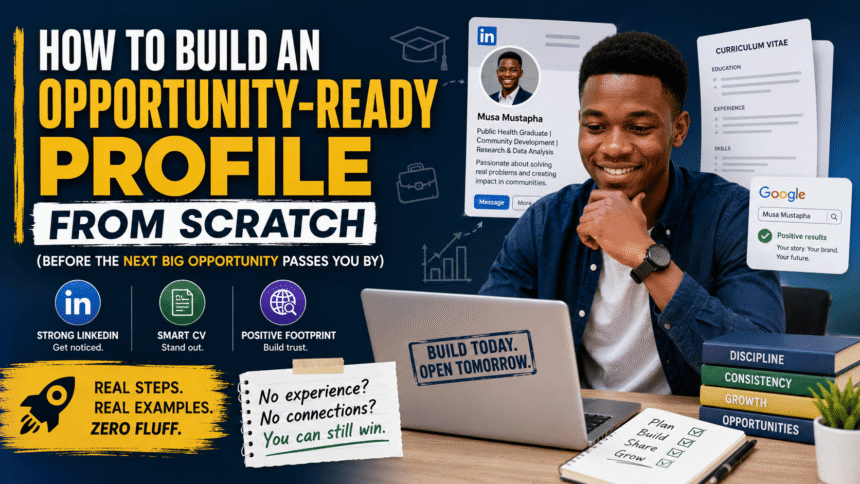
The profile we are talking about here covers three key surfaces: your LinkedIn profile, your CV or resume, and your digital footprint, meaning what comes up when someone Googles your name. These three things together form your professional identity in 2025, and if any one of them is weak, it costs you.
Start With the Thing Most People Skip: Your Story
Before you update any profile anywhere, you need to sit down and figure out your story. Not a fairy tale. Your actual story. What have you done, what are you interested in, and where are you trying to go?
A student I mentored, Adaeze from Enugu, spent 20 minutes listing out everything she had ever done academically and personally. She had volunteered at a community health drive, tutored secondary school students in maths for two years, participated in a UNDP youth conference, and passed her WAEC with distinctions in science subjects. She genuinely thought none of this was impressive enough to put on a profile. She was wrong.
Every one of those experiences became a line item that told a story: here is a young woman who cares about community, who can teach, who has been trusted with international exposure, and who has a science background. That story got her a spot in a competitive African Leadership Academy program eight weeks after we worked on her profile together.
Your story does not have to be extraordinary. It has to be honest and organized.
Building Your LinkedIn Profile Like a Professional
LinkedIn is where most opportunities begin now. Scholarship organisations browse it. Companies recruit from it. Fellowship programs vet candidates on it. If yours is empty or messy, you are invisible.
Your profile photo should be clear, well-lit, and professional. It does not need to be taken by a photographer. A plain wall, good natural light, and a decent phone camera will do. Studies from LinkedIn’s own research team have shown that profiles with photos receive significantly more views than those without. Do not underestimate this.
Your headline is the single most important line on your entire profile, and most people waste it by writing their current job title or putting “Student at XYZ University.” Instead, write what you bring to the table. Something like “Public Health Graduate | Community Development | Research and Data Analysis” tells a reader far more about who you are and what you can offer.
Your About section is where your story lives. Write three to five short paragraphs. Start with what drives you, mention what you have done, and end with what you are looking for or working toward. Write it in first person. Make it sound like a human being wrote it because one should.
Your CV Is Not a History Document
One of the biggest mistakes I see African graduates make is treating the CV like a record of everything they have ever done in chronological order. A CV is not your biography. It is your argument for why you deserve this specific opportunity.
That means you should be willing to have more than one version of your CV. If you are applying for a teaching fellowship, your CV should lead with your education and mentorship experience. If you are applying for a data role, it should lead with any analytical work you have done, even if it was a class project or a personal Excel tracker you built for your NYSC CDS group.
Tailor it. Customize it. Make the reader feel like you wrote this document specifically for them, because you should have.
Also, for Nigerian graduates especially, please make sure your NYSC discharge or exemption certificate is clearly mentioned if you have completed the program. Employers and many scholarship programs treat this as a baseline verification of your status. It matters.
Your Digital Footprint: The Silent Background Check
Here is something almost no career blog in Africa talks about: people Google you before they call you. Scholarship officers do it. Interviewers do it. Fellowship coordinators do it. If your name brings up nothing, or worse, something embarrassing, it affects the outcome.
Start by Googling your own name right now. What do you see? If the answer is nothing useful, that is something you can fix.
One of the fastest ways to build a positive digital footprint is to start writing. You do not need a personal blog right away. You can write articles on LinkedIn. You can comment thoughtfully on industry posts. You can share your work on platforms like GitHub if you are in tech, or ResearchGate if you are in academia. The goal is to leave a trail of competence and curiosity wherever you go online.
Even a single well-written LinkedIn article on a topic related to your field can rank for your name on Google within weeks. I have seen it happen with students I work with repeatedly.
What Nobody Tells You About Building a Profile From Scratch
Here is the uncomfortable truth: most people wait until they need an opportunity to start building their profile. That is backwards. By the time the scholarship application opens, the job listing goes up, or the fellowship program announces their intake, the people who have been quietly building their profiles for six to twelve months already have a head start you cannot close in one frantic weekend.
The other thing people do not say out loud is that a weak profile can disqualify you silently. Nobody emails you to say “we checked your LinkedIn and it was empty so we moved on.” They just move on. You never find out. You assume you were not qualified when in reality you just were not visible.
Visibility and qualification are not the same thing, but in a competitive market, lack of visibility can cost you the same way lack of qualification does.
Your Action Plan: Build It Before You Need It
Step 1: Spend 30 minutes writing a list of everything you have ever done academically, extracurricularly, and professionally. Include volunteer work, competitions, certifications, side projects, and even informal skills like tutoring your neighbors in English. Everything counts.
Step 2: Set up or overhaul your LinkedIn profile using the guidelines above. Use a clear photo, a strong headline, and write your About section in first person. Fill in every section you can.
Step 3: Write one short article on LinkedIn this week. It can be as simple as three lessons you learned from your NYSC experience, or what it is actually like studying your course at your university. Post it publicly.
Step 4: Update your CV and create at least two versions: a general version and one tailored to the specific type of opportunity you most want right now.
Step 5: Google yourself. If you find old social media posts that could embarrass you professionally, clean them up or make them private.
Step 6: Pick one platform beyond LinkedIn that fits your field. Tech? GitHub or X (formerly Twitter). Research? ResearchGate or Academia.edu. Business? You can start sharing insights on LinkedIn and even Substack. Begin adding work there consistently.
Step 7: Ask someone you respect to review your profile and your CV. Fresh eyes catch things you have become blind to.
You Are Not Too Late, But You Are Not Early Either
I want to leave you with this: the best time to build your opportunity-ready profile was last year. The second best time is today, specifically today, not Monday.
The opportunities are real. The Mastercard Foundation Scholars Program is real. The Tony Elumelu Foundation Fellowship is real. The African Development Bank internships are real. Government agencies in Nigeria and across the continent post roles regularly on their official portals. But every one of these programs has someone on the other side making a decision, and that person is forming an impression of you based on what they can find.
Give them something worth finding.
Your background does not have to be elite. Your university does not have to be a top-ten school. What has to be strong is your profile, your story, and your consistency. Build those and doors that looked permanently shut will start to crack open.
Start today. Not when you feel ready. Today.
More Updates

Free Certifications That Open Doors to Global Opportunities (From Someone Who Missed Them at First)

Skills Nigerian Companies Will Pay ₦500K/Month For in 2027 – Start Learning Now

How African Students Are Using AI to Win Scholarships, Write CVs & Prep for Interviews

Femmy O Foundation Grant 2026, €1,000 Funding Opportunity Opens for Small Businesses in Ireland