


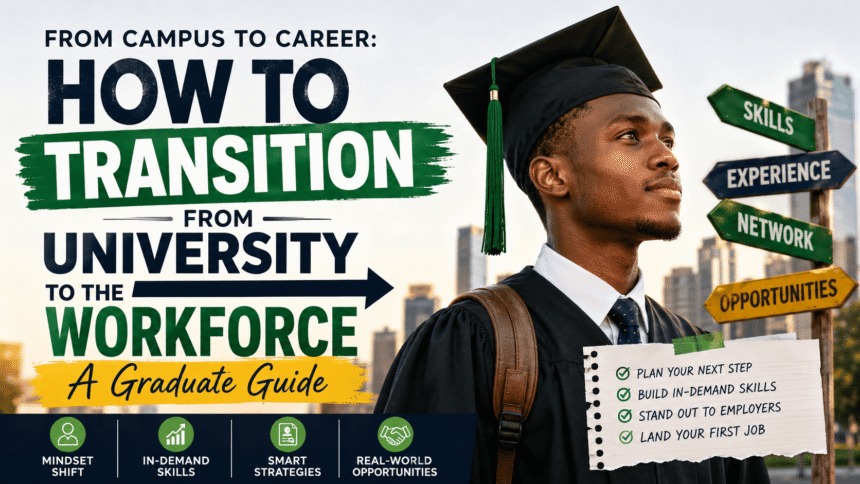
Your degree opened the door but it won't walk you through it. This guide breaks down exactly how Nigerian and African graduates can bridge the gap between university life and real employment, from rethinking your CV to understanding what hiring managers actually want from you on Day One.
Source: EduJobs Africa
The Day My Certificate Stopped Feeling Like a Trophy
Welcome to the blog guys! I remember sitting in my room in Minna, Niger State three months after NYSC staring at my university certificate in its plastic sleeve. I had a Second Class Upper. I had completed service. I had applied to about 20-something jobs. And I had heard nothing back from any of them.
Nobody prepared me for that silence.
University had given me four years of lectures, exams, and the occasional group project done by one person. It had not given me a single practical lesson on how to survive what came after. And if you are reading this as a fresh graduate or someone about to be one I want you to know that what you’re feeling right now is not failure. It’s just the gap. And there’s a way across it.
Why the Gap Between Campus and Career Feels So Wide
The honest truth is that Nigerian universities, for all their value, are still largely teaching students about work rather than preparing them for it. You spend five years writing theory-heavy exams and then suddenly you’re expected to show up somewhere and perform under pressure, in a real organization, with real consequences.
Meanwhile, employers are sitting on the other side of this gap, wondering why candidates who scored 4.5 GPAs can’t write a professional email without three grammatical errors or explain the value they’d bring to a team without just reciting their transcript.
This mismatch is not your fault entirely. But it is your problem to solve. And the earlier you understand that, the faster you’ll move.
Stop Treating Your Degree as the Product — You Are
Here’s something I wish someone had told me at my convocation: your certificate is not what employers are buying. It is the entry ticket the thing that gets your CV past the first filter. After that, what they’re evaluating is you.
When a hiring manager at a bank, an NGO, or a government agency opens your application, they are asking one question that your degree cannot answer: “Can this person actually do the job and fit into how we work?”
I mentored a young woman from Plateau State fresh out of Ahmadu Bello University with a degree in Biochemistry. She kept applying for quality control roles and getting ghosted. When I looked at her CV, it was all coursework and CGPA. No lab attachments. No industrial training outcomes. No demonstration that she had ever done the actual thing. We restructured her story, pulled out her SIWES experience, quantified what she had done, and she got an interview within two weeks of the revised version going out. Her degree didn’t change. Her framing did.
Speaking of CVs if you haven’t read our breakdown of what Nigerian employers actually look at in a CV, that should be your very next tab after this one. It will change how you think about your entire application.
The Mindset Shift That Changes Everything
One of the biggest mistakes new graduates make is entering the job market with an entitlement mindset not in an arrogant way, but in a passive way. They believe that because they have a degree, opportunities should come looking for them.
I understand where it comes from. We were told by parents, by teachers, sometimes by society that education is the key. And it is. But it is the key to the door, not the room. You still have to push it open yourself.
The graduates who transition well are the ones who shift from asking “what can I get?” to asking “what can I prove?” They’re not waiting to be discovered. They are building visibility, building skills, and building evidence that they’re ready.
This means showing up on LinkedIn even when nobody has invited you. It means taking a course in something your degree didn’t fully cover. It means emailing a professional in your field not to beg for a job, but to ask a thoughtful question about their career. Small acts. Massive signals.
What to Do in the First 90 Days After NYSC
The first three months after service are not a waiting period. They are a building period. Most graduates waste this window watching others get hired and wondering when their turn will come.
Here is what I tell every graduate I work with: use the first 30 days to audit yourself. What skills do you actually have not what your transcript says, but what you can do today? What industries are growing in Africa right now? What’s the difference between your current profile and the job descriptions you want to apply for? Write these things down. The gap is your map.
Use the next 30 days to close that gap. Take a short course. Complete a free certification. Volunteer somewhere relevant. Many young people resist this because it feels like working for free. But what you’re actually doing is buying experience with your time instead of money and time, at this stage of your career, is the one currency you have more of than anyone else.
The final 30 days? Apply aggressively but selectively. Not 100 random applications. Twenty targeted ones, each with a tailored cover letter and a CV that speaks directly to the role. Volume without strategy is just noise.
Skills That Are Actually Getting Graduates Hired Right Now
This is where I have to be honest with you in a way that might sting a little: some of the courses that were “hot” when you enrolled may not be carrying the same weight in today’s job market. If you studied something that’s losing relevance and haven’t supplemented it with new, in-demand skills, this is the time to act before you spend another year applying and wondering why the door keeps closing.
We covered this in detail in our article on courses that were hot in 2020 but are now dying in the job market and if your discipline is on that list, the solution is not despair. It’s pivoting, supplementing, and repositioning. I’ve seen Political Science graduates land data roles. I’ve seen Accounting graduates move into fintech product teams. Your degree is not your destiny.
Right now, across Nigeria and the rest of Africa, employers are actively hiring graduates who can do at least one of the following well: analyse data, manage digital content, write professionally, handle financial records accurately, or use technology to solve problems. If you can demonstrate any of those skills formally or informally you are hireable.
What Nobody Tells You About Getting Your First Job
Let me say something most career blogs are too polished to admit: your first job will probably not be your dream job. And that is completely fine.
The graduates who succeed fastest are the ones who take the best available opportunity not the perfect one and use it to build real experience, real networks, and real confidence. That first role, even if it’s a role you didn’t plan for, is where you learn how offices actually work, how to handle a difficult manager, how to meet a deadline with imperfect information, and how to grow.
I took a contract role at a small firm in Abuja that had nothing to do with my degree. Six months later, I had built a portfolio of work, met three people who would recommend me for better roles, and understood more about professional life than four years of university had taught me. Don’t let the pursuit of the ideal become the enemy of the real progress you can make right now.
Also and I say this with all the love in the world stop hiding from the process. FCSC (Federal Civil Service Commission), state civil service portals, reputable private sector companies, NGOs, development organisations like the UN and its agencies, banks these institutions post opportunities regularly. Many graduates miss them because they’re only watching WhatsApp groups. Build a system: check portals directly, set Google alerts, follow organisations on LinkedIn. The information is out there. The access is the work.
Your Step-by-Step Action Plan
1. Do a skills audit. Write down what you can actually do today not your coursework, your real, demonstrable abilities. Be brutal.
2. Research 10 companies or organisations you’d genuinely like to work for. Study what they do, what they value, and what their recent job postings have asked for.
3. Update your CV and LinkedIn profile with outcomes and actions not just titles and dates. Use our CV guide linked above as your benchmark.
4. Add one new skill in the next 30 days. Google Digital Garage, Coursera, ALX Africa, and HubSpot Academy all have free or affordable certifications that employers recognize.
5. Reach out to three professionals in your target field on LinkedIn. Not to ask for a job to ask for insight. “How did you break into this industry?” is a question most people are happy to answer.
6. Apply to 15–20 tailored roles not 200 copy-pasted ones. Quality of application beats volume every single time.
7. Follow up. One professional, respectful follow-up after two weeks is not harassment. It is initiative. Most graduates never do it.
You’ve Earned the Degree. Now Earn the Career.
The transition from university to work is not a single leap. It’s a series of small, deliberate steps taken while you are still figuring things out. Nobody arrives on Day One of their career knowing everything. The ones who succeed are simply the ones who keep showing up, keep adjusting, and refuse to let the silence from hiring managers convince them that they have nothing to offer.
You have more than you think. The degree, the NYSC, the resilience it took to get here those things matter. Now channel them into a strategy, not just a hope.
Go get what you earned.
More Updates

Courses That Were Hot in 2020 That Are Now Dying in the Job Market – Switch Now

Legit Online Jobs Nigerians Can Start With Zero Capital

Why Your Degree Is Not Enough: The Real Truth About Soft Skills in the African Job Market