Tag: Government Jobs

  • Nigerian Army, Navy, and Air Force Recruitment 2026: Requirements, Screening Process, and How to Prepare

    Nigerian Army, Navy, and Air Force Recruitment 2026: Requirements, Screening Process, and How to Prepare

    Last updated: August 6, 2026

    I still remember one evening in Zaria back in 2018.

    A neighbour’s son had just returned from a Nigerian Army screening exercise. His white shirt was soaked through with sweat. His shoes were dusty. He looked exhausted.

    But he was smiling.

    Not because he had passed yet. The final list was not even out.

    He was smiling because he survived the process.

    That stuck with me.

    Military recruitment in Nigeria is one of those things people talk about casually until it’s their turn. Then reality lands hard.

    You suddenly realise it’s not just filling a form online.

    It is medical tests. Fitness drills. Document verification. Height checks. Long queues. Early mornings. Rumours everywhere.

    And if you’re not prepared, it can humble you fast.

    If you’re planning for Nigerian Army, Navy, or Air Force recruitment 2026, this guide will help you understand what to expect and how to prepare properly.

    What Nigerian Army, Navy, and Air Force Recruitment 2026 Usually Looks Like

    The Nigerian Army, Nigerian Navy, and Nigerian Air Force run separate recruitment exercises.

    Their portals, timelines, and requirements may differ slightly, but the process is usually similar.

    As of my last check, recruitment notices are normally announced through official channels:

    • Nigerian Army recruitment portal
    • Nigerian Navy recruitment portal
    • Nigerian Air Force recruitment portal

    Please verify dates directly from the official portal before applying. Timelines can shift.

    Most applicants apply for one of these:

    • Non-tradesmen/women
    • Tradesmen/women
    • Direct Short Service in some cases

    For many young Nigerians, especially fresh WAEC or ND holders, non-trades recruitment is usually the common route.

    Nigerian Army, Navy, and Air Force Recruitment 2026 Requirements

    This is where many people get screened out before physical screening even starts.

    The Nigerian Army, Navy, and Air Force recruitment 2026 requirements will likely include:

    1. Nigerian citizenship

    You must be Nigerian by birth.

    2. Valid identification

    Usually one or more of these:

    • National Identification Number (NIN)
    • BVN in some cases
    • State of origin certificate
    • Birth certificate

    3. Educational qualifications

    Usually:

    • WAEC
    • NECO
    • NABTEB

    Some positions may require:

    • ND
    • HND
    • BSc
    • trade certifications

    Credits in English and Mathematics are often important depending on the role.

    4. Age requirement

    This varies.

    Usually applicants fall within late teens to late twenties depending on entry type.

    Always check the official advert.

    5. Height requirement

    This catches people off guard.

    Minimum height often applies.

    Both men and women are measured physically at the screening centre.

    No amount of online argument changes the tape measure on screening day.

    6. Medical fitness

    You must be medically fit.

    Vision issues, certain health conditions, or physical limitations can affect eligibility depending on the role.

    Nigerian Army, Navy, and Air Force Recruitment 2026 Screening Process

    The Nigerian Army, Navy, and Air Force recruitment 2026 screening process usually moves in stages.

    Online application

    You complete the form online.

    Upload documents.

    Print acknowledgement slips.

    Keep copies.

    Keep backups.

    Then keep backups of the backups.

    Cybercafés lose files every day.

    Shortlisting

    If shortlisted, your name appears on the portal.

    Sometimes candidates also get email or SMS alerts, but do not rely only on that.

    Check manually.

    Physical screening

    This is where things become real.

    Usually involves:

    • credential verification
    • height measurement
    • medical checks
    • fitness assessment

    Expect queues.

    Expect delays.

    Carry water.

    Carry patience.

    Aptitude test

    Some recruitment categories include written exams or aptitude tests.

    Questions may cover:

    • English
    • current affairs
    • basic mathematics
    • Nigerian history
    • military knowledge

    This is why exam preparation matters.

    If you’re brushing up on aptitude tests, this guide on Nigeria civil service exam preparation guide can also help. A lot of the preparation overlaps.

    Final selection and training

    Successful candidates are invited for training.

    That is a different level entirely.

    What Nobody Tells You

    People talk about recruitment forms.

    Few talk about disappointment.

    You may prepare well and still not make the first shortlist.

    You may travel for screening and spend money on transport and accommodation.

    You may pass document verification and fail medicals.

    That happens.

    I’ve seen people break down after travelling across states for screening.

    I’ve also seen people apply three times before getting selected.

    The honest truth is this:

    Preparation improves your chances.

    It does not guarantee selection.

    Still, preparation matters because lack of preparation almost guarantees failure.

    How to Prepare for Nigerian Army, Navy, and Air Force Recruitment 2026

    If I were applying today, this is exactly what I would do.

    1. Gather your documents now

    Do not wait for the portal to open.

    Start with:

    • WAEC or NECO result
    • birth certificate
    • local government certificate
    • NIN slip
    • passport photos

    Keep both physical and scanned copies.

    2. Start basic fitness training

    Start small.

    Jogging.

    Push-ups.

    Sit-ups.

    Walking long distances.

    Nothing extreme.

    Just consistency.

    Your body will thank you later.

    3. Read current affairs weekly

    Follow:

    • defence news
    • Nigerian government announcements
    • major national events

    This helps with aptitude tests.

    4. Follow only official recruitment channels

    Ignore WhatsApp forwards demanding money.

    Military recruitment in Nigeria is regularly targeted by scammers.

    If anybody promises “slot” for payment, be careful.

    Very careful.

    5. Budget for the screening trip

    Transport.

    Feeding.

    Accommodation if needed.

    Photocopies.

    Unexpected expenses always show up.

    Plan ahead.

    Final Thoughts

    If Nigerian Army, Navy, or Air Force recruitment 2026 is on your mind, take it seriously now, not when the portal opens.

    That part is where many people lose time.

    Get your documents ready.

    Build your fitness.

    Prepare for screening.

    Prepare mentally too.

    And if this year doesn’t go your way, it doesn’t automatically mean you’re done.

    Sometimes it just means try again stronger.

    I know what it feels like to miss opportunities. I battled JAMB twice before finding my feet. I applied for more than 40 jobs before my first offer came through.

    Rejection hurts.

    But preparation keeps you in the game.

    If you’re preparing for Nigerian Army, Navy, or Air Force recruitment 2026, start now.

    Your future self will be glad you did.

  • NNPC Recruitment 2026: How to Apply, Eligibility Requirements, and What the Selection Process Actually Looks Like

    NNPC Recruitment 2026: How to Apply, Eligibility Requirements, and What the Selection Process Actually Looks Like

    Last updated: July 26, 2026

    The day my cousin Dauda called me from Kaduna, voice shaking slightly, telling me NNPC recruitment was open and he had no idea where to start. He was a fresh chemical engineering graduate from ABU Zaria, 2.1 CGPA, NYSC certificate in hand, and he had been sending out applications for almost a year with nothing to show for it. He asked me: “Musa, na lie dem dey tell us about this NNPC thing, or e dey real?”

    That question stuck with me. Because the honest answer is: it’s both. NNPC recruitment is real. But most of what young Nigerians think they know about the process is either outdated, exaggerated by secondhand stories, or deliberately kept vague because nobody who got in wants to be fully transparent about how.

    This post is my attempt to change that.

    What NNPC Recruitment Actually Is (And What It Is Not)

    The Nigerian National Petroleum Company Limited, after its transition from a corporation to a limited liability company in 2022 under the Petroleum Industry Act, still runs one of the most competitive recruitment exercises in Nigeria. When the portal opens, we are talking about hundreds of thousands of Nigerians applying for a few hundred positions. That ratio alone should tell you this is not the kind of opportunity you approach casually.

    NNPC recruitment is not an annual event. Let me be direct about that because a lot of people plan their lives around it happening every year like clockwork. It does not. The company recruits based on internal manpower needs, and some years there is nothing. Other years, they open multiple slots across different departments. The last major public recruitment exercise most people reference ran in cycles around 2021 to 2023, and as of 2025 going into 2026, there are fresh indications of a new batch. But you must always confirm on the official NNPC portal at nnpcgroup.com or the dedicated recruitment microsite whenever it is announced.

    Who Can Actually Apply: The Eligibility Requirements

    Here is where many people disqualify themselves before even starting, usually because they read the wrong blog.

    For entry-level graduate roles, NNPC typically requires a minimum of a Second Class Lower degree (2.2) from a recognised university. Some technical departments lean toward candidates with at least a 2.1, though this is not always stated explicitly. OND and HND holders have also been recruited in the past, but usually for technical/field roles rather than professional-track positions.

    Your WAEC or NECO result matters more than you think. A credit in English and Mathematics is non-negotiable for most categories. They also typically require credits in five subjects at a sitting or a combination of two sittings depending on the role. If you passed JAMB twice before getting into university the way many of us did, that does not disqualify you. What matters is what you came out with.

    Age limits are real. Entry-level recruitment usually targets candidates not older than 28 years at the time of application, though this has been extended in some previous exercises. For experienced hires, the ceiling can go up to 35. Always read the specific announcement carefully because these figures shift between recruitment windows.

    Your NYSC discharge certificate is required. Not a call-up letter, not an exemption letter from someone’s uncle. The actual green discharge certificate. If you are still in NYSC when recruitment opens, you may be eligible to apply but you will not be confirmed until your certificate is ready. Factor that into your timeline.

    How to Apply: The Actual Process Step by Step

    When NNPC opens recruitment, the application is always done online. There is no physical submission, no dropping of CVs, and nobody’s connection can submit your form on your behalf at a desk somewhere. Anyone telling you otherwise is either confused or setting you up to be defrauded.

    First, you visit the official recruitment portal. The address has varied between recruitment windows, so the safest approach is to check the NNPC LinkedIn page, their verified Twitter/X account, or the main website nnpcgroup.com for the direct link. Do not apply through any third-party website. Full stop.

    Once on the portal, you create a profile using a valid email address. Use one you check daily and one you have had for more than a few months. Fresh Gmail accounts created the day you see the announcement can sometimes cause verification issues.

    You fill in your personal information, educational qualifications, NYSC details, and upload required documents. These typically include your academic transcripts, degree certificate, birth certificate or declaration of age, NYSC certificate, and a passport photograph that meets their specifications. Poor image quality or oversized files have caused application failures in past exercises. Resize your documents before uploading.

    After submitting, you receive a confirmation email. Save it. Screenshot it. Print it if you want to. That reference number is your evidence of application.

    What the Selection Process Actually Looks Like

    This is the part that most blogs skip entirely, and it is the part that matters most.

    After the application window closes, NNPC typically runs an automated screening to filter candidates based on the stated criteria. Grade, age, discipline, NYSC status. This is the first cut and it happens before any human looks at your application.

    Candidates who pass this stage are invited for a Computer-Based Test (CBT). This is not a formality. The NNPC CBT is timed, rigorous, and tests a combination of verbal reasoning, quantitative aptitude, abstract reasoning, and sometimes discipline-specific technical questions. Past candidates have described it as harder than JAMB, partly because the competition is sharper. People writing that test have degrees, some have master’s degrees, and they have all prepared.

    I have helped people prepare for this kind of test and one thing I tell them every time: the aptitude section is where most people bleed marks. Practice with genuine past questions from NNPC and similar state oil companies, not random aptitude books that are too easy.

    Candidates who pass the CBT move on to an oral interview. For technical roles, this often includes a panel of engineers or subject matter experts who will ask questions specific to your discipline. A petroleum engineering graduate applying for a reservoir role should expect questions about fluid flow, pressure gradients, and simulation basics. It is not enough to answer generally. They want to see whether you know your field or only know how to write it on a CV.

    Medical examination comes after a successful interview. This screens for physical fitness and certain conditions that may disqualify candidates from specific field roles.

    Finally, successful candidates go through a background verification process. Your credentials are confirmed with your institution, your referees are contacted, and any discrepancy between what you claimed and what they find can end your offer even at this stage.

    The Honest Truth: What Nobody Tells You

    Some people get jobs at NNPC without a single person inside. Some people have uncles inside the company and still fail the CBT. Both things are true, and it is important to sit with that.

    The screening process for NNPC, especially at the CBT and interview stage, is competitive enough that favour alone cannot carry someone through unless that person also has the baseline competence. I am not saying connections do not exist in Nigeria. I am saying they are not the wall between you and NNPC the way some people imagine.

    What I have seen disqualify otherwise strong candidates more than anything else is underpreparation for the aptitude test and poor interview performance. A candidate who scored a 2.1 in civil engineering but freezes when asked about structural analysis in an interview will lose to a 2.2 candidate who practised and can think clearly under pressure.

    Also worth saying plainly: NNPC recruitment fraud is massive. People have paid anywhere from fifty thousand to half a million naira to scammers posing as insiders who can “process” their applications. There is no portal that costs money to access. There is no agent who can submit on your behalf. If someone is asking you to pay anything to apply, you are being scammed.

    How to Prepare Before the Portal Even Opens

    Do not wait for the announcement to start preparing. By the time the portal opens, you have maybe two to four weeks before it closes. That is not enough time to fix a weak CV, gather documents, or build aptitude test skills from scratch.

    Start with your documents now. Locate your transcripts, degree certificate, NYSC certificate, and birth certificate. If any of them need to be reissued or verified, that process can take weeks at Nigerian institutions.

    Practice quantitative and verbal aptitude questions. There are legitimate Nigerian aptitude test prep platforms and resources, some specifically focused on oil and gas recruitment exercises.

    Research the specific department you are targeting. If you want to go into NNPC’s upstream business, understand what their subsidiary NNPC Upstream Investment Management Services (NUIMS) does. If you want finance, know how the company reports and where the revenue goes. Interviewers notice candidates who have done their homework.

    For building the general confidence and communication skills that interview panels respond to, I wrote a detailed piece on how to handle common job interview questions in Nigeria that is worth going through before your NNPC panel date.

    A Note on Checking If Recruitment Is Currently Open

    As of the time of writing this post, verify the current status of NNPC recruitment directly at nnpcgroup.com or through their official social media handles. Recruitment windows open and close quickly, and any information you read on any blog, including this one, should be cross-checked with the official source. I will always tell you that plainly.

    My Final Word to You

    My cousin Dauda did eventually apply for NNPC recruitment. He did not get in that cycle. He was honest with me that he went into the CBT underprepared and it showed. But he took that experience seriously, fixed the gaps, and two years later landed a role at a major EPC firm working on oil and gas projects. He jokes now that NNPC rejection was the best thing that happened to his preparation.

    Do not let the scale of this opportunity intimidate you into passivity, and do not let excitement make you sloppy. Apply carefully, prepare seriously, verify everything on official channels, and protect your money from fraudsters who feed on urgency.

    Your engineering degree, your discipline, your years of grinding through school in this country, those are real. Put them behind a real application.

  • Common Documents Needed for Federal Government Recruitment in Nigeria (Before the Portal Opens)

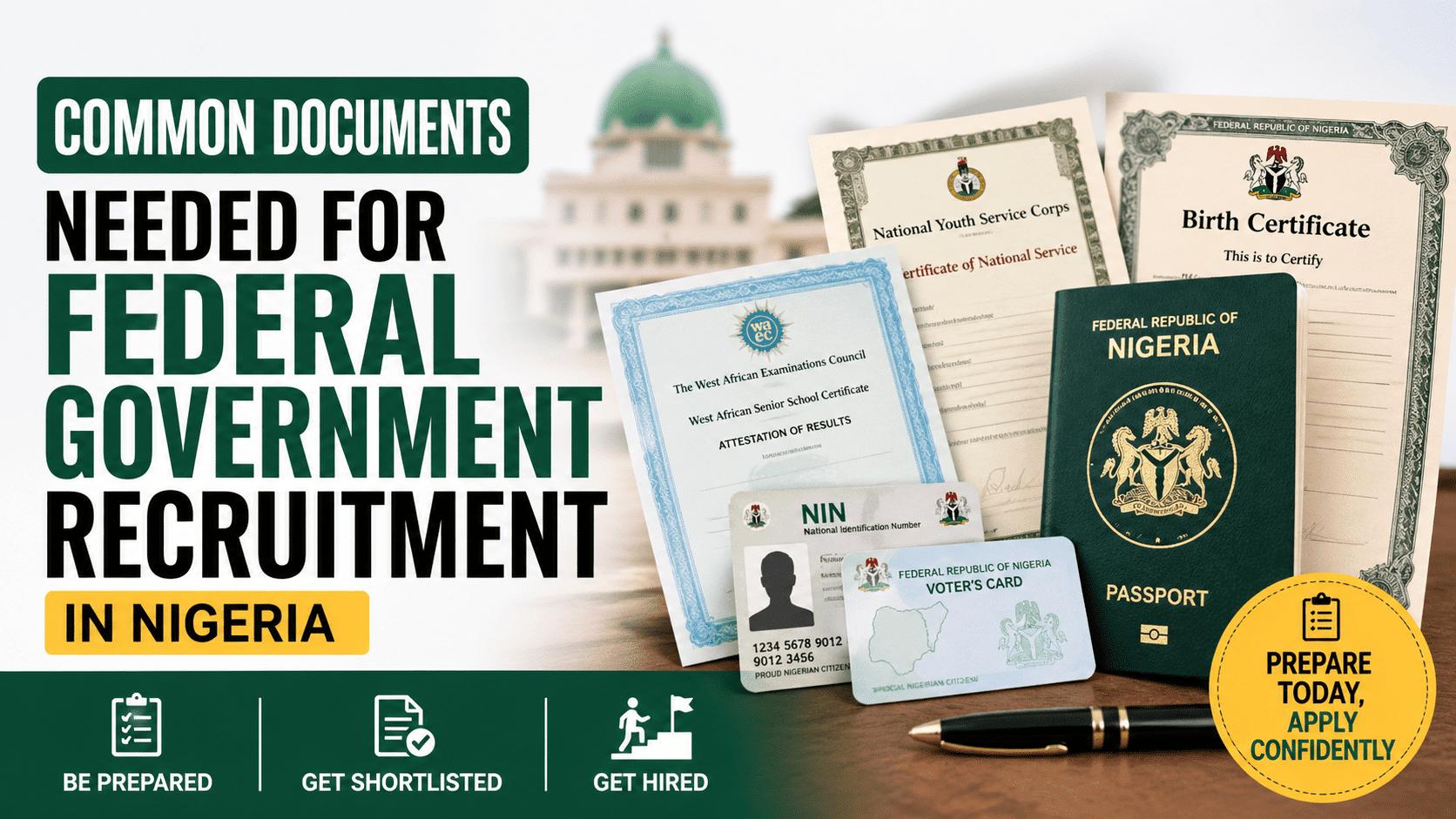
    Common Documents Needed for Federal Government Recruitment in Nigeria (Before the Portal Opens)

    Last updated: July 26, 2026

    When my closed friend, Suleiman finally sees a federal recruitment portal go live. He was excited feels qualified, and ready. Then reality hit him. He had no scanned certificate, no passport photo, no NYSC certificate nearby, and his birth certificate had two different spellings of his surname.

    By morning, the deadline traffic had crashed the site.

    That is how many Nigerians lose opportunities: not because they are unqualified, but because they are unprepared.

    If you plan to apply for any Federal Government recruitment in Nigeria, whether through the Federal Civil Service Commission, customs-related agencies, ministries, parastatals, or national programmes, these are the common documents you should have ready before any portal opens.

    Why Documents Matter More Than Many People Think

    Most applicants focus only on when forms will come out. Smart applicants prepare documents first.

    Federal recruitment portals often ask you to upload files immediately. Some systems reject wrong formats, blurry scans, or incomplete details. If your names do not match across documents, you may face verification issues later.

    That is the painful truth many blogs skip.

    1. Educational Certificates

    Your WAEC, NECO, NABTEB, ND, HND, NCE, or university degree certificate is usually the first requirement.

    Some roles only need SSCE. Others require diploma or degree qualifications. Keep both original copies and clear scanned versions.

    If you are awaiting certificate collection, results statements may sometimes be accepted temporarily, but always verify on the official advert.

    2. Means of Identification

    Most federal applications request valid ID. Common ones include:

    • National Identification Number (NIN) slip/card
    • International Passport
    • Voter’s Card
    • Driver’s Licence

    As of my last check, NIN has become increasingly important in many Nigerian processes. Make sure your name and date of birth match your other records.

    3. Birth Certificate or Age Declaration

    This is where many people panic.

    Some agencies ask for birth certificate from the National Population Commission, while others may accept sworn age declaration.

    If your age is close to recruitment limits, check requirements carefully. Never alter age records. It creates problems later during screening.

    4. NYSC Certificate or Exemption Letter

    For graduates, this is a major requirement.

    If you finished university or polytechnic at degree/HND level, many federal jobs request:

    • NYSC Discharge Certificate
    • Exemption Letter
    • Exclusion Letter (where applicable)

    Without this, many graduate-level applications stop immediately.

    What Nobody Tells You

    Sometimes your biggest enemy is inconsistency.

    “Musa Mustapha” on WAEC. “Mustapha Musa” on NIN. “Musa M.” on degree certificate.

    That small mismatch can delay screening more than low grades.

    I have seen brilliant candidates lose chances because they ignored affidavit correction early enough.

    5. Passport Photograph and CV

    Most portals request a recent passport photo with plain background.

    Also keep an updated CV ready, even if not requested initially. Some agencies ask later by email or during physical screening.

    Your CV should show education, skills, work experience, and referees clearly.

    Practical Steps to Prepare Now

    1. Scan all certificates clearly in PDF and JPEG formats.
    2. Save documents with simple names like WAEC.pdf or NIN.jpg.
    3. Check that all names match exactly.
    4. Renew expired IDs now, not later.
    5. Keep soft copies in email, phone, and flash drive.
    6. Follow only official portals and verified announcements.

    Closing

    Federal Government recruitment in Nigeria is competitive, but many people eliminate themselves before the race starts.

    Do not be that person rushing to cybercafés while others are already submitting calmly from home.

    Prepare your common documents needed for Federal Government recruitment in Nigeria now. Opportunity respects those who are ready.