Last updated: July 21, 2026
I sat in my uncle’s small shop in Minna, three weeks before my WAEC exam, with a booklet of past questions spread open on my lap. The booklet was from 2009. Half the pages were torn. The ink on some questions had smudged so badly you had to guess what the question was asking. But I treated that thing like gold because nobody had told me where else to look.
I passed. Not brilliantly. But I passed.
Years later, a girl named Hauwa from Gombe contacted me on this blog. She had failed WAEC twice, Economics and English. She was 19, her parents were talking about pulling her out of school entirely, and she was spending money she didn’t have on “expo” groups on Telegram that were obviously scams. We talked for about an hour. The first thing I asked her was: “Have you ever sat down with actual past questions from the last five years?” She said she had seen them but never really used them properly.
She sat for WAEC the third time. She got C5 in Economics and B3 in English. She still sends me messages during festive periods.
This article is for everyone who is in the position Hauwa was in. Not just the struggling ones but also the ones who are studying hard and still not sure they’re studying the right things.
Why Past Questions Are Not Just “Practice”
A lot of students treat past questions as a warm-up exercise. They flip through them the night before the exam, tick options at random, and call it studying. That is not how this works.
WAEC, which is managed by the West African Examinations Council, follows something called a syllabus and a scheme of work that stays largely consistent from year to year. The council has examiners who set questions based on that same approved syllabus. Because the syllabus doesn’t change drastically, certain topics come back. Not the exact same question word for word, but the same concept, tested in a slightly different way.
When you study past questions properly, you are not memorising answers. You are learning how WAEC thinks. You are training yourself to recognise the pattern of what they test, how they phrase trap options, and which topics they genuinely care about versus which ones are mentioned in the textbook but never show up in an exam hall.
That is a very different thing from just reading your textbook cover to cover and hoping for the best.
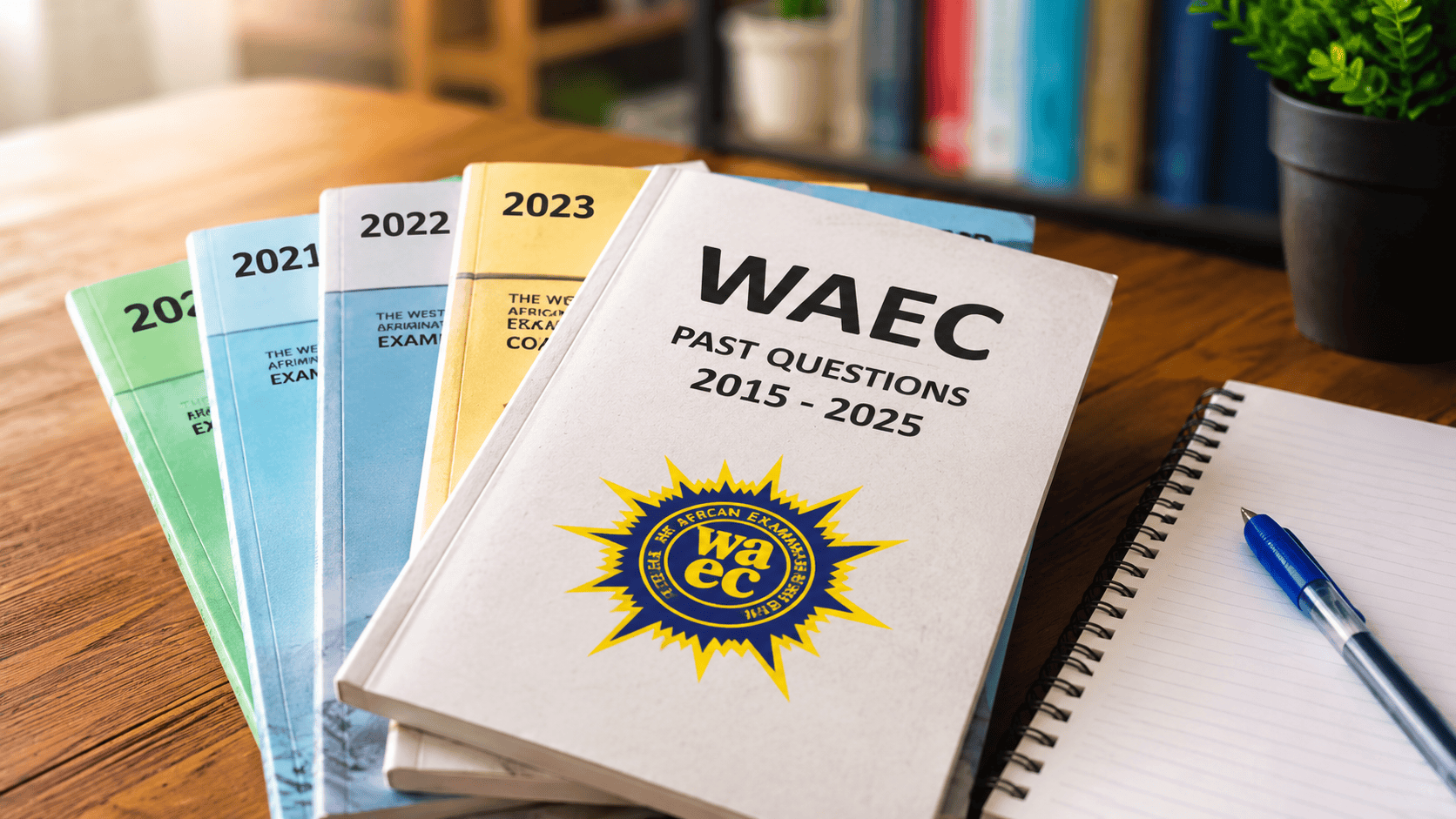
Where to Actually Get WAEC Past Questions (2015-2025)
This is where most students waste money and time. Let me save you both.
The most legitimate and complete source is the WAEC past question booklets sold by the official WAEC office. You can find them at WAEC state offices across Nigeria, and some certified bookshops near federal and state secondary schools stock them. They are the real thing. No missing questions, no altered options. If you can get the physical booklet, get it. As of my last check, they go for between N500 and N1,500 per subject depending on the number of years covered.
Digitally, there are a few platforms that are worth your time. Myschool.ng has a sizeable library of past questions across different WAEC years and subjects. The interface is straightforward, and most of it is free to access. Examguru.ng is another one that has organised past questions in a way that is easy to practice from. There is also the official WAEC e-learning portal at waeconline.org.ng, though I’ll be honest, navigating it can test your patience.
What I tell students to avoid are the random PDF files circulating on WhatsApp groups and Telegram channels. Some of those files are genuine. Many are not. I have seen “WAEC past questions 2024” files that had questions from 2011 relabelled, or files where the answers were simply wrong. One student I spoke to last year had memorised incorrect answers from one of those files and walked into the exam confused.
If you are going to use digital sources, stick to the platforms I named or ask your school’s subject teacher to help you verify the source.
How to Use WAEC Past Questions the Right Way
Getting the materials is the easy part. Using them correctly is where most students fall short.
The approach I always recommend is this: pick one subject, go back ten years, and read through the questions without looking at the answers first. Try to answer from what you know. Then mark yourself. But do not just mark yourself and move on. For every question you got wrong, go back to your textbook and read the concept behind it. Understand why the correct answer is correct. Understand why the option you picked is wrong.
This process is slow. It is supposed to be slow. Hauwa told me she spent three days on five years of Economics past questions alone. That is not excessive. That is how learning actually happens.
After you have gone through that exercise, you will start to notice things. In English Language, the comprehension passages almost always test the same set of comprehension skills: identifying the writer’s tone, inferring meaning from context, and recognising cause-and-effect relationships. In Mathematics, quadratic equations, indices, and probability show up with a consistency that is almost reassuring. In Biology, ecology, genetics, and cell structure are perennial favourites.
If you are also preparing for JAMB alongside WAEC, the same discipline of past-question study applies there. I wrote about the best apps for JAMB CBT practice, and that guide covers tools that are also useful for general exam preparation across both exams. You can read it here.
What Actually Repeats Across 2015 to 2025
I have spent time going through WAEC papers across different subjects, and I want to give you something specific rather than vague reassurances.
In Chemistry, questions on mole concept, electrolysis, and organic chemistry reactions (particularly hydrocarbon series and functional groups) have appeared in every single year I checked from 2015 to 2024. Not the same question. The same concepts. A student who cannot balance a redox equation or explain what happens at the cathode during electrolysis is leaving marks on the table every year.
In Economics, supply and demand analysis, national income concepts, and theories of production recur with high frequency. The data response section almost always tests a student’s ability to calculate or interpret something from a table, not just define terms.
In English Language, the summary section is consistently the one that separates the B grades from the C grades. Students who learn how to identify the main point of a paragraph and write it in their own words, without copying from the passage, tend to score well. Those who lift sentences from the passage rarely do.
In Mathematics, topics like logarithms, mensuration (area and volume calculations), and coordinate geometry have been present in almost every year across the decade I reviewed. Students who skip these topics because they seem “hard” often find themselves staring at familiar concepts in the exam hall with nothing to say.
The Honest Truth About WAEC Expo Culture
I have to say this even though it is uncomfortable.
Every year, thousands of Nigerian students pay money to people who claim they will send WAEC answers the night before or morning of the exam. I know students who have done this. I know families who have pooled money together for it. Some of these schemes are outright fraud. Others involve breached security from individuals inside the exam chain, which is a criminal offence with consequences that extend beyond the student to their parents and their entire school.
Even when it “works,” the student who enters the exam hall dependent on expo enters with anxiety, not knowledge. They cannot attempt the theory questions with confidence. They cannot adapt if the answers they received do not match what is on the actual paper, which happens more often than people admit. And if WAEC cancels their results (which they do, regularly), those students lose an entire year.
The honest calculation is this: six months of consistent study using real past questions gives you a better chance of excellent results than any expo scheme. It also gives you knowledge you actually carry into university or into your career. The expo gives you nothing except stress and, if you’re unlucky, a criminal record.
Practical Steps to Build Your WAEC Study Plan Around Past Questions
Start by getting at least five years of past questions for each subject you are sitting. That is your baseline. Ten years is better.
Work through one year’s worth of questions per subject each week. Do not rush this. Rushing defeats the purpose.
Keep a notebook (physical or digital) where you write down every topic you got wrong. After you finish all the years, that notebook becomes your personal list of weak areas. Focus your remaining study time there.
Simulate exam conditions at least twice before your exam date. Set a timer, put your phone away, and work through a full past paper from start to finish without stopping. The first time you do this, it will be uncomfortable. That discomfort is useful information.
If you have access to a reading group or a good teacher, review the papers together after you have done them individually. You will be surprised how many things you misunderstood that a short conversation can fix.
Finally, verify that you are using current past questions for your year. WAEC occasionally updates its syllabus. As of my last check, the 2023 WAEC Chief Examiner’s Report (available on the WAEC website) contains notes on which topics candidates struggled with most and what the examiners expected. That document is underused and is one of the most valuable free resources available.
The Work Is Yours to Do
Nobody passes WAEC on someone else’s effort. Not permanently. The students I have watched build genuine, lasting success in their education and careers are the ones who did the unglamorous work: sitting with past questions, getting things wrong, going back to the textbook, trying again.
If Hauwa had not been willing to do that, my advice would have been worthless. The information is available. The past questions exist. The patterns are there for anyone who looks carefully enough.
You already know what you need to do. The only question left is whether you will actually do it.
Start today. Not after the next holiday. Not when you “feel ready.” Today.
Leave a Reply