Tag: WAEC Updates

  • I Failed WAEC Twice – Here’s Exactly What I Changed to Score 7 A’s

    I Failed WAEC Twice – Here’s Exactly What I Changed to Score 7 A’s

    Last updated: July 21, 2026

    The second time I saw my WAEC result, I didn’t even open it immediately. I already knew what was inside.

    That kind of silence your chest carries… I had it.

    The first time I failed, people said, “It happens.” The second time, nobody said anything. That silence is worse than insults.

    I’m Musa Mustapha, and I’m not telling you a motivational story. I’m telling you exactly what I did differently the third time that gave me 7 A’s — after two painful failures.

    If you’re preparing for WAEC right now, or you’ve already failed once, read this slowly. This might save you a whole year of your life.

    The Reality I Had to Accept (After Failing Twice)

    After my second failure, I stopped blaming WAEC.

    Not the questions. Not the system. Not even my school.

    I sat down one evening in 2016 at home in Kaduna, and I asked myself one uncomfortable question:

    “If WAEC is truly unfair, why are thousands of students still getting A’s?”

    That question changed everything.

    Because the truth is, I wasn’t failing because WAEC is hard. I was failing because my approach was weak.

    And that’s the part most students don’t want to hear.

    Mistake #1: I Was Reading Hard — But Not Reading Right

    I used to “read” for hours.

    I would open my notebook, underline things, even feel proud of myself.

    But when I tried past questions, I couldn’t answer simple things.

    That’s when I realized something painful:

    Reading is not the same as understanding.

    The WAEC exam is not designed to reward who reads the most. It rewards who understands patterns.

    So I changed my method completely.

    Instead of just reading notes, I started studying with WAEC past questions as my main guide.

    Every topic I read, I immediately asked:

    • How has WAEC asked this before?
    • What pattern do they follow?
    • What kind of trick do they like using?

    Within weeks, things started making sense.

    WAEC is not unpredictable. It repeats styles — just in different forms.

    Mistake #2: I Ignored My Weak Subjects

    Let me be honest — I was avoiding Mathematics like it was a curse.

    English too? I just assumed I was “average” and left it like that.

    But WAEC doesn’t reward comfort.

    It exposes weakness.

    The subjects I feared the most were the exact ones dragging my result down.

    So I did something I had never done before:

    I faced them head-on.

    I started solving Maths every single day — even when I got everything wrong.

    I rewrote English essays and forced someone better than me to mark them.

    It was frustrating. It was slow. But it worked.

    Because consistency beats talent in WAEC.

    Mistake #3: I Studied Alone (Biggest Error)

    This one nearly ruined me.

    I thought studying alone meant I was serious.

    But in reality, I was stuck in my own understanding.

    When I finally joined a small group — just 3 of us — everything changed.

    We argued answers.
    We explained topics to each other.
    We corrected each other’s nonsense.

    And something powerful happened:

    If you can teach a topic, you understand it.

    That’s when I knew I was improving.

    What Nobody Tells You About WAEC

    Let me say something most blogs will never tell you:

    WAEC is not just about intelligence — it’s about exam strategy.

    I’ve seen brilliant students fail.

    I’ve also seen average students score A’s.

    Why?

    Because WAEC rewards:

    • Speed
    • Accuracy
    • Familiarity with question patterns

    Not who is “naturally smart.”

    Another truth?

    Some schools don’t prepare students properly. They rush the syllabus. They don’t focus on past questions.

    So if you’re depending only on your school, you might be in trouble.

    You have to take control of your own preparation.

    Nobody is coming to rescue your result.

    The Exact System I Used to Score 7 A’s

    When I decided I was done failing, I created a system. Not motivation — a system.

    Here’s exactly what I did:

    1. I Studied Past Questions Like a Textbook

    I got at least 10 years of WAEC past questions for each subject.

    Not to “practice” — but to study patterns.

    I noticed:

    • Certain topics come out every year
    • Some questions are just reworded versions of old ones

    That alone increased my confidence massively.

    2. I Created a Daily Timetable I Actually Followed

    Not those unrealistic timetables students draw and abandon after 2 days.

    Mine was simple:

    • 3 subjects per day
    • 2–3 hours total

    Consistency was more important than intensity.

    3. I Focused More on Understanding Than Memorizing

    Before, I used to cram.

    Now, I asked:

    • Why is this the answer?
    • How can WAEC twist this question?

    That mindset changed everything.

    4. I Practiced Under Exam Conditions

    This was a game changer.

    I started timing myself while solving questions.

    No phone. No distraction.

    Because knowing the answer is one thing — finishing on time is another.

    5. I Fixed My English and Maths Aggressively

    I gave them extra time daily.

    Because no matter your course, failing English or Maths can destroy your entire result.

    The Turning Point

    About one month before the exam, something strange happened.

    Past questions started feeling… familiar.

    Not because I had memorized them.

    But because I understood how WAEC thinks.

    That’s when my confidence became real.

    Practical Steps You Can Start Today

    If you’re serious about not failing WAEC, do this:

    1. Get at least 10 years of WAEC past questions for all your subjects
    2. Study topics alongside past questions — not separately
    3. Identify your weakest 2 subjects and double your effort there
    4. Form a small, serious study group (not more than 4 people)
    5. Practice answering questions under time pressure every week
    6. Stop “reading for long hours” — start reading with purpose
    7. Ask for help when you don’t understand something — immediately

    Do this consistently for 2–3 months, and your confidence will change.

    The Day I Saw My Result

    The third time, I opened my WAEC result with fear.

    But this time, it was different.

    A1. A1. B2. A1…

    I checked it again.

    Seven A’s.

    I didn’t shout. I didn’t run.

    I just sat down quietly… and smiled.

    Because I knew something most people don’t:

    It wasn’t luck. It was a system.

    Final Words — Read This Carefully

    If you’ve failed WAEC before, you’re not finished.

    But if you keep using the same method that made you fail…

    You’re repeating the same mistake.

    Change your strategy, not your dream.

    Because the difference between failure and 7 A’s is not talent.

    It’s how you prepare.

  • WAEC Result Upgrade Scams Students Must Avoid in Nigeria (Read Before You Pay Anyone)

    WAEC Result Upgrade Scams Students Must Avoid in Nigeria (Read Before You Pay Anyone)

    Last updated: July 21, 2026

    Every admission season, the pressure returns. JAMB score is out, schools are releasing cut-off marks, parents are asking questions, and WhatsApp groups are full of “helper” contacts. That is when many students fall for WAEC Result Upgrade scams.

    Someone promises to change D7 to B3 in two days. Another claims they “work inside WAEC office.” They ask for ₦20,000, ₦50,000, or more. After payment, they disappear—or send a fake result screenshot.

    I have seen students lose money, miss admission deadlines, and suffer emotional stress because of this trap. If you are considering any WAEC Result Upgrade offer, please read this first.

    What Is WAEC Result Upgrade?

    This phrase is commonly used by fraudsters who claim they can alter or improve your WAEC grades after results have been released.

    Let’s be direct: WAEC does not officially authorize random agents to edit your grades for money.

    If there is any genuine correction process, it is usually for errors like name spelling, date of birth issues, or result checking concerns through official channels—not magically changing F9 to A1.

    How These Scams Usually Work

    1. They Use Urgency

    They say:

    • “Admission closes tomorrow.”
    • “Last batch tonight.”
    • “Do it now before portal shuts.”

    Pressure makes people think less carefully.

    2. They Borrow Trust

    Some use profile photos with suits, NYSC uniforms, or office logos. Others claim to know someone in WAEC.

    A display picture is not proof.

    3. They Request Part Payment First

    They ask for a “commitment fee” or “processing fee.” Once sent, more charges follow.

    4. They Send Edited Screenshots

    Many students do not know this: a screenshot is not an official result slip.

    3 Insights Most Blogs Don’t Mention

    1. Fake Upgrades Can Create Bigger Problems Later

    Even if someone gives you a manipulated printout, universities often verify results directly. Your admission can be delayed or cancelled.

    2. Scammers Target Parents Too

    Some fraudsters know parents are desperate to help their children. They emotionally pressure families into paying quickly.

    3. Cyber Cafés Can Mislead Students

    Not every café owner is dishonest, but some repeat rumors like “I know someone that upgrades results.” Always verify independently.

    Common Mistakes Students Make

    Believing WhatsApp Broadcast Messages

    If it starts with “100% legit,” be careful.

    Paying Without Verification

    Never send money because a friend said it worked for someone else.

    Waiting Too Long Before Planning Alternatives

    Many students waste months chasing fake upgrades instead of registering for the next exam.

    What To Do Instead (Safe Options)

    Rewrite Through Legit Exams

    Consider:

    • WAEC GCE
    • NECO
    • NABTEB (where relevant)

    Improve Other Admission Factors

    A stronger JAMB score or change of institution may help.

    Use Time Wisely

    While waiting, learn digital skills, volunteer, or prepare documents. One exam setback should not pause your whole life.

    Expert Tips From Musa Mustapha

    • If anyone guarantees grade changes, walk away.
    • Always verify updates from official WAEC sources. Policies and procedures can change.
    • Save your money for exam registration, textbooks, transport, or data.
    • Tell younger siblings and friends—many scams survive through silence.

    FAQ

    Is WAEC Result Upgrade real?

    Most offers online are scams. Be extremely cautious.

    Can WAEC correct mistakes?

    Yes, certain genuine data issues may have official procedures. Verify through WAEC directly.

    Can universities detect fake upgraded results?

    Often yes. Many schools verify results with official databases.

    What is the best alternative to poor WAEC grades?

    Rewrite through WAEC GCE, NECO, or other accepted exams.

    I already paid a scammer. What should I do?

    Stop further payments, gather evidence, report to your bank, and report relevant authorities.

    Honest Conclusion

    I understand the pressure. In Nigeria, one result can feel like it controls your future. Family expectations are real. Admission deadlines are stressful. But paying for a fake WAEC Result Upgrade usually adds pain, not progress.

    A delayed success built honestly is better than a rushed shortcut that damages your future. Protect your money, your name, and your peace of mind.

  • WAEC Grading System Explained: How to Calculate Your Points for University Admission

    WAEC Grading System Explained: How to Calculate Your Points for University Admission

    Last updated: July 21, 2026

    Yes guys! I can still recall the afternoon my result came out on the WAEC portal. I was in a cybercafe in Minna, sweating through my shirt, refreshing the page like my life depended on it, because honestly, it did. When I finally saw my results, I had no idea what half of those letters meant. B3 in Chemistry. C5 in Physics. D7 in Further Mathematics. I just stared at the screen and asked the guy beside me, “Abeg, is this one pass or fail?”

    Nobody had explained the WAEC grading system to me properly. My school printed results and distributed them without a single session on what the grades actually meant for my university future. If you are in that same position right now, this post is for you.

    What the WAEC Grading System Actually Looks Like

    WAEC grades are not like your secondary school report card where you got 70% and your teacher wrote “Good.” WAEC uses a number-and-letter system that combines your raw percentage score with a grade that indicates your performance level.

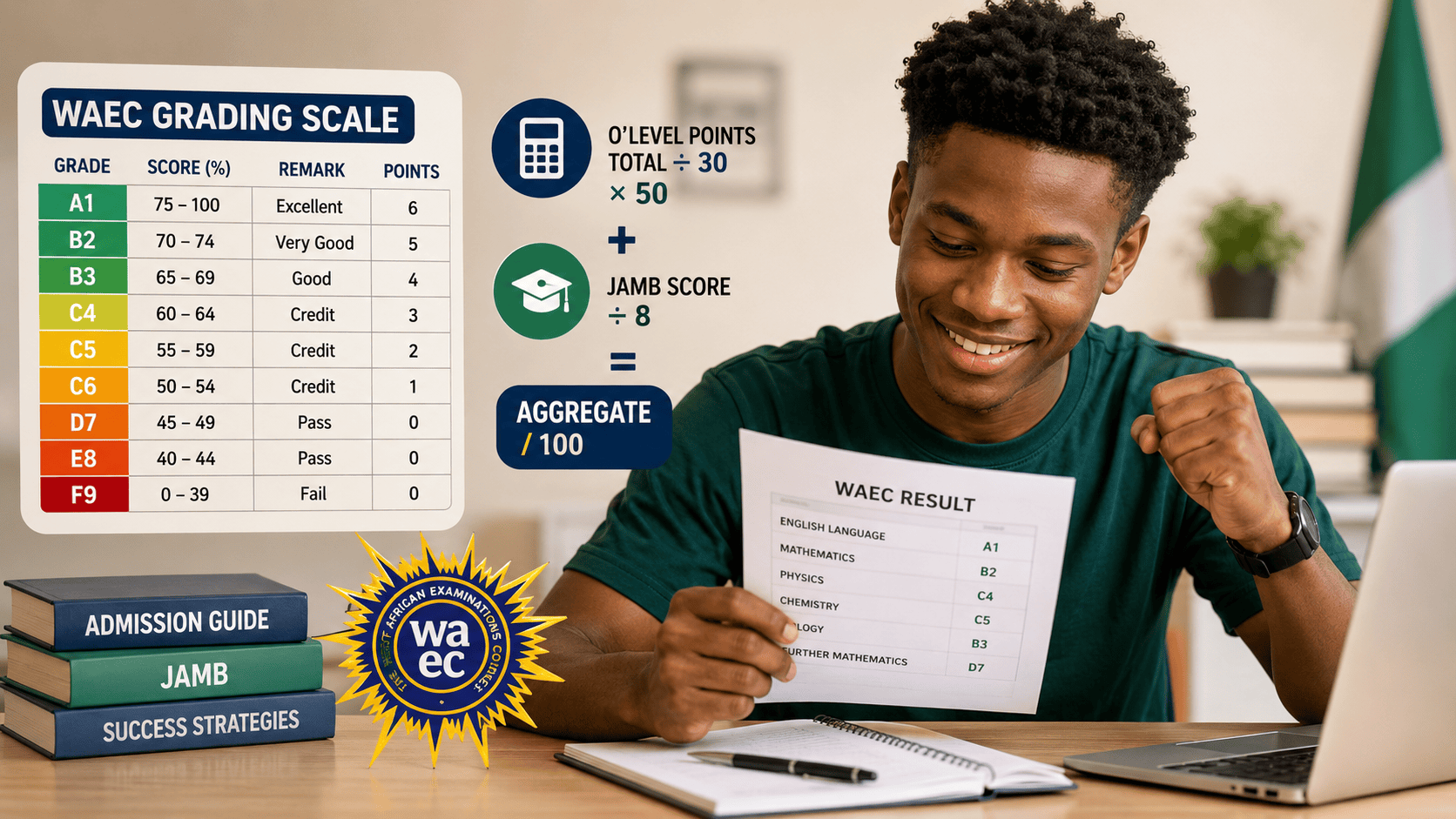
    Here is how it breaks down. A score between 75 and 100 percent gives you an A1, which is Excellent. From 70 to 74 percent, you get a B2, rated Very Good. B3, which is Good, covers 65 to 69 percent. Then come the Credit grades: C4 for 60 to 64, C5 for 55 to 59, and C6 for 50 to 54. Below that, D7 covers 45 to 49 and is a Pass, while E8 covers 40 to 44 and is also a Pass. Anything below 40 is F9, which is a Fail.

    The most important thing to understand is that only grades A1 through C6 are considered Credits. And for university admission in Nigeria, JAMB and WAEC-accepting institutions require a minimum of five Credit passes, which must include English Language and Mathematics for most courses.

    Why Credits Matter More Than Raw Scores

    A lot of students obsess over their percentage score when what universities actually look at is whether you have a Credit or not. The difference between a C6 and a D7 is not just one grade on a paper. That gap could be the reason JAMB rejects your admission during the o’level verification stage.

    I mentored a student from Kogi State, Blessing, who scored 289 on JAMB and was shocked when she did not get admitted to study Nursing. She had D7 in Biology. That was it. One subject, one grade below credit, and her entire admission fell apart. Universities running programs like Medicine, Law, Pharmacy, and Nursing are extremely strict about this.

    How WAEC Grades Translate Into Points for Aggregate Scores

    This is where most students get confused, and honestly, most blogs skip this part entirely. When universities calculate your aggregate admission score, they do not just look at whether you have Credits. They assign numerical points to each of your grades and use those points in a formula alongside your JAMB score and sometimes a Post-UTME score.

    The generally accepted point scale works like this. A1 carries 6 points. B2 carries 5 points. B3 carries 4 points. C4 carries 3 points. C5 carries 2 points. C6 carries 1 point. D7, E8, and F9 carry zero points each.

    Universities typically take your best five O’Level subjects and add up the points. The maximum you can score from your five best subjects is 30 points (5 subjects multiplied by 6 points each). That total is then converted to a score out of 50 using a simple formula: divide your total O’Level points by 30, then multiply by 50.

    Let me give you a real example. Suppose your five best subjects give you these grades: A1 in English (6 points), B2 in Mathematics (5 points), C4 in Physics (3 points), C5 in Chemistry (2 points), and B3 in Biology (4 points). Your total is 20 points. Divide 20 by 30, then multiply by 50. Your O’Level score in the aggregate formula becomes 33.3 out of 50.

    How the Full Aggregate Is Calculated

    Universities combine your O’Level score with your JAMB score (and Post-UTME score where applicable) to get your final aggregate. JAMB scores are usually converted to a score out of 50 by dividing your JAMB score by 8. So a JAMB score of 280 becomes 35 out of 50.

    Your full aggregate is then: O’Level score (out of 50) plus JAMB score (out of 50), giving a total out of 100. Using the example above, 33.3 plus 35 gives an aggregate of 68.3 out of 100.

    Some universities, especially older federal institutions, also factor in a Post-UTME score. In those cases, they may split the 100 marks three ways. Always check the specific formula for your target school on their official admissions portal before making assumptions.

    What Nobody Tells You About Your WAEC Grades and Admission

    Here is the truth that will save you from making a very painful mistake. Not all combinations of five Credit passes are treated equally. If you have A1 in five subjects but none of them are English Language and Mathematics, universities running science or social science courses will still reject your application at the screening stage.

    Also, some JAMB-accepting institutions verify your WAEC result directly through the WAEC Result Checker portal during admission screening. If there is any discrepancy between what you submitted and what the WAEC portal shows, your admission can be revoked, even after you have paid acceptance fees. This has happened to real students. Always cross-check your submitted grades against what the official WAEC portal displays.

    Your Practical Steps From Here

    First, check your result on the official WAEC portal at waecdirect.org and write down each subject grade alongside its numerical point value using the scale explained above.

    Second, identify your five strongest subject grades, making sure English Language and Mathematics are among them if your intended course requires both.

    Third, calculate your O’Level points total, divide by 30, and multiply by 50 to get your O’Level aggregate component.

    Fourth, take your JAMB score and divide by 8. Add that figure to your O’Level component. The result is your base aggregate. Compare this against the cut-off mark for your course and institution.

    Fifth, if your O’Level points are low, know that a higher JAMB score can partially compensate. Retaking JAMB to boost your score is sometimes a smarter move than repeating WAEC if your grades are already at Credit level.

    Sixth, verify everything on official portals. WAEC results go on waecdirect.org. JAMB admission status is checked on efacility.jamb.gov.ng. Never rely solely on your school printout.

    You Are Not Behind, You Just Need the Right Information

    The WAEC grading system is not complicated once someone explains it clearly. The frustrating part is that most students never get that explanation before they are already in a crisis. You have it now.

    Whether you are planning to sit WAEC for the first time, just received your results, or are in the middle of an admission cycle trying to figure out why your aggregate is not adding up, use what you have learned here to take one step forward today. Calculate your O’Level points. Know your number. Own your application.

    And if your grades did not go the way you hoped this time, that is not the end of your story. It was not the end of mine either.

  • WAEC 2026 New Subject Combination Rules: What Changed and How It Affects You

    WAEC 2026 New Subject Combination Rules: What Changed and How It Affects You

    Last updated: July 21, 2026

    Sometime in 2013 I was just sitting in a cybercafe in Birnin Kebbi, sweating through a shirt that had seen better days, trying to figure out why my O’Level combination wasn’t acceptable for the course I wanted to study. The man beside me was printing something. I had nothing to print. I had just wasted a whole registration cycle because nobody told me the rules had quietly changed and the school I wanted to attend had updated its requirements months earlier.

    Nobody wrote about it. Nobody explained it properly. I had to find out the hard way.

    I’m writing this so you don’t repeat that.

    What WAEC Actually Changed for 2026

    WAEC released updated guidelines affecting subject combinations ahead of the 2026 examination cycle. These changes touch on which subjects can be combined, which are now compulsory depending on your intended field of study, and how certain vocational and technical subjects are now being classified.

    The biggest shift that has caught students off guard is the reclassification of some subjects that were previously treated as standalone options. Subjects like Data Processing, which many students in the South-West especially have been picking as a soft credit, now carry stricter pairing requirements. If you’re going into any science or technology-related programme, WAEC now expects you to pair it with a core science subject rather than treat it as a filler.

    For Arts and Social Science candidates, the compulsory English Language and Mathematics rule hasn’t changed, but WAEC has tightened what qualifies as an acceptable third and fourth subject for specific faculties. Literature in English, for instance, can no longer substitute for a social science core in certain combinations that some universities were previously accepting from their end.

    As of my last check on the official WAEC portal (waec.wal-org), these updates are reflected in the 2026 syllabus document. Please verify directly there because things can shift between when I write this and when you’re reading it.

    Why This Matters More Than You Think

    Here’s what most blogs won’t tell you: WAEC doesn’t operate in isolation. What WAEC accepts as a valid combination and what JAMB requires, and what your target university’s Faculty of Medicine or Law or Engineering accepts, are three different conversations. They don’t always agree.

    I’ve seen students who had five credits including the right subjects, but their combination didn’t satisfy the Direct Entry requirements of their school. The university’s departmental requirement had a clause the student never read.

    If you are also currently preparing your JAMB registration, I wrote a detailed breakdown of how JAMB requirements interact with your O’Level combination over here: JAMB Registration 2026/2027 Complete Guide. Read it alongside this post because they connect directly.

    The Science Students Who Are Most Affected

    If you’re sitting for WAEC 2026 and you intend to study Medicine, Pharmacy, Nursing, or any allied health programme, you need to listen carefully.

    WAEC’s updated guidance now places extra scrutiny on combinations that include Biology, Chemistry, and Physics without a practical science component being properly accounted for in school-based assessments. Some schools have been registering students with incomplete practical schedules and WAEC has flagged this as a compliance issue going into 2026. Your result could be withheld if your school’s practical records don’t match the examination body’s expectations.

    This is not something your teacher might warn you about. It’s administrative and quiet. Ask your school’s WAEC coordinator specifically about the practical submission schedule before your exams begin.

    What Nobody Tells You

    The honest truth that this space almost never talks about is this: the students who suffer the most from combination errors are not the ones who were careless. They’re the ones who trusted secondhand information.

    I’ve mentored students who got their subject combination advice from a senior in school who sat WAEC two years earlier. The rules had changed. The senior didn’t know. The student lost a year.

    WAEC reviews its regulations periodically. Some changes are announced loudly. Others slip into the updated syllabus with no press release. The only way to stay safe is to read the primary source yourself or work with someone who has.

    Also, not all WAEC subject changes translate to automatic JAMB or university acceptance. I’ve watched students celebrate five credits only to find out their particular combination doesn’t meet a specific university’s post-UTME screening requirement. The combination game is layered. You have to play all the layers simultaneously, not one at a time.

    Your Practical Action Plan

    First, go to the WAEC official website and download the current 2026 syllabus. Not a summarized version from another blog. The actual document. Look at the subject combination appendix.

    Second, write down the exact course and university you want. Then go to that university’s JAMB brochure entry and look at the O’Level requirements section, not just the subjects but the specific grades and combinations they’ve listed.

    Third, cross-reference what your school has registered you to sit. If there’s a mismatch anywhere, speak to your WAEC registration officer now, not in March when the timetable has dropped.

    Fourth, if you’re combining WAEC with a GCE sitting to strengthen your combination, understand that WAEC now applies the same combination rules to private candidates. Running a second sitting to get a different subject combination that WAEC flags as inconsistent across both results will cause you problems.

    Fifth, screenshot or download everything. Portals change. Pages go offline. You want a local copy of whatever combination rules you relied on at the time you registered.

    You Have Less Room to Guess Than You Think

    The WAEC 2026 changes are not catastrophic if you catch them now. They become catastrophic in August when results are out and you’re sitting with a combination that no university will touch.

    I’ve been in that chair. It is not a nice place to sit. The silence after you realize something went wrong is one of the loneliest feelings a young Nigerian can have.

    You have time right now. Use it. Read the primary documents. Ask the right questions. Don’t let a policy update you never saw take a year from your life.

    If you found this useful, share it with someone sitting WAEC 2026. You might be doing them the biggest favor of their academic life.

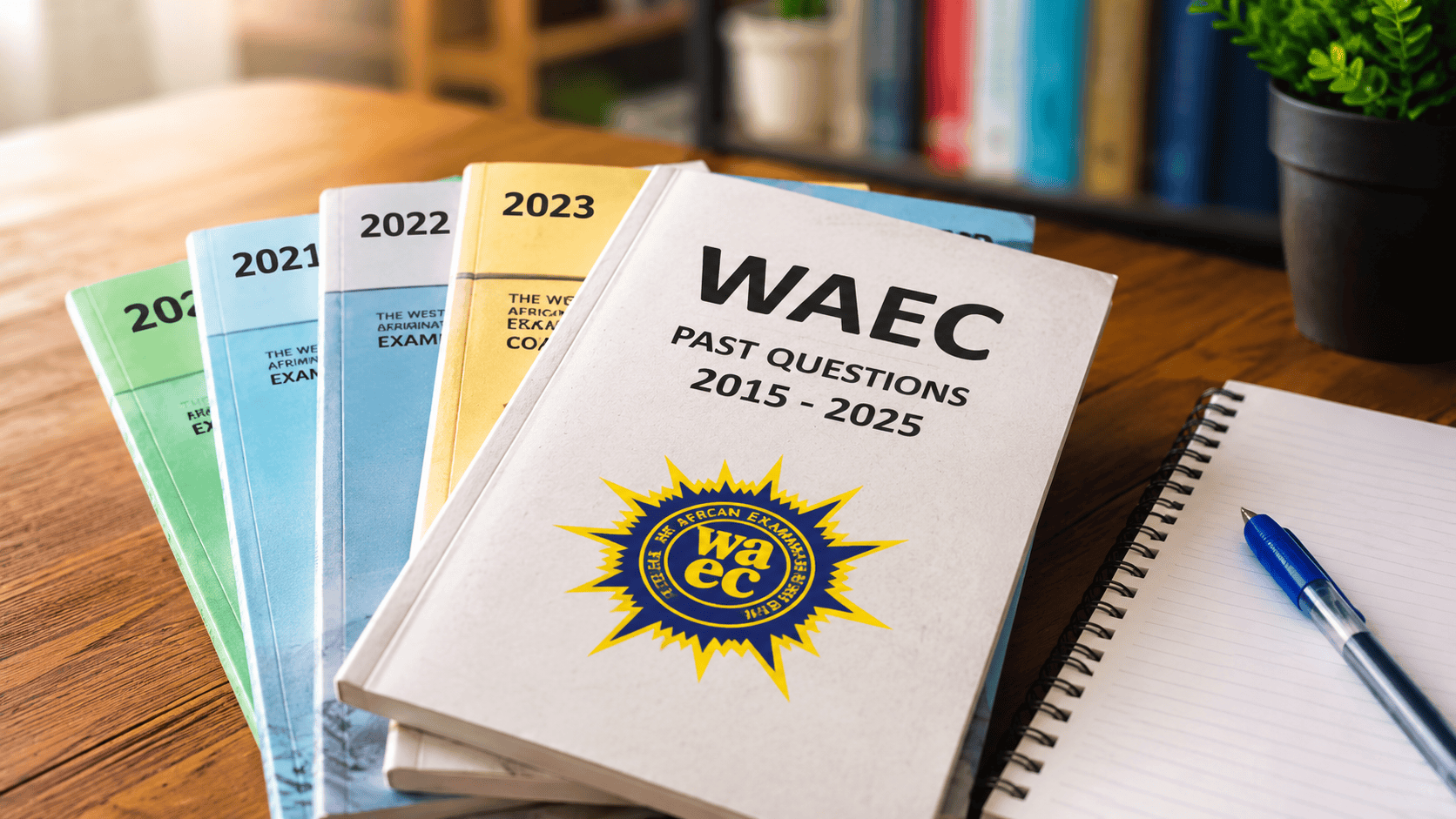
  • WAEC Past Questions and Answers 2015-2025: Best Sources, How to Use Them, and What Really Repeats

    WAEC Past Questions and Answers 2015-2025: Best Sources, How to Use Them, and What Really Repeats

    Last updated: July 21, 2026

    I sat in my uncle’s small shop in Minna, three weeks before my WAEC exam, with a booklet of past questions spread open on my lap. The booklet was from 2009. Half the pages were torn. The ink on some questions had smudged so badly you had to guess what the question was asking. But I treated that thing like gold because nobody had told me where else to look.

    I passed. Not brilliantly. But I passed.

    Years later, a girl named Hauwa from Gombe contacted me on this blog. She had failed WAEC twice, Economics and English. She was 19, her parents were talking about pulling her out of school entirely, and she was spending money she didn’t have on “expo” groups on Telegram that were obviously scams. We talked for about an hour. The first thing I asked her was: “Have you ever sat down with actual past questions from the last five years?” She said she had seen them but never really used them properly.

    She sat for WAEC the third time. She got C5 in Economics and B3 in English. She still sends me messages during festive periods.

    This article is for everyone who is in the position Hauwa was in. Not just the struggling ones but also the ones who are studying hard and still not sure they’re studying the right things.

    Why Past Questions Are Not Just “Practice”

    A lot of students treat past questions as a warm-up exercise. They flip through them the night before the exam, tick options at random, and call it studying. That is not how this works.

    WAEC, which is managed by the West African Examinations Council, follows something called a syllabus and a scheme of work that stays largely consistent from year to year. The council has examiners who set questions based on that same approved syllabus. Because the syllabus doesn’t change drastically, certain topics come back. Not the exact same question word for word, but the same concept, tested in a slightly different way.

    When you study past questions properly, you are not memorising answers. You are learning how WAEC thinks. You are training yourself to recognise the pattern of what they test, how they phrase trap options, and which topics they genuinely care about versus which ones are mentioned in the textbook but never show up in an exam hall.

    That is a very different thing from just reading your textbook cover to cover and hoping for the best.

    Where to Actually Get WAEC Past Questions (2015-2025)

    This is where most students waste money and time. Let me save you both.

    The most legitimate and complete source is the WAEC past question booklets sold by the official WAEC office. You can find them at WAEC state offices across Nigeria, and some certified bookshops near federal and state secondary schools stock them. They are the real thing. No missing questions, no altered options. If you can get the physical booklet, get it. As of my last check, they go for between N500 and N1,500 per subject depending on the number of years covered.

    Digitally, there are a few platforms that are worth your time. Myschool.ng has a sizeable library of past questions across different WAEC years and subjects. The interface is straightforward, and most of it is free to access. Examguru.ng is another one that has organised past questions in a way that is easy to practice from. There is also the official WAEC e-learning portal at waeconline.org.ng, though I’ll be honest, navigating it can test your patience.

    What I tell students to avoid are the random PDF files circulating on WhatsApp groups and Telegram channels. Some of those files are genuine. Many are not. I have seen “WAEC past questions 2024” files that had questions from 2011 relabelled, or files where the answers were simply wrong. One student I spoke to last year had memorised incorrect answers from one of those files and walked into the exam confused.

    If you are going to use digital sources, stick to the platforms I named or ask your school’s subject teacher to help you verify the source.

    How to Use WAEC Past Questions the Right Way

    Getting the materials is the easy part. Using them correctly is where most students fall short.

    The approach I always recommend is this: pick one subject, go back ten years, and read through the questions without looking at the answers first. Try to answer from what you know. Then mark yourself. But do not just mark yourself and move on. For every question you got wrong, go back to your textbook and read the concept behind it. Understand why the correct answer is correct. Understand why the option you picked is wrong.

    This process is slow. It is supposed to be slow. Hauwa told me she spent three days on five years of Economics past questions alone. That is not excessive. That is how learning actually happens.

    After you have gone through that exercise, you will start to notice things. In English Language, the comprehension passages almost always test the same set of comprehension skills: identifying the writer’s tone, inferring meaning from context, and recognising cause-and-effect relationships. In Mathematics, quadratic equations, indices, and probability show up with a consistency that is almost reassuring. In Biology, ecology, genetics, and cell structure are perennial favourites.

    If you are also preparing for JAMB alongside WAEC, the same discipline of past-question study applies there. I wrote about the best apps for JAMB CBT practice, and that guide covers tools that are also useful for general exam preparation across both exams. You can read it here.

    What Actually Repeats Across 2015 to 2025

    I have spent time going through WAEC papers across different subjects, and I want to give you something specific rather than vague reassurances.

    In Chemistry, questions on mole concept, electrolysis, and organic chemistry reactions (particularly hydrocarbon series and functional groups) have appeared in every single year I checked from 2015 to 2024. Not the same question. The same concepts. A student who cannot balance a redox equation or explain what happens at the cathode during electrolysis is leaving marks on the table every year.

    In Economics, supply and demand analysis, national income concepts, and theories of production recur with high frequency. The data response section almost always tests a student’s ability to calculate or interpret something from a table, not just define terms.

    In English Language, the summary section is consistently the one that separates the B grades from the C grades. Students who learn how to identify the main point of a paragraph and write it in their own words, without copying from the passage, tend to score well. Those who lift sentences from the passage rarely do.

    In Mathematics, topics like logarithms, mensuration (area and volume calculations), and coordinate geometry have been present in almost every year across the decade I reviewed. Students who skip these topics because they seem “hard” often find themselves staring at familiar concepts in the exam hall with nothing to say.

    The Honest Truth About WAEC Expo Culture

    I have to say this even though it is uncomfortable.

    Every year, thousands of Nigerian students pay money to people who claim they will send WAEC answers the night before or morning of the exam. I know students who have done this. I know families who have pooled money together for it. Some of these schemes are outright fraud. Others involve breached security from individuals inside the exam chain, which is a criminal offence with consequences that extend beyond the student to their parents and their entire school.

    Even when it “works,” the student who enters the exam hall dependent on expo enters with anxiety, not knowledge. They cannot attempt the theory questions with confidence. They cannot adapt if the answers they received do not match what is on the actual paper, which happens more often than people admit. And if WAEC cancels their results (which they do, regularly), those students lose an entire year.

    The honest calculation is this: six months of consistent study using real past questions gives you a better chance of excellent results than any expo scheme. It also gives you knowledge you actually carry into university or into your career. The expo gives you nothing except stress and, if you’re unlucky, a criminal record.

    Practical Steps to Build Your WAEC Study Plan Around Past Questions

    Start by getting at least five years of past questions for each subject you are sitting. That is your baseline. Ten years is better.

    Work through one year’s worth of questions per subject each week. Do not rush this. Rushing defeats the purpose.

    Keep a notebook (physical or digital) where you write down every topic you got wrong. After you finish all the years, that notebook becomes your personal list of weak areas. Focus your remaining study time there.

    Simulate exam conditions at least twice before your exam date. Set a timer, put your phone away, and work through a full past paper from start to finish without stopping. The first time you do this, it will be uncomfortable. That discomfort is useful information.

    If you have access to a reading group or a good teacher, review the papers together after you have done them individually. You will be surprised how many things you misunderstood that a short conversation can fix.

    Finally, verify that you are using current past questions for your year. WAEC occasionally updates its syllabus. As of my last check, the 2023 WAEC Chief Examiner’s Report (available on the WAEC website) contains notes on which topics candidates struggled with most and what the examiners expected. That document is underused and is one of the most valuable free resources available.

    The Work Is Yours to Do

    Nobody passes WAEC on someone else’s effort. Not permanently. The students I have watched build genuine, lasting success in their education and careers are the ones who did the unglamorous work: sitting with past questions, getting things wrong, going back to the textbook, trying again.

    If Hauwa had not been willing to do that, my advice would have been worthless. The information is available. The past questions exist. The patterns are there for anyone who looks carefully enough.

    You already know what you need to do. The only question left is whether you will actually do it.

    Start today. Not after the next holiday. Not when you “feel ready.” Today.