Author: Musa Mustapha

  • How to Write an Internship Application Email That Gets a Reply in Nigeria

    How to Write an Internship Application Email That Gets a Reply in Nigeria

    Last updated: July 30, 2026

    It was 2022. I had just finished my second year at university and desperately needed somewhere to do my SIWES. A family friend had given me a contact at a mid-sized engineering firm in Abuja. I spent two days “composing” what I thought was a professional email. I wrote things like “I am humbly bringing this letter to your esteemed organization…” I addressed it “Dear Sir/Ma.” I attached a CV that was basically a Word document with my name in bold at the top and very little else.

    Nobody replied. Not even to reject me.

    I did not get a response for three weeks. Eventually my mother called the family friend, who called someone at the firm, who told him that the HR person had read my email and could not figure out what I was actually asking for.

    That was the moment I realized something that changed how I write every professional email since: most Nigerian students are taught to write formal letters, not professional emails. These are two different things. A letter and an email have completely different rhythms, different expectations, and different rules. Nobody explicitly teaches students this gap, so they fall into it, again and again.

    If you have been sending internship emails and hearing nothing back, I want to show you exactly where things are going wrong, and how to fix it.

    Why Your Emails Are Being Ignored (And It Is Not What You Think)

    Most students assume their emails are ignored because the company is not hiring, or because their GPA is too low, or because they do not have connections. Sometimes those things are true. But more often, the email itself is the problem.

    HR staff at Nigerian companies, especially the bigger ones in Lagos, Port Harcourt, and Abuja, receive dozens of internship emails every week. Many of those emails look and read identically. They all say “I am a student of [university] writing to express my interest in an internship position.” They all attach a CV without explaining anything in the body. Most of them have vague subject lines like “Internship Application” or, worse, no subject at all.

    When someone reads the same opening line seventeen times in a day, they stop reading. Your email needs to make them stop scrolling within the first two sentences.

    What a Good Internship Application Email Actually Looks Like

    Before the template, understand the logic behind it.

    Your email should do four things and nothing else. It should tell them who you are in one line. It should tell them exactly what you want (not “an opportunity to learn and grow,” but specifically which department and for how long). It should give them one or two reasons to take you seriously. Then it should make it easy for them to say yes by telling them what to do next.

    That is it. The whole email should be five to eight short paragraphs and should take no more than forty-five seconds to read.

    Here is a real example based on an email I helped a 300-level Mass Communication student from UNILAG write last year. She sent it to four media companies. Two replied within 72 hours. She ended up at TVC Communications for her SIWES.

    Subject: SIWES Internship Request – Mass Communication, UNILAG (Available July–September)

    Good morning [Name or HR Team],

    My name is Adaeze Okonkwo, a 300-level Mass Communication student at the University of Lagos. I am writing to request a SIWES internship placement in your news or digital content department for the July to September 2024 period.

    I have been following TVC’s coverage of the Lagos state elections this cycle and was particularly impressed by your behind-the-scenes social media content. I have been running a student radio segment at the UNILAG campus station for the past year where I produce two short-form audio features weekly, and I believe the skills I have built there would let me contribute meaningfully from week one.

    I have attached my CV and my ITF Student Industrial Training letter for your review. I am available for a brief call or interview at your convenience and can be flexible around your team’s schedule.

    Thank you for your time.

    Adaeze Okonkwo 08XXXXXXXXX adaeze.okonkwo@student.unilag.edu.ng

    Study that email. Notice she did not say she was “humbly seeking.” She did not say she “looks forward to contributing to the growth of your organization.” She said something specific about TVC that showed she actually knew who they were. She mentioned a real thing she had done. She kept it clean and short.

    That is the template. Adjust for your name, school, department of interest, and one specific thing you know or like about the company.

    Also Read: How to Write a SIWES Placement Application Letter That Actually Gets You Accepted (With Real Examples)

    How to Research a Company Before Emailing Them

    This is the part most people skip, and it is the part that makes the biggest difference.

    Before you write a single word of your email, spend fifteen minutes on the company’s website and LinkedIn page. Look at what they have been doing recently. Did they launch a new product? Win an award? Post a job that is related to your field? Any of these can become the sentence that proves you are not just copy-pasting to fifty companies at once.

    You do not need to write an essay about their history. One sentence of genuine observation is enough. “I saw that your firm recently won the CIBN innovation award” or “I noticed your team has been expanding into digital banking” does more work than three paragraphs of general praise.

    If you cannot find a specific person’s name and email address, call the company’s front desk and ask who handles internship applications. Sending to a named person almost always performs better than sending to a generic info@ or hr@ address.

    The Attachment Problem Nobody Warns You About

    A lot of internship emails fail at the attachment stage, not the writing stage.

    Your CV should be a PDF, not a Word document. Word documents can look different on different computers and sometimes refuse to open entirely on phones, which is where many HR staff check emails first. A PDF looks the same everywhere.

    Name your file properly. “CV.pdf” tells them nothing. “AdaezeOkonkwo_CV_MassCom_2024.pdf” is searchable, professional, and shows you understand how to organize documents.

    If your SIWES requires you to attach your ITF student placement letter, include it as a separate attachment and mention both attachments by name in the email body. Do not make someone open your email and wonder what they are looking at.

    Also, speaking of SIWES: if you are still figuring out your logbook alongside your placement search, this guide on how to fill your SIWES logbook correctly will save you a serious headache later.

    What Nobody Tells You About Following Up

    Sending one email and waiting is not a strategy. It is hope.

    If you have not heard back in five to seven working days, send a follow-up. One short follow-up. Not “I am just checking in” (which says nothing) but something like: “I sent an internship request on [date] and wanted to confirm it reached the right person. I remain available and happy to provide any additional information.”

    That single follow-up has gotten more placements for students I have mentored than the original email. People get busy. Inboxes get messy. A polite nudge at the right moment is not annoying; it is competence.

    Do not follow up after two days. Do not follow up three times in a week. One follow-up, one week after the original email. If they still do not reply after that, move to the next company.

    The Honest Truth About Internship Emails in Nigeria

    Here is what most career blogs will not say plainly.

    Some companies in Nigeria have no structured internship process at all. They accept interns based on who calls first, whose uncle works there, or which student showed enough persistence to call back. This is not fair, and it is not how things should work. But it is real.

    This means your email is sometimes competing not against other emails but against phone calls and personal referrals. This is why I always tell students to use every channel available. Send the email. Then call to confirm they received it. Then send a polite LinkedIn connection request to someone in the department if you can find them. Do not be desperate or aggressive. Be persistent and professional. Those are different things.

    Your email gets you in the room. Your follow-through gets you the placement.

    Your Action Plan From Here

    Start by picking five companies in your field and writing company-specific emails for each one, not the same email sent five times. Use the subject line format: [Your Course] Internship Request + [University] + [Dates Available]. Attach a PDF CV named with your full name and year. Send between 8am and 10am on a Tuesday, Wednesday, or Thursday (these days consistently get higher open rates in professional email). Follow up exactly seven working days later if you hear nothing. Keep a simple spreadsheet tracking who you emailed, when, and what happened.

    Fifty applications taught me that the students who get placements are rarely the most qualified. They are the ones who communicate the clearest and follow up the most consistently.

    Your email is not a prayer. It is a pitch. Write it like one.

    If this helped you or if you have a story about an internship email that worked or flopped spectacularly, I want to hear it. Drop it in the comments. Someone else reading this needs to know they are not alone.
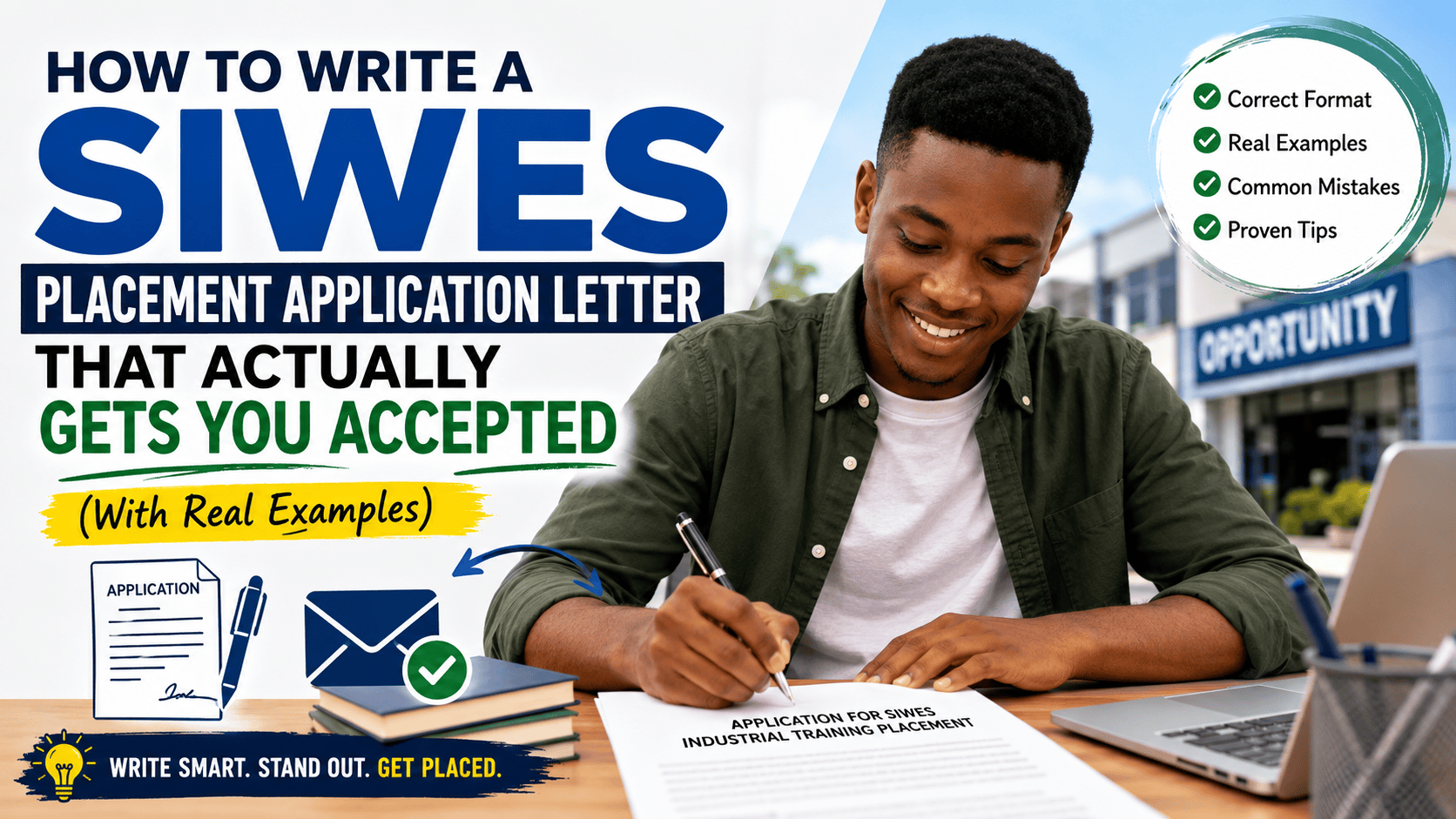

  • How to Write a SIWES Placement Application Letter That Actually Gets You Accepted (With Real Examples)

    How to Write a SIWES Placement Application Letter That Actually Gets You Accepted (With Real Examples)

    Last updated: July 30, 2026

    I want to tell you about a student named Ibrahim.

    Ibrahim was a 300-level Mechanical Engineering student at Ahmadu Bello University, Zaria. Smart boy. Good grades. But when SIWES season came around in 2021, he spent three weeks sending application letters to companies across Kaduna and Abuja and heard nothing. Not one response. Not even a rejection.

    When he finally sent me his letter, I understood why immediately. The first line read: “I am writing to humbly apply for industrial training placement in your reputable organization.”

    I have seen that exact sentence word for word n over thirty student letters. And I am not exaggerating. It is the most copy-pasted opening line in Nigerian student history. No recruiter reads past it with any excitement.

    We rewrote Ibrahim’s letter from scratch. Tailored it to a specific engineering firm in Kaduna. Mentioned their ongoing infrastructure projects. Linked his coursework in thermodynamics and manufacturing processes to what they actually did. Two weeks later, he had his placement.

    The letter did not get him the job. But it got him in the door. And that is exactly what it is supposed to do.

    First, Understand What This Letter Is Actually For

    Before you write a single word, you need to understand the purpose of a SIWES placement application letter because most students get this wrong from the start.

    This is not a begging letter. It is not a formality you rush through just to tick a box. It is a professional document that represents you before you walk into any building. It tells an employer: here is who I am, here is what I can contribute, and here is why your organization specifically is where I want to train.

    The Students Industrial Work Experience Scheme (SIWES) is coordinated by the Industrial Training Fund (ITF) in partnership with universities, polytechnics, and colleges of technology across Nigeria. It is designed to bridge the gap between classroom knowledge and real workplace experience. But the ITF does not assign you a placement. You find it yourself. And the first tool you use to find it is this letter.

    That pressure should not paralyze you. It should sharpen you. Because if you understand what the letter is for, you will stop writing it like everyone else and start writing it like someone who actually wants the placement.

    The Common Mistakes That Are Killing Your Chances

    Let me be blunt here, because I have read hundreds of these letters and the same errors appear over and over again.

    Using a recycled template without editing it properly. This is the number one killer. Students download a letter from a WhatsApp group or forum, change the name and maybe the company address, and send it off. Recruiters can feel this. The language is stiff, the content is generic, and nothing in the letter reflects any knowledge of the organization they are applying to. It reads like a letter addressed to the universe not to any specific company.

    Writing too formally to the point of sounding robotic. There is a difference between professional and inhuman. Sentences like “I wish to solicit your magnanimous consideration for industrial attachment in your esteemed establishment” do not impress anyone. They make you sound like you swallowed a 1990s government memo. Write with dignity, but write like a real person.

    Mentioning nothing about the company. This is probably the biggest missed opportunity. If you are applying to a petroleum servicing company and your letter does not mention oil and gas, pipelines, or anything connected to their work, why would they pick you over someone who did their research?

    Poor formatting and presentation. Torn edges, handwriting that bleeds into the margin, no date, wrong address format these things signal carelessness before anyone reads your first sentence. A letter that looks sloppy says: this person does not pay attention to detail.

    Spelling the company name wrongly. I have seen this happen. I wish I was joking.

    The Anatomy of a Perfect SIWES Application Letter

    Let us now break down what a strong letter looks like, section by section, so you understand not just what to write but why each part matters.

    Your Header and Address Block

    Your letter starts with your home address or school address, written at the top right of the page, followed by the date. Then, on the left side, below a small gap, comes the name and address of the person or organization you are writing to.

    If you know the name of the HR Manager or the person in charge of industrial training, use it. “The Human Resources Manager” is fine. “To Whom It May Concern” is lazy. Do a small Google search or call the company’s front desk and ask for the name of the HR contact. That small effort already separates you.

    Here is what a proper header looks like:


    No. 14, Gaskiya Road, Barnawa, Kaduna State. 15th May, 2025.

    The Human Resources Manager, Dangote Cement Plc, Obajana Plant, Kogi State.


    Simple. Clean. Professional.

    The Subject Line

    Right after the address block, before your salutation, write a short and clear subject line. It tells the reader immediately what this letter is about. Format it like this:

    RE: APPLICATION FOR SIWES INDUSTRIAL TRAINING PLACEMENT MECHANICAL ENGINEERING

    Bold it or underline it. Make it visible. This is not optional it is one of the first things a busy HR person scans.

    The Opening Paragraph — Where Most Letters Die

    This is your one shot to make a first impression. Do not waste it with “I humbly write to apply…” That line is dead. Bury it.

    Instead, open with a clear, confident statement of who you are and what you want then connect it immediately to something specific about the company. Here are two versions of an opening paragraph so you can see the difference:

    Weak version: “I am writing to apply for industrial training placement in your reputable organization. I am a student of Civil Engineering and I believe your company will provide me with a good learning experience.”

    Strong version: “My name is Amaka Okafor, a 300-level Civil Engineering student at the University of Nigeria, Nsukka, currently seeking a six-month SIWES placement for the 2025/2026 academic session. I am particularly interested in training with Julius Berger Nigeria because of your ongoing work on the Lagos-Ibadan Expressway rehabilitation project an area directly tied to my coursework in highway and pavement design.”

    Do you see the difference? The second version is specific, researched, and immediately tells the employer: this person knows who we are. That matters.

    The Middle Section — Sell What You Know

    In the next one to two paragraphs, you connect your academic training to what the company does. This is not about boasting. It is about relevance. You are basically answering the question every employer is silently asking: “What can this student actually do for us during those six months?”

    Be honest. You are a student they know that. But you have studied specific things. Mention them. Here is an example for a Computer Science student applying to a fintech company:

    “In the course of my studies at Covenant University, I have completed coursework in database management systems, object-oriented programming, and web application development. I have also built a small expense-tracking web application as part of my second-year project using HTML, CSS, and JavaScript. While I acknowledge that professional practice demands a far deeper skill set, I am eager to learn within your development and IT operations teams and contribute wherever I am found useful.”

    That paragraph does three things: it shows relevant knowledge, demonstrates initiative, and strikes a humble but confident tone. That combination works.

    The Closing Paragraph and Sign-Off

    Your closing paragraph should do two things: make a polite, direct request for placement, and invite further communication. Do not be wishy-washy. Here is a solid example:

    “I would be grateful for the opportunity to undergo my SIWES industrial training at your organization between July and December 2025. I am available for any interview or documentation requirements at your convenience. Please find attached a copy of my student ID, a letter of introduction from my department, and my curriculum vitae. I look forward to your kind response.”

    Then close with:

    Yours faithfully, (Your Signature) Chisom Eze Department of Computer Science, Covenant University Matric No: CU/21/0034 Phone: 08012345678 Email: chisom.eze@stu.cu.edu.ng

    Include your phone number and email in the sign-off. You would be shocked how many students forget this and then wonder why nobody called them.

    A Full Sample SIWES Application Letter

    Let me put it all together in one complete example so you have something real to reference:

    No. 7, Kwame Nkrumah Street, Wuse Zone 3, Abuja, FCT. 10th June, 2025.

    The Human Resources Manager, Nestlé Nigeria Plc, 22-24 Industrial Avenue, Ilupeju, Lagos State.

    RE: APPLICATION FOR SIWES INDUSTRIAL TRAINING PLACEMENT — FOOD SCIENCE AND TECHNOLOGY

    Dear Sir/Ma,

    My name is Hauwa Suleiman, a 300-level student of Food Science and Technology at the University of Abuja, currently seeking a six-month SIWES industrial training placement for the 2025/2026 academic year. I am applying specifically to Nestlé Nigeria because of your reputation for innovation in food processing and quality control areas that align directly with the training I am pursuing.

    Over the past three academic sessions, I have studied food chemistry, food microbiology, quality assurance principles, and post-harvest technology. In my second-year laboratory practicals, I carried out proximate composition analysis and sensory evaluation of food samples. These experiences have sparked a genuine interest in understanding how large-scale food manufacturing organizations like Nestlé maintain product quality from raw material sourcing through to final packaging.

    I am a fast learner, attentive to safety and hygiene protocols, and comfortable working in structured team environments. I am eager to observe and contribute within your production, quality control, or research and development units wherever I can be of most benefit.

    I have attached a copy of my student ID card, a formal letter of introduction from my Head of Department, and my curriculum vitae for your review. I would welcome the opportunity to discuss my application further at your convenience. Thank you sincerely for your time and consideration.

    Yours faithfully,

    (Signature)

    Hauwa Suleiman Department of Food Science and Technology, University of Abuja Matric No: UA/FST/2022/0187 Phone: 08134567890 Email: hauwa.suleiman@students.uniabuja.edu.ng


    That is a complete, clean, professional SIWES application letter. It is specific, it is honest, and it sounds like a real human being wrote it.

    Tailoring Your Letter for Different Industries

    One letter does not fit all situations, and this is something students rarely think about. A letter to an oil and gas company should feel different from one going to a hospital or a bank. The structure is the same, but the language and emphasis shift.

    If you are applying to a petroleum or engineering firm, emphasize fieldwork readiness, any technical software you have been introduced to (AutoCAD, MATLAB, etc.), and your interest in the company’s specific projects or operations. Companies like Schlumberger, Total Energies, or Nigerian Agip Oil Company receive applications from students across multiple disciplines you need to sound like you belong in their world.

    If you are applying to a hospital or health institution, your letter should reference clinical rotations, patient safety awareness, and the specific department you hope to train under pharmacy, laboratory science, nursing, physiotherapy, depending on your course. Mention any community health or anatomy coursework that connects to clinical practice.

    If you are applying to a bank or financial institution, use language around financial services, data handling, customer experience, or regulatory compliance. Banks like GTBank, Zenith, or Access Bank run structured SIWES programs and they expect students who understand the basic environment they are walking into.

    The principle is the same everywhere: make the employer feel like you chose them specifically not that you sent this letter to twenty places and they just happened to be on the list. Even if you did send it to twenty places, each letter should not feel that way.

    Documents to Attach With Your Letter

    Your letter alone is rarely enough. Most organizations will expect supporting documents before they give you a formal placement. Here is what you should prepare:

    A formal Department Introduction Letter signed by your Head of Department or SIWES coordinator is usually the most important attachment. Without it, many companies will not even process your application because they need to confirm you are an officially registered SIWES student.

    Your student ID card a photocopy is fine in most cases, though some organizations ask for a certified true copy.

    A curriculum vitae yes, even as a student. Keep it to one page. Include your school, department, year of study, relevant courses, any projects or competitions, and your contact details. Do not pad it with things that are not real.

    Some companies, especially in Lagos and Abuja, are now requesting a cover email alongside the physical letter if you are applying digitally. The email itself should be a short, professional message not the full letter directing them to read the attached documents.

    What Nobody Tells You

    Here is the part other blogs skip because it is uncomfortable.

    Your letter matters less than people think in some places and more than you expect in others. If your uncle works at Total and he has already told HR to expect your name, your letter is almost irrelevant. That is the reality in Nigeria, and pretending otherwise helps no one.

    But here is what is also true: connections get you in the door, and your competence keeps you there. And more importantly, not everyone has connections. If you are reading this and you are genuinely trying to get a SIWES placement on merit through a well-written letter, proper documentation, and follow-up it works. I have seen it work. I have helped make it work for students who had no family member in any company.

    If you want a deeper guide on navigating the placement process without relying on who you know, I wrote something specifically for that situation: How to Get an Internship Placement in Nigeria Without Connections. Read it alongside this one.

    The other thing nobody says: follow up. Most students send their letter and wait. Three weeks pass. Nothing happens. They assume they were rejected. But many times, the letter simply sat in a pile that nobody sorted yet. A polite follow-up email or phone call one week after submission shows initiative and seriousness. It keeps your name alive in someone’s mind. Do it.

    Your Step-by-Step Action Plan

    Follow these steps in order, and do not skip any:

    Step 1: Research the company. Spend thirty minutes on their website. Know what they do, what sectors they operate in, and if possible, any recent projects or news about them. This feeds directly into your opening paragraph.

    Step 2: Collect your documents first student ID, department introduction letter, and a draft of your CV before you start writing the application letter. This way you are not rushing.

    Step 3: Write your first draft without worrying about perfection. Just get the information down: who you are, why you are applying, what you know, and what you are asking for.

    Step 4: Revise with these questions in mind Is every sentence specific? Have I mentioned the company by name more than once? Does my letter sound like me, or like a template?

    Step 5: Check your formatting. Proper address block. Date. Bold subject line. Clean paragraphs. One page only.

    Step 6: Proofread for spelling and grammar. Read it out loud if it sounds awkward when you speak it, it will read awkwardly too.

    Step 7: Get one other person a senior student, a lecturer, or someone who has been through SIWES to read it before you send it.

    Step 8: Send it via email and deliver a printed copy where you can. Follow up one week later with a short, polite message or call.

    A Final Word

    I know SIWES season is stressful. Between your department’s deadlines, the ITF portal issues, and the pressure to secure a placement before your mates, it feels like a lot. But the application letter is the one thing entirely within your control. Nobody can write it for you. Nobody can make it specific to you except you.

    Take the time. Do the research. Write something that sounds like a person who is serious about their future because you are.

    Your first placement is not just a school requirement. It is the first time the professional world sees your name. Make it count.

  • How to Get Internship (SIWES) Placement Without Connection in Nigeria

    How to Get Internship (SIWES) Placement Without Connection in Nigeria

    Last updated: July 30, 2026

    Back in my 300 level in university in the North, I spent three weeks walking under the scorching sun in Birnin Kebbi with my crumpled SIWES logbook. Everywhere I went, the gateman or the tired-looking secretary at the reception would ask me the same annoying question: “Who sent you?”

    I did not know anyone. My parents were civil servants in another state, and I had zero “long legs” to pull strings for me. I felt completely defeated watching my coursemates resume at top firms simply because their uncles knew the manager.

    Figuring out how to get internship placement without connection in Nigeria will absolutely test your sanity. You will hear “drop your letter, we will get back to you” until your Industrial Training (IT) period is halfway gone.

    But I eventually secured a placement at a top manufacturing firm, and I did not bribe, beg, or use a single connection to get it. Let me show you the exact approach I used, because the traditional method of hunting for internships is broken.

    Stop Dropping Brown Envelopes with the Gateman

    The biggest mistake Nigerian students make is treating their internship application like a postal delivery. You print your university introduction letter, put it in a brown envelope, and hand it to a security guard or front desk officer.

    Let me be brutally honest with you. Nine times out of ten, that letter ends up in a dusty drawer or the trash can. Front desk officers are gatekeepers trained to keep uninvited people away from the management.

    To get an internship placement without connection in Nigeria, you have to bypass the gatekeepers completely. You need to put yourself directly in front of the people who actually have the power to say “yes” to your application.

    Target Mid-Level Managers, Not the HR Department

    Everyone rushes to the Human Resources department. HR professionals are incredibly swamped dealing with payroll, employee disputes, and full-time recruitment. A student looking for a six-month SIWES spot is at the bottom of their priority list.

    Instead, look for the mid-level managers. If you are an accounting student, find the Head of Audit or Lead Accountant. If you are studying computer science, look for the IT Infrastructure Manager. These are the people drowning in daily tasks who actually need an extra pair of hands.

    You can find these managers on LinkedIn or by doing a smart Google search of the company’s team. If you think this direct approach only works for small local businesses, you need to read how Micheal got a UN internship without knowing anyone inside. It is all about strategic positioning.

    The Honest Truth: Nobody Cares About Your SIWES Letter

    Here is the bitter truth that most career blogs will never tell you. Companies do not care about your ITF requirements or your university grading system. They are running a business, not a charity for undergraduates.

    When you walk in waving your university letter, you look like a liability. You look like someone who is going to consume their time, ask too many questions, and mess up their files.

    You must flip the script. Stop presenting yourself as a student begging for a spot. Present yourself as a young professional offering free value. Tell them you already know how to use Microsoft Excel, or that you can manage their data entry, or help organize their chaotic filing system.

    Your Action Plan for Securing a Spot

    Step one is to build a target list of twenty medium-sized companies. Stop obsessing over Shell, Chevron, or the CBN. Startups and mid-tier companies are far more likely to take a chance on an unknown student because they actually need the free labor.

    Step two is to find the direct contact of the department head. Call the company line and politely ask for the name of the person in charge of the department you want to work in. Once you have a name, finding their professional email format is easy.

    Step three is to send a direct, value-first message. Keep it under four paragraphs. State what you are studying, name two specific tools or skills you can use to make their daily work easier, and attach your introduction letter.

    Step four is the follow-up. Do not just send one email and pray. Wait exactly five working days, then send a polite reply to your own email asking if they had a moment to review your request. Persistence shows character.

    Go Take What Belongs to You

    Finding an internship placement without connection in Nigeria is entirely possible, but you must stop acting like a helpless student. You have skills, you have energy, and you have value to offer.

    Do not let the lack of a prominent surname keep you at home while your mates are gaining corporate experience. Dust off your CV, get on LinkedIn, and start sending those strategic messages today. Your placement is out there waiting for you to claim it.

    Written by Musa Mustapha — Education and career blogger at edujobsafrica.com. Musa has spent 8 years helping African students navigate scholarships, exams, and job opportunities. Have a question or story to share? Reach him via the Contact page.

  • How to Align Your JAMB Subject Combination with International Scholarship Requirements

    How to Align Your JAMB Subject Combination with International Scholarship Requirements

    Last updated: July 29, 2026

    In 2021, a girl named Amina from Kaduna State reached out through this blog. She had just received a soft rejection from a UK university she was applying to under a scholarship program. Her JAMB combination was Economics, Government, Literature, and English. The university’s conditional offer required a Mathematics equivalent at A-Level. Nobody had warned her. Not her SS3 class teacher, not her JAMB lesson instructor, not her school’s guidance counselor. She had spent three years making choices that worked perfectly inside Nigeria and became a locked door the moment she looked outward.

    That is the conversation I want to have with you before you walk into that JAMB registration center.

    If you are in SS2, SS3, or currently preparing for JAMB, almost all the pressure you feel is about one thing: what combination gets you into a Nigerian university. That makes complete sense. But if you have any plans to study abroad, apply for international scholarships, or compete for global funding after your undergraduate program, the subjects you register now carry consequences that most students only discover when it is already too late to fix easily.

    This is not panic talk. It is what nobody said to me when I was in secondary school, and I want you to hear it now.

    Before we get into specifics, if you are still in secondary school and your scholarship thinking is still at the early stage, please read this first: How Secondary School Students in Nigeria Can Start Preparing for Scholarships Early. It will give you the foundation this article builds on.

    Why International Scholarship Bodies Care About Your JAMB Subjects

    Most students assume that scholarship programs only care about your university degree. That assumption breaks down quickly at the undergraduate level.

    Programs like the Chevening Scholarship, Commonwealth Shared Scholarships, the MasterCard Foundation Scholars Program, and DAAD scholarships require your academic background to be relevant and competitive for the field you are entering. At the undergraduate application stage, many partner universities will request your O’Level results, your JAMB combination, and sometimes a statement of your academic track. Your subject list is a signal. It tells them whether your foundation matches the course you want to take.

    A scholarship body sorting through eight thousand applications does not slow down to make exceptions. If your documents do not show the expected prerequisites, your application is filtered before any human reads your personal statement.

    The smaller the scholarship, the stricter this filtering often gets. Micro-opportunities inside these programs are given to applicants who match cleanly on paper. Students who require explanations usually lose to those who do not.

    The Combinations That Quietly Close Doors Abroad

    If you are a science student aiming for Engineering, Computer Science, or Applied Mathematics abroad, the expected core subjects are Physics, Chemistry, and Mathematics. Many Nigerian students swap Chemistry for Agricultural Science because it feels more manageable and still satisfies some Nigerian university requirements. That swap can damage your international application. A university in Germany or the UK evaluating you for a STEM scholarship will not treat Agricultural Science as equivalent to Chemistry. Those are different academic tracks, and admissions staff know it.

    If your goal is Medicine or Pharmacy abroad, the global standard is Biology, Chemistry, Physics, and Mathematics. I see students drop Physics in favor of Geography or Economics because their secondary school makes it seem optional. It is not optional for international medical applications. UK UCAS guidelines and North American pre-medical programs both expect Physics. Dropping it is the single most common mistake I see from students who later realize they want to apply internationally.

    Social science students face a less obvious but equally damaging problem. A student who wants to study Economics at the University of Edinburgh or Warwick on a scholarship will compete against applicants who took Mathematics at A-Level equivalent. If Mathematics is absent from both your JAMB combination and your O’Level results, you are walking into a quantitative field with a visible gap in your profile.

    I mentored a young man from Ogun State who wanted to study Public Policy at a Canadian university. His JAMB combination was Government, CRS, Literature, and English. Valid for Nigerian Arts, but Public Policy programs abroad want quantitative literacy, and three separate scholarship applications flagged the same issue: missing mathematics background. He spent an extra year sitting Mathematics as an external WAEC candidate before reapplying. That year cost him more than time.

    What Micro-Opportunities Your Subject Choices Are Actually Holding

    Your JAMB subjects are micro-opportunities that look like routine administrative choices. The student who picks Government instead of Economics because “I can explain it in my personal statement” is betting on goodwill in a process that runs on data. Personal statements do not override prerequisite checklists.

    This matters even beyond the first application. When you eventually apply for postgraduate scholarships like Gates Cambridge or the Africa Oxford Initiative, your undergraduate trajectory is traced backward. Evaluators look at the logic of your academic progression. A student whose secondary school background, JAMB combination, undergraduate major, and research interests form a coherent line is far easier to fund than one whose path requires lengthy explanation.

    Your subjects are not just about getting into a Nigerian school. They are the first chapter of an academic story that scholarship bodies will read in full.

    Science Students and the Physics Problem

    This section is specifically for MBBS dreamers looking at international medical scholarships.

    Many Nigerian students who want to study Medicine abroad are drawn to Eastern European universities, Caribbean schools, and some North African institutions because the entry requirements look more accessible. But if you are aiming at a scholarship attached to any recognized medical program in Europe, the UK, or North America, Physics is not negotiable. It underpins biophysics, medical imaging, radiation biology, and biomechanical content that international medical curricula test from the first year.

    Beyond Physics, Mathematics at credit level in your O’Level has become a baseline requirement for medical school scholarships even in countries where it was not required five years ago. As admission standards tighten globally, Nigerian students with subject gaps are being filtered out earlier in the process, often before the scholarship review committee ever sees their file.

    The Honest Truth About JAMB and Foreign Prerequisites

    JAMB was not designed with Chevening in mind. It was not designed for Oxford, the University of Toronto, or DAAD. It was designed to manage mass university admissions inside Nigeria, and it does that job reasonably well within its scope. The problem is that the Nigerian secondary school curriculum and international prerequisite systems speak different languages, and nobody at the registration center is there to translate.

    Most JAMB lesson teachers are focused on helping students hit cut-off marks at federal universities. They are managing hundreds of students and thinking about ABU Zaria, UNILAG, and OAU, not about what a scholarship committee in Edinburgh needs to see. That is not a criticism of them. It is just the reality of what they were hired to do.

    The responsibility to think internationally falls entirely on you. If your ambitions extend beyond Nigeria’s borders, you have to research this yourself or find someone who has already done it.

    Six Steps to Fix This Before It Costs You

    First, write down your target field, not the school, not the country. The field. Medicine, Engineering, Economics, Law, Data Science. Hold that.

    Second, look up the entry requirements for at least five international universities that offer degrees in that field. Many UK universities publish their international student prerequisites clearly on their admissions pages. Check what they expect at the A-Level equivalent. Write it down.

    Third, compare those requirements to your current or planned JAMB combination and O’Level results. Be honest. If there is a gap, it is better to see it now than after your results are confirmed.

    Fourth, look at the specific scholarship programs tied to your target field. Chevening, Commonwealth, DAAD, the African Development Bank internship programs, MasterCard Foundation, and Gates Cambridge all have different eligibility rules. Read the actual documents, not blog summaries of them.

    Fifth, if you have already locked in a combination that does not align, do not treat that as final. WAEC allows candidates to sit additional subjects as external candidates. Many students have used this path to recover missing prerequisites. It costs money and time, but it is better than reapplying with the same gap.

    Sixth, start your scholarship profile early and build it deliberately. The earlier you understand what international programs want, the more micro-opportunities you can actually use.

    You Still Have Time to Get This Right

    Amina reapplied two years after that first rejection. She sat Mathematics as an external candidate, got a strong grade, updated her academic documents, and was shortlisted under a different scholarship program the following cycle. She got there. But she will tell you directly that she wished someone had stopped her before that first JAMB registration.

    If you are reading this before your registration date, use what you now know. If your combination is already set, look at it honestly. See what it opens and what it narrows. The micro-opportunities inside international funding are still available to you, but only if your documents tell a coherent story about who you are academically.

    Do not let a choice made in one afternoon become the ceiling on a future that deserves more than that.

  • How Secondary School Students in Nigeria Can Start Preparing for Scholarships Early

    How Secondary School Students in Nigeria Can Start Preparing for Scholarships Early

    Last updated: July 29, 2026

    There was A time in my university hostel in 200 level, watching a coursemate of mine a quiet girl from Katsina named Hauwa pack for Canada. She had just won a full undergraduate scholarship. She was calm. Almost unbothered. While the rest of us were calculating how to survive the semester on ₦15,000, Hauwa was printing out visa documents.

    I asked her, “When did you start applying?”

    She looked at me and said, “Musa, I started preparing in JSS3.”

    That conversation changed how I think about scholarships forever. Most of us don’t miss scholarships at the application stage we miss them years before, when we didn’t know we were supposed to be building our profile.

    If you’re a secondary school student in Nigeria, or you’re a parent or teacher reading this on behalf of one, this post is the most important thing you’ll read this year.

    Why Secondary School Is the Most Underrated Scholarship Season

    Here’s something most education blogs won’t tell you: scholarship committees don’t just look at your WAEC result. They look at who you were before the result. They want to know what you did with your time. They want to see leadership. Community impact. Academic consistency. Awards. Essays that show real thought.

    By the time you’re in SS3 furiously looking for scholarships to apply for, most of the work that should have supported your application was supposed to happen two or three years earlier. This is why many brilliant students lose to “less brilliant” ones not because of grades, but because of preparation.

    The earlier you understand this, the better your chances.

    Step 1: Take Your Grades Seriously From JSS1 Not SS3

    I know this sounds basic. But you’d be surprised how many students think they can “redeem” themselves in SS3 alone. Some scholarship bodies especially international ones ask for your full secondary school transcript or your BECE result. Federal Government Scholarship programs in Nigeria, for instance, have grade benchmarks that reflect your overall academic trajectory.

    Start strong and stay consistent. Your first term result in JSS1 matters more than you think, because it builds the habit and the record.

    If you’re already in SS2 or SS3 and your grades haven’t been great, don’t panic. Focus on bringing them up now and explaining your growth in your scholarship essays. Some committees respect a turnaround story but only if you can tell it honestly.

    Step 2: Start Building a “Scholarship CV” Right Now

    Most students don’t know what a scholarship CV is until they’re filling a form and the question says, “List all leadership roles, community projects, or achievements.” Then they stare at the screen with nothing to write.

    A scholarship CV is simply the record of your activities outside the classroom. It includes things like being the class captain or student union rep, winning a quiz competition even at school level, volunteering at a community event or mosque/church program, starting a small reading club or peer tutoring group, or participating in debate, JETS club, science fairs, or spelling bees.

    None of these need to be grand or national. Scholarship committees just want to see that you’re a person with initiative someone who does things beyond memorizing textbooks.

    Start today. Join one club. Solve one problem in your school. Document it.

    Step 3: Learn About the Types of Scholarships Available to You

    Not all scholarships are for university students. Some are specifically designed for SS3 students or even younger. The earlier you know which ones exist, the earlier you can position yourself.

    For instance, the Shell Nigeria/SPDC Scholarship targets university students but requires WAEC grades so your secondary school performance feeds directly into your eligibility. The Agbami Medical & Engineering Professional Scholarship is another that’s rooted in WAEC performance. And you’d be surprised some international scholarships like the Mastercard Foundation Scholars Program look at your secondary school community involvement as part of the selection criteria.

    Speaking of WAEC your result is literally a passport. I wrote a full post about scholarships you can apply for with only your WAEC result go and bookmark that page right now, because you’ll need it when the time comes.

    Step 4: Develop the Habit of Writing Your Essays Will Win or Lose the Scholarship

    I’ve reviewed hundreds of scholarship applications over the years. I can tell you with confidence: the essay is where most Nigerian students lose.

    Not because they’re not smart. Because they’ve never been taught how to write about themselves. We grow up in a culture that says modesty is a virtue, and so when someone says “Tell us about yourself and why you deserve this scholarship,” we write something vague and humble that says nothing at all.

    Scholarship essays reward clarity, honesty, and specificity. The student who writes “I want to study medicine to help my community because I once watched my younger sister nearly die from a preventable illness in a clinic with no drugs” will beat the student who writes “I am passionate about medicine and wish to contribute to national development.” Every single time.

    Start writing now. Keep a journal. Practice writing about your experiences, your struggles, your dreams. The muscles you build writing in secondary school will carry you further than you know.

    Step 5: Get a Mentor or a Community That Knows This World

    I’ve said this before and I’ll keep saying it: information poverty is the biggest scholarship killer in Nigeria. Not lack of talent. Not even lack of money. Information.

    There are students right now in Kano who have the grades, the story, and the hunger but nobody around them knows what a “personal statement” is or where to find legitimate scholarship listings. They’ll graduate, apply for five jobs, and never know that a full scholarship to study abroad was available to them.

    You need to be in spaces where people share this kind of information. That’s why platforms like this one exist. Read posts. Follow reputable education pages. Join WhatsApp groups for scholars. And if you ever doubt that it’s possible read the story of this student from a poor family in Kano who won a full scholarship to Canada. It is real, and it is possible.

    The Honest Truth: Scholarships Are Not for “Special” People

    Here’s what nobody tells secondary school students about scholarships in Nigeria: the students who win them are rarely the most brilliant in their class. They are the most prepared. They are the ones who found out about the opportunity six months before the deadline. They are the ones who had someone review their essay. They are the ones who had three extra-curricular activities to list, even small ones.

    Scholarship committees are not magic. They are people sitting down with a checklist, and your job is to tick as many boxes as possible. The earlier you understand what those boxes are — and start filling them the better your odds.

    This isn’t motivation talk. This is strategy.

    Your Practical Action Plan (Start This Week)

    1. Pull out your last school report card. Check your average and be honest with yourself about where you stand. Set a grade target for next term.
    2. Join at least one school club or organization this term. It doesn’t have to be glamorous. Science club, debate, press club pick one and show up consistently.
    3. Open a notebook or Google Doc called “My Scholarship Profile.” Start logging every achievement, role, or project no matter how small.
    4. Practice writing one paragraph about yourself every week. Just one. What you did, why you did it, and what you learned. This builds your essay voice.
    5. Bookmark edujobsafrica.com and at least two other scholarship resource platforms. Scholarship listings come out randomly. You need to already be in the ecosystem when they do.
    6. Talk to one teacher or mentor about your scholarship goals. Not because they’ll hand you a scholarship, but because saying it out loud makes it real and you never know who knows what.

    You Have Time But Not as Much as You Think

    If you’re in JSS1 right now, you have the most beautiful runway in front of you. Use it wisely and you could be at a world-class university before you’re 20, with someone else footing the bill.

    If you’re in SS2 or SS3, you don’t have the luxury of starting from scratch but you still have enough time to strengthen your profile, sharpen your essays, and find the right opportunities. Don’t waste another term.

    The students who win scholarships didn’t get lucky. They got ready.

    Start getting ready today.

  • How to Apply for the Mastercard Foundation Scholars Program as a Nigerian Undergraduate

    How to Apply for the Mastercard Foundation Scholars Program as a Nigerian Undergraduate

    Last updated: July 29, 2026

    The first time I heard about the Mastercard Foundation Scholars Program, I thought it was one of those scholarships people post on WhatsApp status with “apply now before midnight” written in all caps.

    I ignored it.

    That was years ago, during my second year in a federal university in Northern Nigeria. I was broke, tired, and doing what many students do, scrolling through scholarship lists without believing any of them would actually work for someone like me.

    Then one student in my department got it.

    Not from Lagos. Not from a rich family. No uncle abroad. Just a regular student with strong grades, leadership work on campus, and a clear story.

    That changed how I looked at scholarships.

    If you’re trying to apply for the Mastercard Foundation Scholars Program as a Nigerian undergraduate, this guide is for you. I’ll walk you through what it is, how it actually works, and what usually makes the difference.

    What the Mastercard Foundation Scholars Program Actually Is

    The Mastercard Foundation Scholars Program is a fully funded scholarship created to support academically talented young Africans who have financial need and leadership potential.

    And when I say fully funded, I mean properly funded.

    Depending on the university, it can cover:

    • tuition fees
    • accommodation
    • books
    • feeding or living stipend
    • travel costs
    • mentoring
    • internship support
    • leadership training

    For many Nigerian students, it can carry you from undergraduate level all the way to graduation without the constant stress of “school fees deadline is next week.”

    The program works through partner universities across Africa, Europe, and North America.

    You don’t usually apply directly to the Mastercard Foundation itself.

    You apply through a partner university offering the scholarship.

    That part confuses a lot of people.

    How to Apply for the Mastercard Foundation Scholars Program as a Nigerian Undergraduate

    This is where many students miss it.

    They search “Mastercard Foundation scholarship application form” on Google, land on random websites, and get lost.

    Here’s the actual process.

    1. Find a partner university

    Start with universities officially partnered with Mastercard Foundation.

    Popular ones Nigerians often target include:

    • University of Pretoria
    • University of Cape Town
    • McGill University
    • University of Edinburgh
    • Ashesi University

    Each school has its own eligibility rules.

    Some are for undergraduate applicants.

    Some are only for master’s.

    Some require you to first gain admission before scholarship consideration.

    Some combine both into one application.

    Always check the university’s official scholarship page.

    As of my last check, requirements vary every cycle.

    2. Check eligibility carefully

    As a Nigerian undergraduate, schools usually look at some combination of:

    • strong academic results
    • financial need
    • leadership experience
    • community impact
    • commitment to giving back

    Academic excellence matters.

    But it’s not enough on its own.

    I’ve seen students with near-perfect CGPAs miss out because their application felt empty outside academics.

    They want your story too.

    Maybe you:

    • mentored WAEC students in your community
    • led a student association project
    • volunteered in an NGO
    • taught children after school
    • organized a campus initiative

    Those things count.

    3. Prepare your documents early

    This part takes longer than people expect.

    Common requirements include:

    • WAEC or NECO results
    • university transcripts
    • admission letter if required
    • CV
    • recommendation letters
    • passport photograph
    • personal statement or essays
    • proof of financial need

    Recommendation letters slow many people down.

    Lecturers are busy.

    Some forget.

    Some delay.

    Ask early.

    Not one week before deadline.

    What Nobody Tells You

    Most scholarship blogs will tell you to “be confident” and “submit before deadline.”

    That’s fine.

    But here’s what I’ve learned helping students apply over the years.

    The essay usually decides more than people admit.

    Not grammar.

    Not sounding fancy.

    Story.

    Clarity.

    Evidence.

    That’s what wins.

    They don’t want to read another essay saying:

    “I have always dreamed of becoming a leader who will change Africa.”

    They’ve read that line thousands of times.

    Tell the truth instead.

    Talk about where you’re from.

    Talk about what school looked like in your area.

    Talk about why you care.

    Talk about the problem you’ve seen with your own eyes.

    Real beats polished almost every time.

    I keep telling students this.

    You don’t need to sound like a motivational speaker.

    You need to sound like yourself.

    Your Application Plan

    If you’re applying for the Mastercard Foundation Scholars Program as a Nigerian undergraduate, this is the process I’d follow.

    1. Shortlist 3–5 partner universities

    Don’t apply to only one.

    Scholarships are competitive.

    Give yourself options.

    2. Study each scholarship page

    Read everything.

    Deadline.

    Eligibility.

    Country restrictions.

    Required essays.

    Required uploads.

    Don’t skim.

    3. Write your story before writing the essay

    Open a document.

    Answer:

    • Where did you grow up?
    • What financial challenge shaped your education?
    • What leadership role have you played?
    • What problem do you want to solve?
    • Why this university?

    Then shape your essay from there.

    4. Get someone to review it

    Not ten people.

    One or two.

    Too many opinions can ruin your voice.

    5. Submit early

    Portal crashes happen.

    Uploads fail.

    Internet disappears.

    Nigerian electricity can humble anybody.

    Submit before the final day.

    Scholarship Opportunities You Should Also Check

    If you’re applying for the Mastercard Foundation Scholars Program, don’t stop there.

    I always tell students to build a scholarship pipeline.

    Apply to several.

    I put together a list here:

    Top Fully Funded Scholarships for Nigerian Students in 2026

    Bookmark it and work through it one by one.

    Final Thoughts

    I know what it feels like to see scholarships online and assume they’re for other people.

    I felt that too.

    Back when I was battling JAMB, trying again after not getting the score I needed, scholarships felt distant.

    Later during NYSC, I met people whose entire education changed because they applied for one opportunity they almost skipped.

    That’s why I take applications seriously now.

    If you want to apply for the Mastercard Foundation Scholars Program as a Nigerian undergraduate, don’t talk yourself out of it before the application committee even sees your name.

    Apply.

    Even if you feel underqualified.

    Even if your school is not popular.

    Even if nobody around you has ever applied.

    Let them be the ones to say no.

    Not you.

  • NNPC Recruitment 2026: How to Apply, Eligibility Requirements, and What the Selection Process Actually Looks Like

    NNPC Recruitment 2026: How to Apply, Eligibility Requirements, and What the Selection Process Actually Looks Like

    Last updated: July 26, 2026

    The day my cousin Dauda called me from Kaduna, voice shaking slightly, telling me NNPC recruitment was open and he had no idea where to start. He was a fresh chemical engineering graduate from ABU Zaria, 2.1 CGPA, NYSC certificate in hand, and he had been sending out applications for almost a year with nothing to show for it. He asked me: “Musa, na lie dem dey tell us about this NNPC thing, or e dey real?”

    That question stuck with me. Because the honest answer is: it’s both. NNPC recruitment is real. But most of what young Nigerians think they know about the process is either outdated, exaggerated by secondhand stories, or deliberately kept vague because nobody who got in wants to be fully transparent about how.

    This post is my attempt to change that.

    What NNPC Recruitment Actually Is (And What It Is Not)

    The Nigerian National Petroleum Company Limited, after its transition from a corporation to a limited liability company in 2022 under the Petroleum Industry Act, still runs one of the most competitive recruitment exercises in Nigeria. When the portal opens, we are talking about hundreds of thousands of Nigerians applying for a few hundred positions. That ratio alone should tell you this is not the kind of opportunity you approach casually.

    NNPC recruitment is not an annual event. Let me be direct about that because a lot of people plan their lives around it happening every year like clockwork. It does not. The company recruits based on internal manpower needs, and some years there is nothing. Other years, they open multiple slots across different departments. The last major public recruitment exercise most people reference ran in cycles around 2021 to 2023, and as of 2025 going into 2026, there are fresh indications of a new batch. But you must always confirm on the official NNPC portal at nnpcgroup.com or the dedicated recruitment microsite whenever it is announced.

    Who Can Actually Apply: The Eligibility Requirements

    Here is where many people disqualify themselves before even starting, usually because they read the wrong blog.

    For entry-level graduate roles, NNPC typically requires a minimum of a Second Class Lower degree (2.2) from a recognised university. Some technical departments lean toward candidates with at least a 2.1, though this is not always stated explicitly. OND and HND holders have also been recruited in the past, but usually for technical/field roles rather than professional-track positions.

    Your WAEC or NECO result matters more than you think. A credit in English and Mathematics is non-negotiable for most categories. They also typically require credits in five subjects at a sitting or a combination of two sittings depending on the role. If you passed JAMB twice before getting into university the way many of us did, that does not disqualify you. What matters is what you came out with.

    Age limits are real. Entry-level recruitment usually targets candidates not older than 28 years at the time of application, though this has been extended in some previous exercises. For experienced hires, the ceiling can go up to 35. Always read the specific announcement carefully because these figures shift between recruitment windows.

    Your NYSC discharge certificate is required. Not a call-up letter, not an exemption letter from someone’s uncle. The actual green discharge certificate. If you are still in NYSC when recruitment opens, you may be eligible to apply but you will not be confirmed until your certificate is ready. Factor that into your timeline.

    How to Apply: The Actual Process Step by Step

    When NNPC opens recruitment, the application is always done online. There is no physical submission, no dropping of CVs, and nobody’s connection can submit your form on your behalf at a desk somewhere. Anyone telling you otherwise is either confused or setting you up to be defrauded.

    First, you visit the official recruitment portal. The address has varied between recruitment windows, so the safest approach is to check the NNPC LinkedIn page, their verified Twitter/X account, or the main website nnpcgroup.com for the direct link. Do not apply through any third-party website. Full stop.

    Once on the portal, you create a profile using a valid email address. Use one you check daily and one you have had for more than a few months. Fresh Gmail accounts created the day you see the announcement can sometimes cause verification issues.

    You fill in your personal information, educational qualifications, NYSC details, and upload required documents. These typically include your academic transcripts, degree certificate, birth certificate or declaration of age, NYSC certificate, and a passport photograph that meets their specifications. Poor image quality or oversized files have caused application failures in past exercises. Resize your documents before uploading.

    After submitting, you receive a confirmation email. Save it. Screenshot it. Print it if you want to. That reference number is your evidence of application.

    What the Selection Process Actually Looks Like

    This is the part that most blogs skip entirely, and it is the part that matters most.

    After the application window closes, NNPC typically runs an automated screening to filter candidates based on the stated criteria. Grade, age, discipline, NYSC status. This is the first cut and it happens before any human looks at your application.

    Candidates who pass this stage are invited for a Computer-Based Test (CBT). This is not a formality. The NNPC CBT is timed, rigorous, and tests a combination of verbal reasoning, quantitative aptitude, abstract reasoning, and sometimes discipline-specific technical questions. Past candidates have described it as harder than JAMB, partly because the competition is sharper. People writing that test have degrees, some have master’s degrees, and they have all prepared.

    I have helped people prepare for this kind of test and one thing I tell them every time: the aptitude section is where most people bleed marks. Practice with genuine past questions from NNPC and similar state oil companies, not random aptitude books that are too easy.

    Candidates who pass the CBT move on to an oral interview. For technical roles, this often includes a panel of engineers or subject matter experts who will ask questions specific to your discipline. A petroleum engineering graduate applying for a reservoir role should expect questions about fluid flow, pressure gradients, and simulation basics. It is not enough to answer generally. They want to see whether you know your field or only know how to write it on a CV.

    Medical examination comes after a successful interview. This screens for physical fitness and certain conditions that may disqualify candidates from specific field roles.

    Finally, successful candidates go through a background verification process. Your credentials are confirmed with your institution, your referees are contacted, and any discrepancy between what you claimed and what they find can end your offer even at this stage.

    The Honest Truth: What Nobody Tells You

    Some people get jobs at NNPC without a single person inside. Some people have uncles inside the company and still fail the CBT. Both things are true, and it is important to sit with that.

    The screening process for NNPC, especially at the CBT and interview stage, is competitive enough that favour alone cannot carry someone through unless that person also has the baseline competence. I am not saying connections do not exist in Nigeria. I am saying they are not the wall between you and NNPC the way some people imagine.

    What I have seen disqualify otherwise strong candidates more than anything else is underpreparation for the aptitude test and poor interview performance. A candidate who scored a 2.1 in civil engineering but freezes when asked about structural analysis in an interview will lose to a 2.2 candidate who practised and can think clearly under pressure.

    Also worth saying plainly: NNPC recruitment fraud is massive. People have paid anywhere from fifty thousand to half a million naira to scammers posing as insiders who can “process” their applications. There is no portal that costs money to access. There is no agent who can submit on your behalf. If someone is asking you to pay anything to apply, you are being scammed.

    How to Prepare Before the Portal Even Opens

    Do not wait for the announcement to start preparing. By the time the portal opens, you have maybe two to four weeks before it closes. That is not enough time to fix a weak CV, gather documents, or build aptitude test skills from scratch.

    Start with your documents now. Locate your transcripts, degree certificate, NYSC certificate, and birth certificate. If any of them need to be reissued or verified, that process can take weeks at Nigerian institutions.

    Practice quantitative and verbal aptitude questions. There are legitimate Nigerian aptitude test prep platforms and resources, some specifically focused on oil and gas recruitment exercises.

    Research the specific department you are targeting. If you want to go into NNPC’s upstream business, understand what their subsidiary NNPC Upstream Investment Management Services (NUIMS) does. If you want finance, know how the company reports and where the revenue goes. Interviewers notice candidates who have done their homework.

    For building the general confidence and communication skills that interview panels respond to, I wrote a detailed piece on how to handle common job interview questions in Nigeria that is worth going through before your NNPC panel date.

    A Note on Checking If Recruitment Is Currently Open

    As of the time of writing this post, verify the current status of NNPC recruitment directly at nnpcgroup.com or through their official social media handles. Recruitment windows open and close quickly, and any information you read on any blog, including this one, should be cross-checked with the official source. I will always tell you that plainly.

    My Final Word to You

    My cousin Dauda did eventually apply for NNPC recruitment. He did not get in that cycle. He was honest with me that he went into the CBT underprepared and it showed. But he took that experience seriously, fixed the gaps, and two years later landed a role at a major EPC firm working on oil and gas projects. He jokes now that NNPC rejection was the best thing that happened to his preparation.

    Do not let the scale of this opportunity intimidate you into passivity, and do not let excitement make you sloppy. Apply carefully, prepare seriously, verify everything on official channels, and protect your money from fraudsters who feed on urgency.

    Your engineering degree, your discipline, your years of grinding through school in this country, those are real. Put them behind a real application.

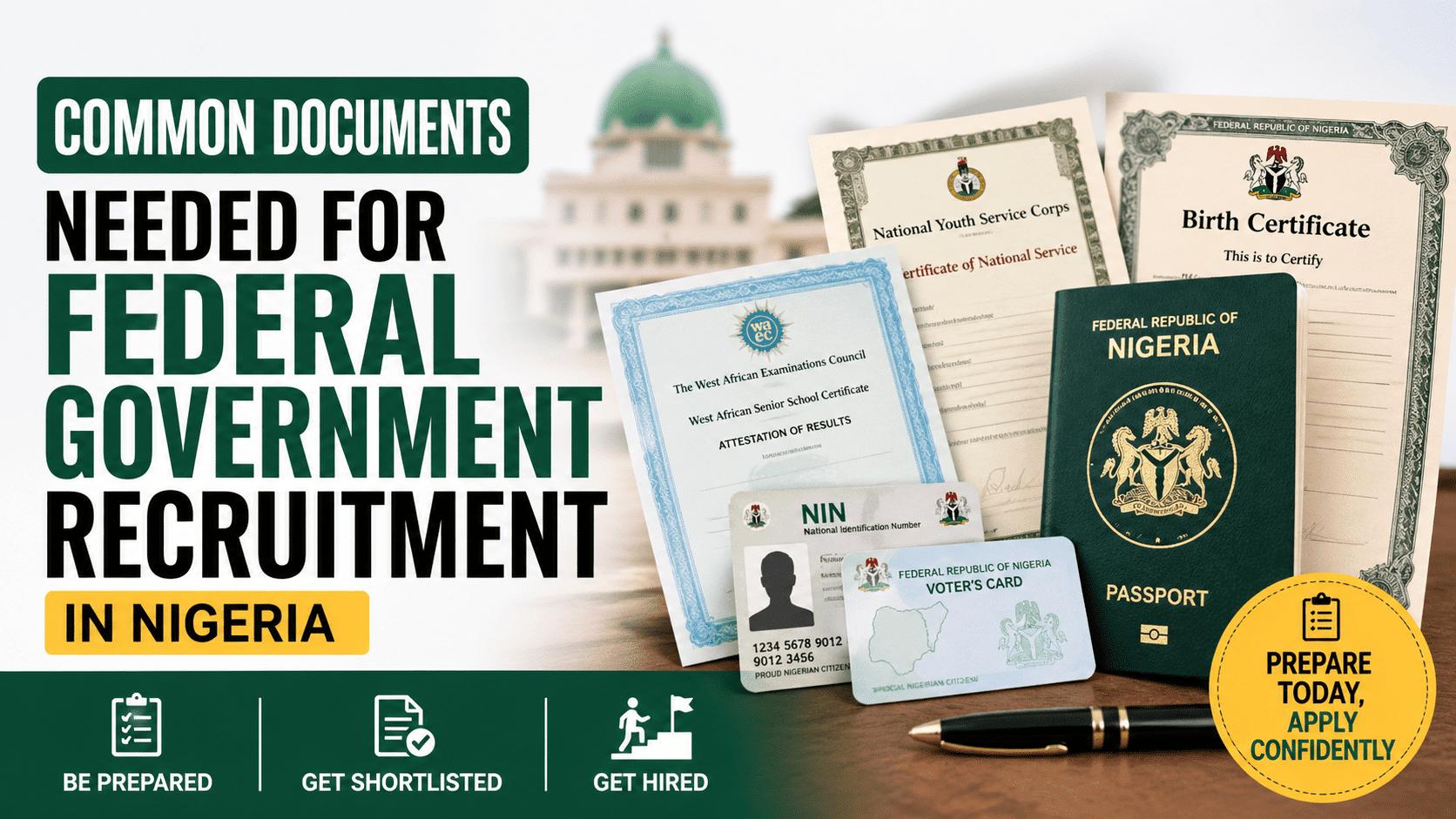
  • Common Documents Needed for Federal Government Recruitment in Nigeria (Before the Portal Opens)

    Common Documents Needed for Federal Government Recruitment in Nigeria (Before the Portal Opens)

    Last updated: July 26, 2026

    When my closed friend, Suleiman finally sees a federal recruitment portal go live. He was excited feels qualified, and ready. Then reality hit him. He had no scanned certificate, no passport photo, no NYSC certificate nearby, and his birth certificate had two different spellings of his surname.

    By morning, the deadline traffic had crashed the site.

    That is how many Nigerians lose opportunities: not because they are unqualified, but because they are unprepared.

    If you plan to apply for any Federal Government recruitment in Nigeria, whether through the Federal Civil Service Commission, customs-related agencies, ministries, parastatals, or national programmes, these are the common documents you should have ready before any portal opens.

    Why Documents Matter More Than Many People Think

    Most applicants focus only on when forms will come out. Smart applicants prepare documents first.

    Federal recruitment portals often ask you to upload files immediately. Some systems reject wrong formats, blurry scans, or incomplete details. If your names do not match across documents, you may face verification issues later.

    That is the painful truth many blogs skip.

    1. Educational Certificates

    Your WAEC, NECO, NABTEB, ND, HND, NCE, or university degree certificate is usually the first requirement.

    Some roles only need SSCE. Others require diploma or degree qualifications. Keep both original copies and clear scanned versions.

    If you are awaiting certificate collection, results statements may sometimes be accepted temporarily, but always verify on the official advert.

    2. Means of Identification

    Most federal applications request valid ID. Common ones include:

    • National Identification Number (NIN) slip/card
    • International Passport
    • Voter’s Card
    • Driver’s Licence

    As of my last check, NIN has become increasingly important in many Nigerian processes. Make sure your name and date of birth match your other records.

    3. Birth Certificate or Age Declaration

    This is where many people panic.

    Some agencies ask for birth certificate from the National Population Commission, while others may accept sworn age declaration.

    If your age is close to recruitment limits, check requirements carefully. Never alter age records. It creates problems later during screening.

    4. NYSC Certificate or Exemption Letter

    For graduates, this is a major requirement.

    If you finished university or polytechnic at degree/HND level, many federal jobs request:

    • NYSC Discharge Certificate
    • Exemption Letter
    • Exclusion Letter (where applicable)

    Without this, many graduate-level applications stop immediately.

    What Nobody Tells You

    Sometimes your biggest enemy is inconsistency.

    “Musa Mustapha” on WAEC. “Mustapha Musa” on NIN. “Musa M.” on degree certificate.

    That small mismatch can delay screening more than low grades.

    I have seen brilliant candidates lose chances because they ignored affidavit correction early enough.

    5. Passport Photograph and CV

    Most portals request a recent passport photo with plain background.

    Also keep an updated CV ready, even if not requested initially. Some agencies ask later by email or during physical screening.

    Your CV should show education, skills, work experience, and referees clearly.

    Practical Steps to Prepare Now

    1. Scan all certificates clearly in PDF and JPEG formats.
    2. Save documents with simple names like WAEC.pdf or NIN.jpg.
    3. Check that all names match exactly.
    4. Renew expired IDs now, not later.
    5. Keep soft copies in email, phone, and flash drive.
    6. Follow only official portals and verified announcements.

    Closing

    Federal Government recruitment in Nigeria is competitive, but many people eliminate themselves before the race starts.

    Do not be that person rushing to cybercafés while others are already submitting calmly from home.

    Prepare your common documents needed for Federal Government recruitment in Nigeria now. Opportunity respects those who are ready.

  • NLNG Undergraduate Scholarship 2026: Eligibility, Benefits, and Application Guide

    NLNG Undergraduate Scholarship 2026: Eligibility, Benefits, and Application Guide

    Last updated: July 24, 2026

    The first time I heard someone say “build your portfolio first,” I almost threw my phone across the room.

    I had just graduated, my NYSC allowance was running thin, and I’d applied for enough jobs to wallpaper a room. Someone in a WhatsApp group was saying “clients won’t hire you without a portfolio” and I’m thinking, how do I get a portfolio without clients? It felt like the bank telling you they need a salary before giving you a loan to find a job.

    That loop broke me for a while. Then I figured out how to escape it.

    If you’re reading this right now and you have zero client experience but you want to freelance, this post is specifically for you. Not the “7 tips” version you’ve seen on five other websites. The actual way.

    The Lie We Were Sold About Portfolios

    Most blogs tell you to “practice projects” or “do spec work.” Nobody explains what that actually means or why it works. So let me break it down properly.

    A freelance portfolio is not a record of paid work. It is a record of what you can do. Those two things are completely different, and a lot of Nigerian graduates confuse them.

    When a client visits your portfolio, they are asking one question: “If I give this person my money, will they deliver something good?” They are not asking “how many people have paid you before.” That means your goal is not to prove payment history. Your goal is to show output quality.

    Once you understand that, the whole game changes.

    Start With One Skill, Not Five

    The temptation when you’re starting out is to list every skill you’ve ever touched. Graphic design, content writing, video editing, social media management, data entry. I’ve seen CVs and portfolio pages that look like a supermarket receipt.

    Pick one skill. Your strongest one or the one you enjoy enough to practice daily without being paid.

    This matters because your first portfolio pieces will come from doing the work voluntarily, and you need the stamina to produce quality without immediate reward. That’s harder with a skill you barely like.

    If you’re unsure what to pick, ask yourself which one you’d do even if WhatsApp was down and NEPA took light. That’s usually the one.

    How to Create Portfolio Pieces Without Clients

    This is where most blogs give vague answers. I won’t.

    If you are a graphic designer, find real Nigerian brands with ugly logos or poorly designed social media pages. Pick three of them, redesign their materials completely, and put it in your portfolio as “concept redesign.” Companies like small suya joints, local logistics startups, neighborhood pharmacies. You are not lying to anyone. You are showing what you would do if they hired you.

    If you write content, pick a topic in a niche you want to work in and write a full article as if a client briefed you. Then publish it on Medium, Substack, or your own free WordPress blog. Now it’s a real published piece, not just a word document on your laptop.

    If you do social media management, offer to run one month of free content for a small business in your area. Many shop owners in Lagos, Kano, Abuja and other cities have Instagram pages they barely update. Walk in, show them what you’ve already done as examples, and offer to help free for 30 days. At the end of that month, you have real screenshots, real engagement numbers, and a real person who can vouch for you.

    Web developers can build fake company websites. Virtual assistants can create sample SOPs and inbox management templates. The work doesn’t need to come from a paying client to be real.

    What Nobody Tells You About Nigerian Freelancing

    Here is the uncomfortable truth that other blogs will not say.

    Most Nigerian clients who find you on Fiverr or Upwork at the beginning will pay you very little. That is not where the real money is, especially in your first year. The real money comes from referrals, and referrals come from results.

    So your first priority is not to find high-paying clients. Your first priority is to find any client, deliver excellent work, and make that person tell someone else about you. That chain is what builds a real freelance income in Nigeria.

    The other thing nobody says: your portfolio does not need a fancy website to work. A Canva PDF, a Google Drive folder with a clean link, or a Notion page with your samples will do the job. I’ve seen people close clients from a well-organized Google Drive link alone. Don’t let “I don’t have a website” be an excuse to not start.

    Using Free Resources to Sharpen Your Skill Fast

    While you’re building your samples, you should also be leveling up. Google’s Skillshop, HubSpot Academy, Coursera, and ALX Africa all offer free or low-cost courses with certificates that you can add alongside your portfolio.

    A certificate from a recognized institution does two things. It tells clients you took the skill seriously enough to formalize it, and it adds a line to your profile that communicates effort. It is not a replacement for portfolio work, but it supports it.

    If you’re still in school or just graduated and you’re also looking at scholarships or structured career programs to fund your development, do check our breakdown of the Shell, Chevron, and TotalEnergies Scholarships in Nigeria for 2026. Some of those programs go beyond tuition and actually create pathways into full careers.

    Building the Actual Portfolio Document

    Keep it simple. A clean, organized presentation beats a messy one on an expensive platform every time.

    Your portfolio should have: a short professional bio that tells people exactly what you do and who you help, three to five strong work samples with brief explanations of what problem you solved, your contact information, and if you have any, one or two short testimonials even from people you helped for free.

    That’s it. One page or five pages, the structure should be that clear.

    Your First Five Steps From Today

    First, write down the one skill you are building your freelance career around. Second, create three sample projects this week using the approach described above, real brands, real problems, fake billing. Third, publish at least one piece of work publicly, whether a blog post, a design, a website, anything with a link. Fourth, tell ten people in your network what you now do professionally. Not “I’m looking for clients.” Be specific: “I design social media graphics for small businesses.” Fifth, set up a simple portfolio page, even a free Canva website or a clean Notion page, and put your samples on it.

    That’s your first week. It won’t make you rich. But it gets you out of the loop where you’re waiting for experience before you can build experience.

    The Distance Between You and Your First Client Is Smaller Than You Think

    The Nigerian freelance market is growing, and clients both local and international are actively looking for skilled people. The barrier is rarely talent. Most times it is presentation, confidence, and the willingness to do the work before the money shows up.

    Every successful freelancer I know, every person who messaged me through edujobsafrica.com to say they finally got their first client, they all have one thing in common. They stopped waiting for permission and started producing.

    You don’t need five years of experience. You need three strong samples, a clear skill, and the courage to say “I can do this for you.” Go build the evidence first. The clients will come.

  • Scholarships You Can Apply for With Only WAEC in 2026

    Scholarships You Can Apply for With Only WAEC in 2026

    Last updated: July 24, 2026

    I still remember well the heavy, dry heat of that Tuesday afternoon in Minna, Niger State when I checked my second WAEC result. I had finally secured my 5 credits, including Math and English. But my JAMB score? That wasn’t good and for the second year in a row.

    I thought my dream of entering a university was completely dead. Like many of you reading this right now, I believed that without crossing the JAMB hurdle or having a fat bank account, getting a degree was impossible. I definitely didn’t think studying abroad was even on the table.

    Listen to me: you do not need to let the Nigerian admission system hold your future hostage. If you have a solid WASSCE result, there are fully funded undergraduate scholarships you can apply for with only WAEC. You just need to know where to look and how to position yourself.

    Why Your WASSCE Result Carries Global Weight

    A lot of Nigerian students look down on their secondary school certificates. Don’t do that. When evaluated internationally, a strong WASSCE result is roughly equivalent to the UK’s O-Level or a standard high school diploma in the US.

    Universities in Europe, Asia, and the Americas recognize this. They know how rigorous the West African Examination Council curriculum actually is. As long as you have your minimum of five credits, including your core subjects, the door is wide open for undergraduate funding.

    The Türkiye Burslari (Turkish Government) Scholarship

    This is one of my absolute favorites for fresh secondary school graduates. The Turkish government offers a fully funded undergraduate program, and yes, they happily accept your WAEC certificate for admission.

    It covers your tuition, accommodation, health insurance, and even gives you a monthly stipend. The catch? You usually need to be under 21 years old to apply for the undergraduate tier. Always verify the exact age cutoff on their official portal when the application window opens.

    The Stipendium Hungaricum (Hungarian Government)

    If you want to study in Europe, Hungary is throwing its doors open to Nigerian students through a bilateral agreement with the Federal Government. This process is coordinated directly through the Federal Scholarship Board in Abuja.

    You apply through their portal using your WAEC results. If nominated, Hungary covers your tuition, provides a dorm room, and gives a monthly stipend. Because you are applying from an English-speaking African country, you can often bypass strict English language tests entirely. In fact, if you want more options like this, check out my guide on the best countries giving scholarships to Africans without IELTS in 2026.

    The Honest Truth About “WAEC Only” Scholarships

    I promised I would always be straight with you on this blog. Applying for scholarships with only your WAEC certificate is brutally competitive. You are competing against thousands of brilliant, hungry students from Ghana, Kenya, and beyond.

    A result with straight C6s will rarely win a full ride. Furthermore, your grades aren’t everything. Scholarship boards want to see leadership. Were you a prefect? Did you volunteer in your church or mosque? That motivation letter you write is just as important as your grades. Don’t submit a weak, rushed application and blame the system when you get a rejection email.

    Your Action Plan for Undergraduate Scholarships

    1. Go to your former secondary school and collect your original WAEC certificate. The flimsy printout from the cybercafé is not going to cut it for serious international applications.
    2. Apply for your International Passport immediately. You cannot start an overseas scholarship application with just a NIN slip. Get the green passport ready before the portals even open.
    3. Start writing your personal statement today. Write down your story, your struggles, and why you want to study your chosen course. Refine it over the next few months until it is perfect.

    Stop sitting at home feeling defeated because of one local exam. There is a whole world out there waiting for you. There are life-changing scholarships you can apply for with only WAEC, but you have to take the first step today. Start researching, start preparing, and let’s get you into school.


    Written by Musa Mustapha — Education and career blogger at edujobsafrica.com. Musa has spent 8 years helping African students navigate scholarships, exams, and job opportunities. Have a question or story to share? Reach him via the Contact page.